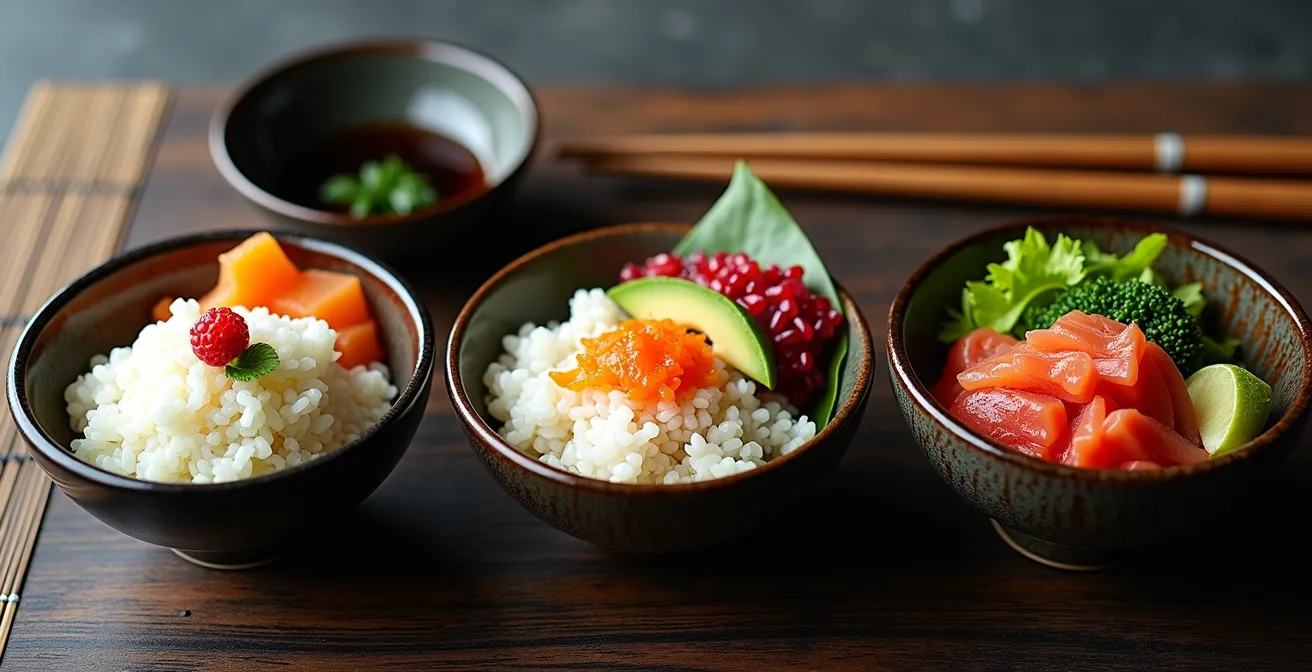
Many home cooks believe all Japanese rice bowls start with the same base, often reaching for vinegared sushi rice. This is a fundamental flavor error. The art of the perfect bowl lies in understanding the rice’s role: a neutral, absorbent canvas for saucy donburi, versus a seasoned, acidic foundation for chirashi. Using the wrong rice doesn’t just change the dish; it creates a culinary conflict that undermines the harmony of the ingredients. This guide clarifies the why, not just the what.
The sight of a perfectly constructed Japanese rice bowl is one of simple elegance. But beneath the meticulously arranged toppings lies a foundation that can make or break the entire experience: the rice. For many home cooks, especially those confused between the architecture of a Donburi and a Chirashi bowl, a critical error is made at this foundational level. The assumption is that all “Japanese rice” is interchangeable, leading to the use of seasoned sushi rice for a saucy donburi bowl.
This is more than a minor deviation; it is a culinary misstep that fundamentally misunderstands the philosophy of Japanese cuisine. The choice is not arbitrary. It’s a deliberate decision rooted in principles of balance, texture, and flavor interaction. A donburi relies on its rice to be a neutral canvas, eagerly absorbing the complex, savory-sweet *tare* sauce that defines dishes like Oyakodon or Gyudon. Introducing vinegared rice into this equation creates a competing acidity, a flavor collision that clashes with the sauce’s profile and sabotages the intended harmony.
But what if the goal is a different kind of bowl, like a poke bowl or a deconstructed sushi bowl? Here, the rules shift, and the world of vinegared rice—or *shari*—opens up. The key is not to follow a single rule but to understand the distinct function of each component. This is the path of a true rice connoisseur, moving beyond simple recipes to master the underlying principles.
This guide will deconstruct the science and art of the rice bowl foundation. We will explore the critical differences in rice preparation, from water ratios to cooling techniques, and clarify why the right rice is not just an ingredient, but the very soul of the dish. By understanding these distinctions, you will elevate your rice bowls from a simple meal to a balanced and authentic culinary creation.
To navigate the nuances of perfecting your rice bowl, this article breaks down the essential techniques and principles. The following summary outlines the key areas we will cover to transform your understanding of this foundational element of Japanese cuisine.
Summary: The Definitive Guide to Rice Bowl Fundamentals
- Red Vinegar or White Vinegar: Which Base Suits a Poke-Style Bowl?
- How to Cool Rice Quickly for Bowls Without Drying It Out?
- How to Layer Sauce so It Doesn’t Ruin the Rice Texture at the Bottom?
- Nori Strips or Shiso: Which Garnish Breaks the Monotony of a Rice Bowl?
- Can Day-Old Rice Be Re-Seasoned for a Decent Lunch Bowl?
- Why Should Chirashi Rice Be Seasoned More Heavily Than Nigiri Rice?
- Why Use Less Water for Sushi Rice Than for Table Rice?
- How to Perfect Vinegared Shari Rice Like a Tokyo Itamae in 30 Minutes?
Red Vinegar or White Vinegar: Which Base Suits a Poke-Style Bowl?
When preparing a base for a poke-style bowl, which often features raw, marinated fish akin to chirashi, the choice of vinegar is not merely cosmetic; it is a defining flavor decision. The debate centers on two primary options: traditional white rice vinegar (*komezu*) and the more complex, umami-rich red vinegar (*akazu*). While white vinegar provides a clean, sharp acidity that is familiar to most, *akazu* introduces a deeper, more rounded flavor profile with natural sweetness. Historically, *akazu* was the original choice for Edomae-style sushi, and its revival in high-end establishments speaks to its superior ability to complement rich, fatty fish.
The distinction becomes clear when comparing their properties. The decision ultimately depends on the desired flavor profile for your poke bowl. For a modern, bright bowl with lean fish and tropical fruits, the clean slate of white vinegar may be preferable. For a richer, more traditional experience that complements fatty tuna or salmon, the complexity of red vinegar is unparalleled. In fact, its use is a hallmark of quality, with a recent survey showing that 27 out of 34 Michelin-starred sushi restaurants in Tokyo use this type of vinegar.
The following table, based on a detailed comparison of sushi vinegars, breaks down the key differences:
| Property | Red Vinegar (Akazu) | White Vinegar (Komezu) |
|---|---|---|
| Production Time | 3-4 years fermentation | About 1 year |
| Base Ingredient | Sake lees (sake kasu) | Fermented rice |
| Color Impact | Dyes rice slightly red | Leaves rice bright white |
| Flavor Profile | Flavorful, refreshing, umami taste | Mild, mellow flavor |
| Sugar Needed | No sugar needed, naturally sweet | Sugar typically added |
Therefore, when constructing a poke-style bowl, consider the ingredients. If your toppings are rich and savory (like fatty tuna, avocado, or classic shoyu marinade), akazu will elevate the dish by adding complexity and umami without excess sweetness. If your bowl is light and zesty (with shrimp, mango, and edamame), the sharp, clean profile of komezu will provide the necessary acidic cut without overpowering the delicate flavors.
How to Cool Rice Quickly for Bowls Without Drying It Out?
The process of cooling rice for a Japanese bowl is as critical as cooking it. Proper cooling prevents the growth of bacteria, achieves the correct texture, and allows seasoned rice to absorb vinegar effectively. The challenge is to reduce the temperature rapidly without creating a dry, hard, or clumpy mess. The enemy here is trapped steam, which turns rice mushy, and slow cooling, which promotes stickiness and bacterial growth. The traditional method involves a *hangiri*, a wooden tub, and a paddle (*shamoji*) to spread and fan the rice, promoting rapid and even evaporation.
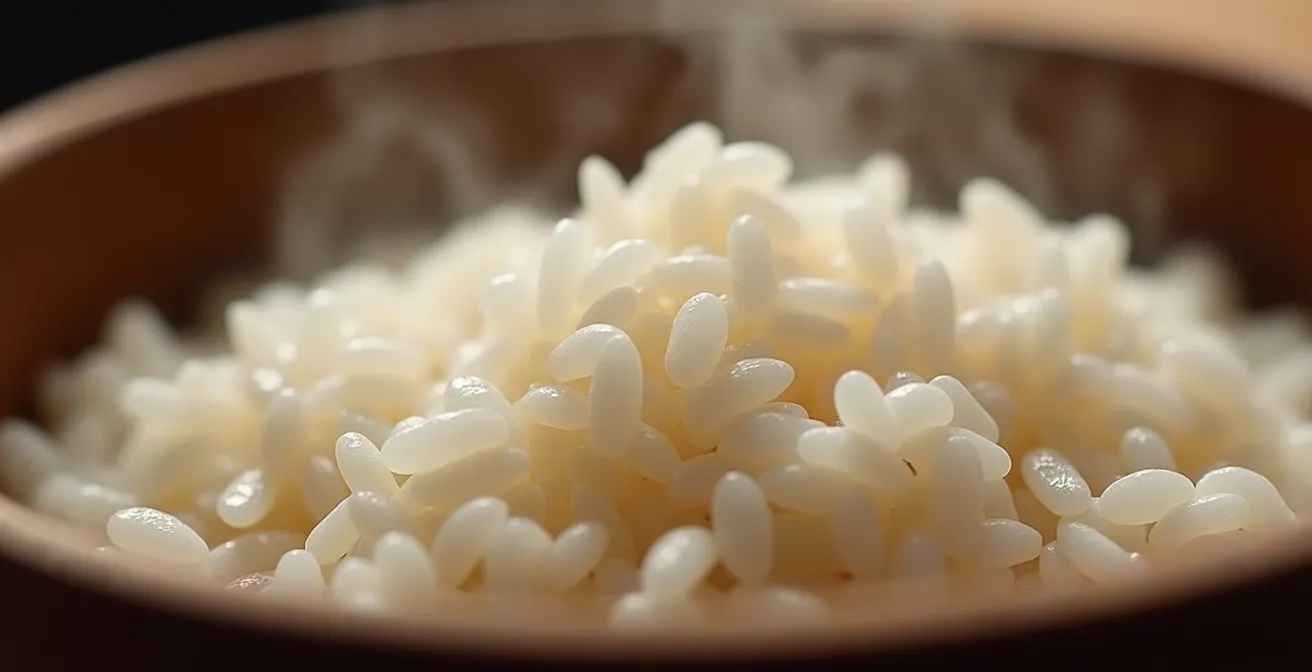
As the illustration demonstrates, the key is maximizing surface area. By spreading the rice thinly and fanning it, you are actively removing heat and surface moisture, which allows the grains to achieve a perfect glossy sheen (*tsuya*) while remaining tender inside. For home cooks without a *hangiri*, a large baking sheet or wide, non-metallic bowl can serve as an effective substitute. It is crucial to work quickly and gently, using a cutting and folding motion with the paddle rather than stirring, which would crush the delicate grains. This meticulous process ensures the structural integrity of each grain.
Depending on the final use of the rice, different techniques can be applied for optimal results. Food safety is also a primary concern, especially when preparing rice for later use.
- For sushi-style rice: Spread the freshly cooked rice in a thin, even layer on a large baking sheet. This allows heat and steam to escape rapidly, preventing the rice from becoming gummy and preparing it to properly absorb the vinegar seasoning.
- For meal-prep safety: It is crucial to cool rice to below 40°F (4°C) within two hours to prevent the growth of *Bacillus cereus*. This can be achieved with a two-stage cooling process: first, cool the rice in shallow containers from 135°F to 70°F within 2 hours, then refrigerate to drop it to 41°F within an additional 4 hours.
- To revive refrigerated rice: When reheating, place a damp paper towel over the rice in the microwave. This reintroduces steam and helps restore moisture to the grains, making them palatable again.
- For non-sushi bowls: While the rice is still hot and being cooled, tossing it with a small amount of neutral oil can prevent clumping and add a subtle layer of flavor.
How to Layer Sauce so It Doesn’t Ruin the Rice Texture at the Bottom?
A common tragedy in the world of homemade rice bowls is the “soggy bottom.” This occurs when a delicious, savory sauce meant to complement the toppings instead pools at the base of the bowl, turning the bottom layer of rice into a dense, waterlogged paste. This ruins the textural contrast that is a hallmark of a great donburi. The solution lies not in using less sauce, but in understanding how and when to apply it. The rice in a donburi is a neutral canvas, but it is also a sponge. Hot, freshly cooked rice is especially absorbent, and dousing it directly with a liquid sauce is a guaranteed recipe for sogginess.
The first rule of sauce layering is to avoid direct application to the bulk of the rice. The sauce is primarily intended for the toppings (the meat, fish, or vegetables). These ingredients should be simmered in or glazed with the sauce, which then naturally seasons the top layer of rice it comes into contact with. This creates a gradient of flavor and texture, from the heavily sauced toppings to the perfectly steamed rice below. The diner can then control how much rice they mix with the sauced components in each bite, preserving the integrity of the meal until the very end.
For an even more controlled application, consider these professional techniques. First, create a “sacrificial” barrier. A bed of shredded cabbage, lettuce, or even a thin omelet layer between the rice and the main topping can help absorb initial sauce runoff. Second, consider the viscosity of your sauce. A slightly thickened *tare*, reduced to a glaze-like consistency, will cling to the toppings rather than running off immediately. Finally, for bowls where the sauce is served separately, instruct the diner to pour it over the toppings, never directly onto the plain rice. This ensures the structural integrity of the rice bed is maintained throughout the meal.
Nori Strips or Shiso: Which Garnish Breaks the Monotony of a Rice Bowl?
Beyond the primary toppings and the rice foundation, the final garnish—or *yakumi*—plays a vital role in elevating a rice bowl from simple sustenance to a complex sensory experience. Among the myriad options, thin strips of toasted nori and fresh shiso leaves are two of the most iconic. The question is not which is “better,” but what function each serves. Choosing the right one requires an understanding of the overall flavor profile of the bowl and what element is needed to complete it. They are not interchangeable; each provides a distinct form of “monotony breaking.”
Toasted nori strips (kizami nori) offer a savory, umami-rich flavor and a subtle, crisp texture. Their function is to add a deep, roasty, and slightly briny counterpoint. Nori works exceptionally well in bowls that have a milder, more delicate flavor profile that would benefit from an injection of umami. It pairs beautifully with egg-based donburi like *oyakodon*, or with simple raw fish bowls where its savory notes can complement the clean taste of the fish. Its texture, while initially crisp, softens as it absorbs moisture, adding another layer of complexity to the eating experience.
Fresh shiso leaves, on the other hand, provide a completely different kind of contrast. Shiso is a member of the mint family, and its flavor is bright, herbaceous, and slightly peppery with hints of anise and citrus. Its role is to cleanse the palate and cut through richness. A chiffonade of shiso is the perfect garnish for bowls with rich, oily, or fatty components, such as a fatty tuna (*toro*) chirashi, a grilled eel (*unagi*) donburi, or a fried pork cutlet (*katsudon*). The leaf’s powerful aromatic quality provides a burst of freshness that prevents the palate from becoming fatigued by the richness of the main ingredients. It acts as a bright, herbal reset in every bite.
Can Day-Old Rice Be Re-Seasoned for a Decent Lunch Bowl?
In the spirit of minimizing food waste (*mottainai*), the question of repurposing day-old rice is a practical one. The immediate challenge with refrigerated rice is a process called starch retrogradation. As the cooked starch in the rice cools, its molecules recrystallize and align into a tight structure, pushing out moisture and resulting in hard, dry grains. While this property is ideal for fried rice (as it prevents sogginess), it presents a problem for a soft, fluffy rice bowl. So, can it be saved for a “decent” lunch bowl? From a purist’s perspective, the texture will never match that of freshly made rice, but with the right technique, it can be made surprisingly palatable.
The key to reviving old rice is reintroducing moisture and heat gently. The most effective method is to place the rice in a microwave-safe bowl, sprinkle it with a small amount of water, and cover it with a damp paper towel. Microwaving it in short bursts will steam the rice, allowing the starch granules to relax and reabsorb moisture, thus softening the texture. It is crucial not to overheat it, which can lead to tough, chewy spots. This process restores the rice to a state that is acceptable as a neutral base for a donburi-style lunch.
However, the question of re-seasoning it for a sushi-style bowl is more complex. Attempting to mix cold, hard rice with sushi vinegar is futile; the grains will not absorb the seasoning properly and will likely break apart. To re-season, you must first fully reheat and soften the rice using the steaming method. Once it is hot and pliable, you can then attempt to mix in the sushi vinegar. While technically possible, the final texture will likely be a compromise—gummier and less distinct than *shari* made from fresh rice. For a quick donburi, it’s a viable hack. For a quality chirashi or poke bowl, using fresh rice is always the superior choice.
Why Should Chirashi Rice Be Seasoned More Heavily Than Nigiri Rice?
A common point of confusion even for seasoned enthusiasts is the subtle variation in the seasoning level of sushi rice (*shari*) depending on its application. The *shari* used for a *chirashi* bowl is often intentionally seasoned more assertively—with a higher concentration of vinegar, salt, and sometimes sugar—than the rice used for individual pieces of *nigiri*. This is not an accident or a regional quirk; it is a deliberate decision based on culinary physics and the principles of flavor balance. The difference lies in the topping-to-rice ratio and distribution.
In *nigiri* sushi, the balance is precise and controlled. A single, small piece of fish or topping sits atop a perfectly formed, bite-sized mound of rice. The ratio is high, and the fish is the undisputed star. The rice’s role is to support and complement, providing a subtle acidic and sweet counterpoint without overwhelming the delicate flavor of the topping. The seasoning is therefore restrained and nuanced. Each piece is consumed in one or two bites, delivering a consistent, chef-calibrated experience.
A *chirashi* bowl, meaning “scattered sushi,” is an entirely different architecture. Here, various pieces of raw fish, vegetables, and other garnishes are scattered over a much larger bed of rice. The topping-to-rice ratio is lower and completely inconsistent from bite to bite. One mouthful might contain a piece of tuna and rice, the next might be cucumber, tamago, and rice. The rice itself becomes a primary component of the flavor. Therefore, the seasoning must be more robust to stand on its own and to adequately season the other, often unseasoned, ingredients in the bowl. It ensures that even a bite of just rice and cucumber is flavorful and balanced. The stronger seasoning acts as a unifying element in a deliberately chaotic assembly.
Why Use Less Water for Sushi Rice Than for Table Rice?
The secret to perfect sushi rice, or *shari*, begins long before the vinegar is added. It starts at the cooking stage, with a counterintuitive instruction: use less water. While a standard pot of Japanese rice for table consumption typically uses a 1.2:1 water-to-rice ratio for a soft, fluffy result, sushi rice requires a firmer, more “al dente” grain. This is often achieved with a ratio closer to 1:1. The reason for this is rooted in the concept of a two-stage hydration process. The initial cooking is only the first stage.
The goal of cooking sushi rice is not to produce a finished product, but to prepare the grains for the second stage of hydration: the absorption of the *sushizu* (sushi vinegar). If the rice is cooked with too much water, the grains will be fully saturated, soft, and slightly sticky. When you then try to add the liquid seasoning, the already waterlogged grains have no capacity to absorb it. The vinegar will simply coat the outside of the grains, making the surface mushy and failing to penetrate the core. This results in a weak flavor, a porridge-like texture, and a rice that breaks apart easily. This is a fatal flaw for *shari*.
By cooking the rice with less water, you produce a grain that is cooked through but remains firm, with a distinct core (*shikkari*). Each grain has structural integrity. When the hot rice is then mixed with the vinegar seasoning, the thirsty grains eagerly absorb the liquid. The heat of the rice helps the vinegar penetrate to the core, seasoning each grain from the inside out while also helping to preserve it. This two-stage process is what creates the ideal *shari*: distinct, glossy grains that are flavorful to the core, yet hold together perfectly. It is a foundational technique that cannot be skipped.
Key Takeaways
- The primary function of rice in a saucy Donburi is to act as a neutral, absorbent canvas; using vinegared rice creates a flavor conflict.
- Shari (vinegared rice) is a seasoned component, not a neutral base, designed to balance the fats and flavors in dishes like Chirashi and Poke.
- Mastering rice for bowls requires controlling not just flavor, but also water ratios and cooling methods to ensure perfect texture and structural integrity.
How to Perfect Vinegared Shari Rice Like a Tokyo Itamae in 30 Minutes?
Perfecting *shari* is a rite of passage for any aspiring sushi chef, or *itamae*. While true mastery takes a lifetime, the fundamental principles can be applied at home to dramatically elevate your rice bowls. It is a process of precision, from washing the rice to the final cooling. The “30 minutes” refers not to the entire process, but to the crucial, active window after the rice is cooked. This is when the transformation from plain steamed rice to exquisite *shari* occurs. It requires focus and the right tools. The process synthesizes all the principles we have discussed: the correct water ratio, the rapid cooling, and the gentle incorporation of seasoning.
Achieving this level of quality requires a methodical approach. It is not just about mixing rice and vinegar; it is about creating a chemical and physical reaction that results in glossy, perfectly seasoned, and structurally sound grains. Each step has a specific purpose designed to build upon the last, culminating in a foundation worthy of the finest toppings. To replicate this process consistently, it’s helpful to think of it as a checklist of non-negotiable actions. Following this sequence will ensure your *shari* has the texture, flavor, and integrity of that found in a high-quality Tokyo restaurant.
Your Action Plan: Perfecting Shari Rice
- Rinse and Cook: Rinse your short-grain rice until the water runs almost clear to remove excess surface starch. Cook it using a 1:1 rice-to-water ratio to achieve a firm, *shikkari* texture.
- Prepare Sushizu: While the rice cooks, gently heat your rice vinegar, salt, and sugar (if using) until dissolved. Do not boil. Let it cool. This is your sushi vinegar, or *sushizu*.
- Transfer and Spread: Immediately after cooking, transfer the hot rice to a wide, non-metallic bowl (*hangiri* is ideal). Use a paddle (*shamoji*) to spread it out evenly to maximize surface area for cooling.
- Season and Cut: Pour the *sushizu* over the rice paddle onto the hot rice to distribute it evenly. Using the paddle, “cut” through the rice at a 45-degree angle and fold it over. Do not stir or mash. This coats each grain without breaking it.
- Fan and Cool: Continue the cutting and folding motion while fanning the rice (with a fan or stiff piece of cardboard). This rapid evaporation process removes excess moisture, cools the rice quickly, and gives it a characteristic glossy sheen (*tsuya*).
By following these steps, you are not just making seasoned rice; you are controlling temperature, texture, and taste with purpose. This meticulous process is the heart of creating a truly authentic and delicious Japanese rice bowl that is built on a flawless foundation.
Now that you understand the fundamental principles separating a simple base from a purposefully crafted foundation, the next step is to apply this knowledge. Begin by consciously choosing your rice preparation based on the bowl you intend to create, and you will immediately notice the improvement in balance and flavor.