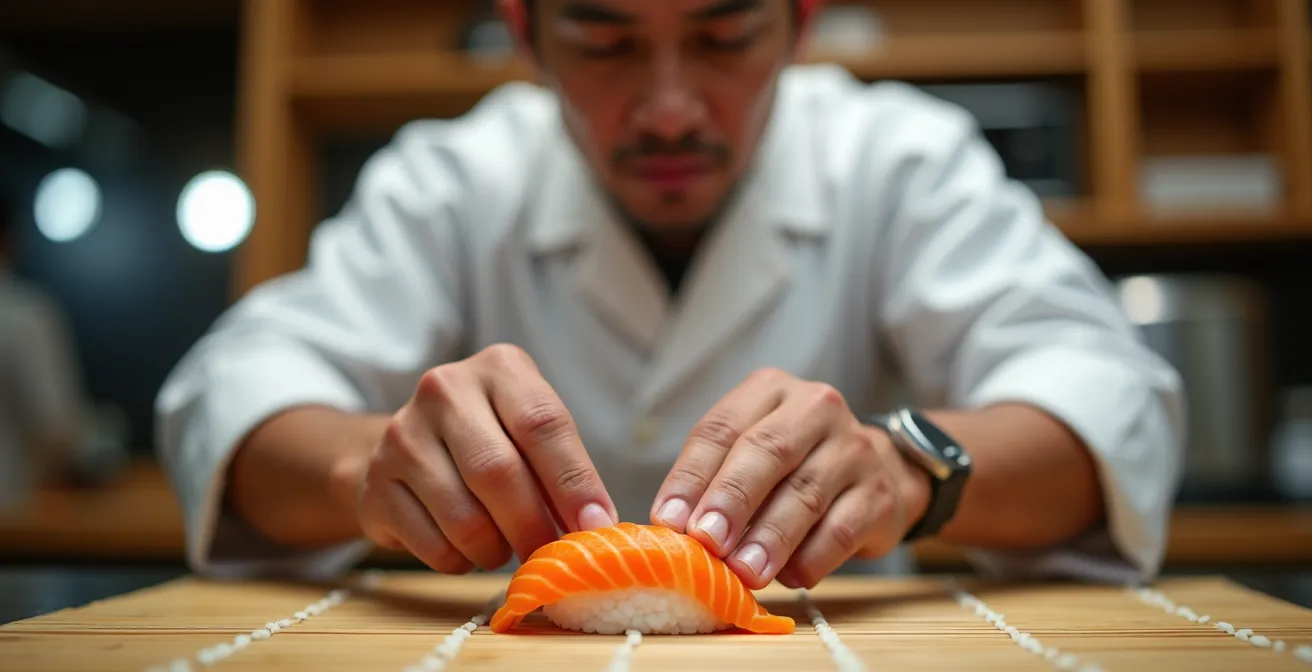
Contrary to popular belief, the essence of sushi isn’t just “freshness.” Its true genius lies in a deep history of preservation, where techniques like aging, fermentation, and even the use of wasabi were born from necessity, not just the pursuit of flavor. Understanding this heritage of solving historical problems transforms eating sushi from a simple meal into an act of tasting history, revealing layers of umami and complexity you never knew were there.
When you sit at a quiet sushi counter, the world narrows to the stage before you: the polished wood, the gleaming blade, the focused movements of the chef. You anticipate the clean, pure taste of fresh fish on perfectly seasoned rice. This is the modern image of sushi—an art form dedicated to pristine simplicity. But this perception, while beautiful, is incomplete. It misses the turbulent, centuries-long story of survival, innovation, and happy accidents that shaped every single bite you are about to take.
The real history of sushi is not a serene painting; it’s a dynamic map of cultural and economic pressures. What if the savory depth of that tuna isn’t just a product of the ocean, but of a 1,200-year-old religious law? What if the subtle tang in the rice is the ghost of an ancient preservation method born thousands of miles away? To taste nigiri without this context is to see only the surface of the ocean, unaware of the rich, complex world thriving beneath.
This journey into sushi’s past is an act of sensory archaeology. By uncovering the historical pressures that led to its evolution, we don’t just learn facts; we fundamentally re-engineer our palates. We will explore how Buddhist vegetarianism inadvertently perfected sushi rice, how techniques from the Mekong River laid the groundwork for fermentation, and why the most coveted tuna is often not the freshest. Prepare to discover the hidden narratives that transform a simple piece of fish and rice into a profound story.
For a visual glimpse into the dedication and ritual that defines the highest level of this craft, the following video offers a mesmerizing look at the art of making tamago (egg) sushi, a piece often considered the ultimate test of a master’s skill.
To fully appreciate how these historical threads weave together into the modern sushi experience, this article breaks down the key moments and misconceptions that define its heritage. The following sections will guide you through this fascinating evolution.
Contents: The Story Behind Your Sushi
- Did Buddhist Vegetarian Laws Influence the Development of Sushi Rice?
- How Fermented Fish Techniques Traveled From the Mekong to Japan?
- Street Stall vs. Michelin Star: How Did Sushi Change Its Social Status?
- The Wasabi Misconception: Was It Originally for Flavor or Food Safety?
- Why the Myth That Sushi Must Always Be Fresh Is Historically Inaccurate?
- What Edo Period Innovations Still Define Modern Sushi Making Today?
- The Pricing Error That Makes People Think Sushi Can’t Be Cheap and Good
- How Are Traditional Sushi Techniques Being Protected for Future Generations?
Did Buddhist Vegetarian Laws Influence the Development of Sushi Rice?
The perfect sushi rice—subtly sweet, tangy, with each grain distinct yet cohesive—is the foundation of nigiri. Yet, its development was not a direct pursuit of flavor but an indirect consequence of a profound historical pressure: a widespread ban on eating meat. For centuries, Japan maintained a meat prohibition for over 1,200 years, a policy heavily influenced by the arrival of Buddhism in the sixth century. This religious and state-enforced dietary restriction fundamentally altered the nation’s culinary trajectory.
Without meat, Japanese cuisine was forced to innovate, leading to the flourishing of shōjin ryōri, a sophisticated form of Buddhist vegetarian cooking. The central challenge of shōjin ryōri was creating satisfying, flavorful meals without animal products. This spurred a deep exploration of plant-based ingredients, fermentation, and the mastery of umami—the fifth taste of savory depth. Chefs became experts at extracting umami from kombu (kelp), mushrooms, and fermented beans (miso and soy sauce).
This national focus on non-animal umami created the perfect environment for perfecting rice. While early sushi used rice merely as a medium for fermenting fish (and was often discarded), the advanced understanding of flavor chemistry from shōjin ryōri bled into all aspects of cooking. A case study on the modern revival of this cuisine notes that the influx of vegetarian tourists has renewed interest in temple cooking, where fermentation and umami extraction techniques are recognized as foundational. This deep-seated culinary knowledge—how to balance sweetness, acidity, and umami—was the essential toolkit needed to eventually transform simple rice into the complex, flavorful shari (sushi rice) we know today.
How Fermented Fish Techniques Traveled From the Mekong to Japan?
The earliest ancestor of sushi has a surprising origin, not in the coastal waters of Japan, but in the freshwater rivers of Southeast Asia. The original concept was born out of a universal need: preserving fish without refrigeration. The method involved packing fish in salted, cooked rice. The rice would begin to ferment, producing lactic acid that pickled the fish and preserved it for months or even years. This ancient form of sushi, known as narezushi, was a culinary import that traveled from the Mekong Delta region through China and eventually arrived in Japan around the Nara period (710-794 AD).
In this early form, the rice was purely functional. After it had served its purpose of fermenting the fish, it was scraped off and discarded. The resulting fish had a pungent, sour, and cheesy flavor profile, a world away from the clean taste of modern sushi. This is the “ghost of preservation” in its most literal form. The closest modern equivalent is funazushi, a delicacy from the Lake Biwa region, which still uses these ancient methods. Making traditional funazushi requires fermentation for a period ranging from one to three years, a testament to its primary role as a preservation technique.

As this technique became entrenched in Japan, a gradual but significant shift occurred. Over centuries, the fermentation time was shortened. People began to eat the fish when the rice was still palatable and slightly sour, enjoying the combination of textures and flavors. This was the critical evolutionary step: the moment when the preservation medium (rice) began to be seen as part of the meal itself. It marked the long, slow transition from narezushi to the vinegared rice of modern sushi, a journey from pure function to celebrated flavor.
Street Stall vs. Michelin Star: How Did Sushi Change Its Social Status?
For most of its life, sushi was not a luxury item. Following the innovations of the Edo period, it became Japan’s original fast food, sold from mobile street stalls (yatai) to busy workers in a rapidly growing city. It was quick, convenient, and affordable. So how did this humble street food transform into a global symbol of high-end, ritualized dining, often commanding hundreds of dollars for a single meal? The shift was driven by a combination of economic changes, technological advancements, and a powerful cultural narrative.
The 2011 documentary ‘Jiro Dreams of Sushi’ was a pivotal moment in this transformation. The film, which grossed over $2.55 million in North America, codified the image of the sushi master as a shokunin—a dedicated artisan-philosopher on a relentless quest for perfection. It transformed the meal into a performance, a ritualized experience where proximity to the master was part of the product. This narrative provided the cultural justification for astronomical prices, framing sushi not as food, but as edible art. The contrast between the old and new is stark, as seen in the economics of the industry.
This table illustrates the dramatic divergence between the sushi’s fast-food roots and its modern luxury status.
| Aspect | Traditional Yatai (Street Stall) | Modern Michelin-Star Sushi |
|---|---|---|
| Average Price | $2-5 per piece | $270+ for omakase (20 pieces) |
| Seating Capacity | 5-10 seats | 8-12 seats |
| Service Style | Quick, casual | Ritualized, 2-3 hours |
| Chef Training | 2-3 years | 10+ years apprenticeship |
| Market Share 2024 | Conveyor belt: 14% in Japan | Premium dining: 34% of revenue |
This evolution created two parallel worlds: the accessible, high-volume conveyor belt restaurants and the exclusive, high-cost omakase counters. Both are authentic expressions of sushi’s heritage, but they serve entirely different social and economic functions. The journey from a $2 street snack to a $270 culinary event is a story about the power of narrative to redefine value.
The Wasabi Misconception: Was It Originally for Flavor or Food Safety?
The fiery green paste served alongside sushi is an iconic part of the experience. We’re taught to mix it into soy sauce or dab a small amount on our fish for a burst of pungent flavor. However, the true story of wasabi is clouded by a major misconception, starting with the fact that most of what we consume isn’t wasabi at all. It’s a mixture of horseradish, mustard, and green food coloring. A study on Japanese food culture reveals that authentic wasabi represents only less than 5% of what’s served in restaurants worldwide, even in Japan.
The second misconception concerns its original purpose. Before refrigeration, eating raw fish was a risky endeavor. Early sushi chefs discovered that grating the rhizome of the Wasabia japonica plant and placing it between the fish and rice had a powerful effect. It wasn’t just about taste. As Dr. Masahiro Yamamoto of the Journal of Japanese Culinary Science explains, wasabi’s power lies in its chemistry:
The same volatile chemical compounds (isothiocyanates) that kill microbes are what create the characteristic sharp ‘aroma’ that hits the nose, which is distinct from the ‘heat’ of chili
– Dr. Masahiro Yamamoto, Journal of Japanese Culinary Science
This is a perfect example of a “culinary accident” where a solution to a food safety problem became an essential flavor component. The antimicrobial properties of wasabi were its primary function; the intense, nose-clearing “flavor” was a side effect of the very chemicals that made the fish safer to eat. This is another echo of the “ghost of preservation” that haunts so many of sushi’s ingredients.
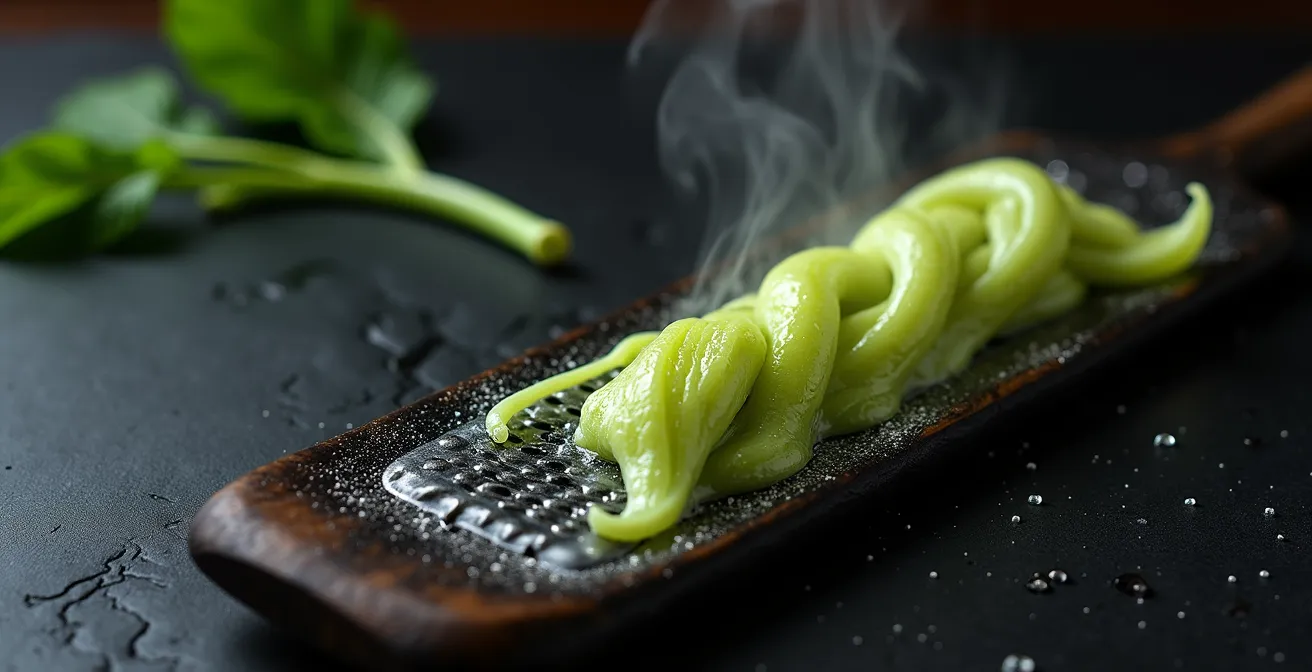
Understanding this dual role changes how you perceive wasabi. That sharp kick isn’t just an aggressive flavor; it’s the taste of historical food science. It’s the remnant of a time when every bite of raw fish was a calculated risk, and this pungent green paste was the first line of defense.
Why the Myth That Sushi Must Always Be Fresh Is Historically Inaccurate?
In the modern Western mindset, “freshness” is the ultimate measure of quality in sushi. We imagine fish being plucked from the sea and served hours later. While this is true for some types of fish, for many of the most prized cuts, particularly tuna, peak flavor is achieved not through absolute freshness but through a deliberate and scientific process of aging known as jukusei. This practice is a direct contradiction of the “fresh is always best” myth and is deeply rooted in Edomae tradition.
When fish is first caught, it enters rigor mortis, making it tough and texturally unpleasant. Immediately after, its flavor is often described as one-dimensional or metallic. The magic of jukusei happens in the days and weeks that follow. In a controlled, low-temperature environment, the fish’s natural enzymes begin to break down large protein and fat molecules into smaller, more flavorful components. Most importantly, this process dramatically increases the concentration of amino acids like inosinic acid and glutamic acid—the compounds responsible for umami.
A modern case study from sushi university experts details this transformation. A piece of tuna (maguro), for instance, might be aged for ten days or more. During this time, its bright, metallic taste mellows into a rich, complex, and almost buttery flavor with a steak-like depth. Its texture softens from chewy to melt-in-your-mouth tender. Different fish require different aging periods: yellowtail (hamachi) might be aged for 5-7 days to concentrate its sweetness, while sea bream (tai) develops enhanced umami after 3-5 days. Conversely, firm, white-fleshed fish like flounder (hirame) are often best when very fresh to preserve their crisp texture. This careful, fish-by-fish calibration is a core skill of the sushi master, proving that optimal taste is a science, not a simple matter of a short timeline from ocean to plate.
What Edo Period Innovations Still Define Modern Sushi Making Today?
The Edo period (1603-1868) was the crucible where ancient preservation techniques were forged into the recognizable form of modern sushi. As Edo (now Tokyo) swelled into one of the world’s largest cities, the demand for fast, convenient food skyrocketed. This urban pressure sparked two key innovations that remain the cornerstones of sushi today.
The first and most significant revolution was led by a chef named Hanaya Yohei in the 1820s. Frustrated by the months-long process of fermenting narezushi, he pioneered a radical shortcut. Instead of waiting for natural fermentation, he began mixing freshly cooked rice with rice vinegar, salt, and sugar. This created the iconic sweet, sour, and savory flavor profile of modern shari and, crucially, allowed him to prepare “sushi” in minutes, not months. This single innovation, detailed in historical accounts of his work, transformed sushi from a preserved food into Japan’s first true fast food, served from his mobile street stall. The foundational taste he established persists in every piece of nigiri served today.
The second innovation was the format itself. The yatai street stall created a unique, intimate dynamic. Customers would stand at the counter, eating pieces as the chef made them, leading to a direct, face-to-face interaction. As Professor Hiroshi Nakamura of the History of Japanese Culinary Arts notes, this format is the direct ancestor of the modern high-end experience. This is the birthplace of the omakase (“I leave it up to you”) tradition, where the customer places their trust in the chef’s expertise. That intimate chef-to-customer dialogue, born of necessity on the bustling streets of Edo, is the same ritual now performed in hushed, reverent Michelin-starred restaurants around the world.
The Pricing Error That Makes People Think Sushi Can’t Be Cheap and Good
The rise of high-end omakase has created a powerful perception: that good sushi must be expensive. This leads to a cognitive dissonance when faced with kaiten-zushi, or conveyor belt sushi, where plates can cost as little as a few dollars. Many assume this low price must equate to low quality, but this misunderstands the brilliant business model and technology that makes affordable quality possible. The conveyor belt sushi industry is not a cheap imitation; it’s a multi-billion dollar market, with one report valuing the conveyor belt sushi industry reached $15 billion in 2024.
The success of major chains like Kura-zushi and Sushiro is built on volume economics and automation. A case study of their business model shows that they reduce labor costs by up to 48% through robotic rice-shapers, automated ordering systems, and the conveyor belt delivery itself. This allows them to invest more in their supply chain, where they leverage immense bulk purchasing power to secure high-quality fish at lower prices.
Crucially, they overcome the “freshness” dilemma with advanced technology. The idea that their fish is inferior because it’s frozen is often incorrect. As the Marine Technology Institute notes in a 2024 report, modern at-sea freezing techniques are revolutionary. “Flash-freezing at sea to -60°C moments after the catch locks in a quality that is often superior to ‘fresh’ fish that has spent days in transit,” the report states. This “fresh-frozen” technology stops degradation instantly, preserving the fish in a state of suspended animation. This scientific approach ensures a consistent, high-quality, and safe product that can be delivered at an affordable price point. The result is a system that democratizes sushi, making it an accessible, everyday meal without sacrificing the core quality of the ingredients.
Key Takeaways
- Sushi’s origin is rooted in the need for fish preservation, not the pursuit of freshness.
- Key flavor elements, like vinegared rice and the use of wasabi, are often byproducts of historical food safety solutions.
- The status and price of sushi are shaped as much by social narratives and economic models as by the quality of the ingredients.
How Are Traditional Sushi Techniques Being Protected for Future Generations?
In an age of globalization and automation, the ancient traditions of sushi face a dual threat. On one hand, the global demand has led to overfishing and a dilution of authentic practices. On the other, technology offers tempting shortcuts that risk eroding the very soul of the craft. Reports show that robotic sushi systems have been adopted by 12% of chain restaurants, a number that is steadily growing. These machines can produce hundreds of perfectly formed rice balls per hour, threatening to make the years-long apprenticeship of a human chef seem obsolete.
In the face of these pressures, a multi-faceted conservation effort is underway, driven by chefs, governments, and even consumers. The most critical element is the master-apprentice relationship. The shokunin tradition, which requires 10 or more years of dedicated training, is the primary vehicle for transmitting tacit knowledge—the feel of the rice, the angle of the knife, the subtle signs of a perfectly aged fish. This knowledge cannot be written down in a book or programmed into a robot.
Governments and cultural bodies also play a role. The designation of “Washoku” (traditional Japanese cuisine) as a UNESCO Intangible Cultural Heritage in 2013 brought global attention to the need to preserve these foodways. This encourages documentation and provides a framework for supporting traditional practitioners. However, the ultimate protectors of these techniques are often the consumers themselves. By seeking out and supporting chefs who practice traditional methods, valuing the story behind the food, and understanding the difference between handcrafted quality and mass-produced convenience, we create the economic incentive for these traditions to survive and thrive.
Your Action Plan for Tasting History in Every Bite
- Ask questions: Engage with the chef. Ask about the fish’s origin, or if it has been aged (jukusei). This shows respect and a desire to learn.
- Observe the rice: Notice the gloss, the separation of the grains, and the temperature (it should be slightly warm). This is often the true mark of a master.
- Eat with your hands: For nigiri, this is traditional. It allows you to feel the texture and temperature, and invert it easily to dip the fish, not the rice, in soy sauce.
- Try the tamago (egg omelet): This seemingly simple piece is often the most difficult to master and is considered a benchmark of a chef’s skill.
- Seek out variety: Move beyond just tuna and salmon. Try hikari-mono (shiny fish like mackerel or sardine) or shellfish to taste different aging and curing techniques.
Frequently Asked Questions About Sushi Heritage
How does narezushi differ from modern sushi?
Narezushi uses lactic acid fermentation over months to years, creating a cheese-like taste, and the rice is typically discarded. Modern sushi uses vinegared rice for immediate consumption, emphasizing the flavor of both the fish and the seasoned rice.
What role did Lake Biwa play in preserving ancient sushi techniques?
Lake Biwa remains one of the few places in Japan where funazushi, the closest existing form to original narezushi sushi, is still produced using traditional methods that date back over 1,000 years, making it a living museum of sushi’s origins.
What percentage of modern soy sauce uses traditional fermentation methods?
Fewer than 1% of soy sauces available on the market today use the centuries-old technique of brewing in traditional cedar casks (kioke) with naturally colonized ambient yeasts and bacteria. This highlights a similar trend of industrialization seen in sushi production.