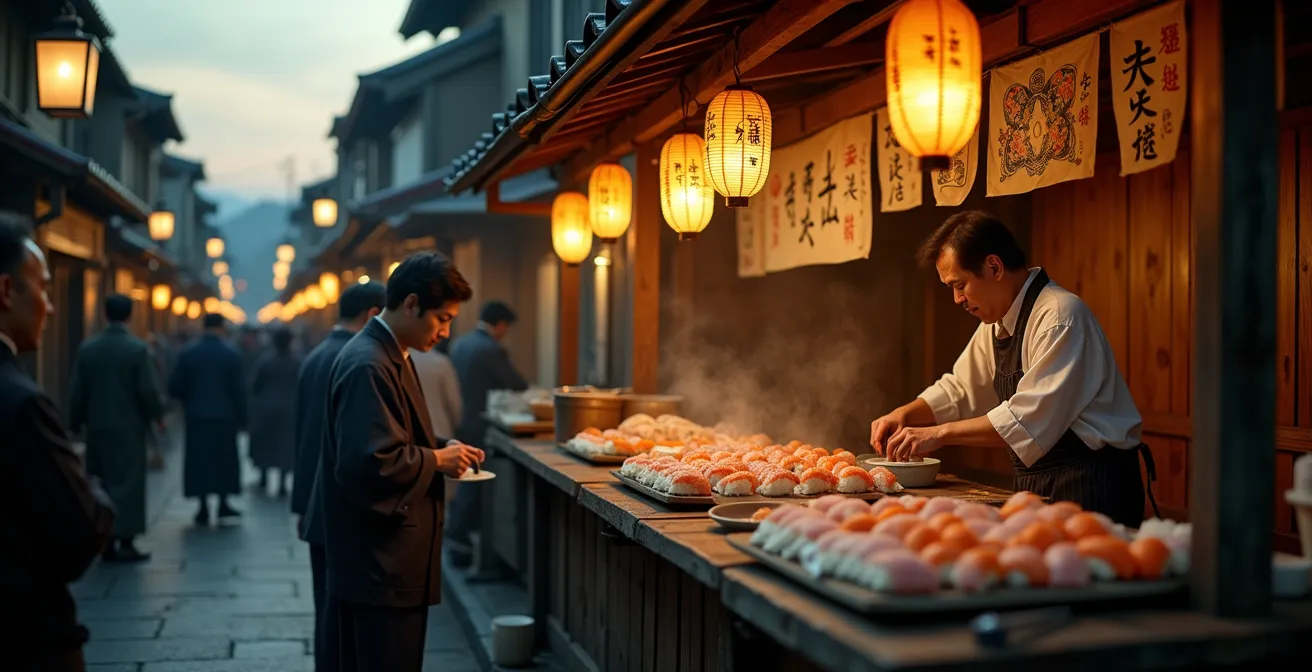
Contrary to its modern image as a luxury, sushi began as a large, cheap, and incredibly fast meal for workers in 19th-century Tokyo.
- Originally, nigiri pieces were three times larger and cost the equivalent of a dollar, serving as a hearty, affordable snack.
- An entire “fast food engine” based on pre-cooked rice and pre-sliced fish allowed chefs to serve customers in under a minute.
Recommendation: Next time you see a standing sushi bar, recognize it not as a modern gimmick, but as a direct link to sushi’s true, fast-paced origins.
Picture a sushi dinner today: delicate, bite-sized pieces of fish on perfectly formed rice, served in a serene setting with a price tag to match. It’s considered an art form, a refined culinary experience. Now, what if I told you that in the 19th century, sushi was the 1800s equivalent of a hot dog stand? It was the go-to fast food for busy laborers in Tokyo (then called Edo), served from mobile street carts, eaten standing up, and devoured in minutes.
This radical shift from street snack to high-end cuisine wasn’t an accident. It was the result of major historical events, economic changes, and a complete cultural rebranding. We often talk about the freshness of the fish or the skill of the chef, but we’ve forgotten the brilliant “fast food engine” that made sushi accessible to the masses. The original sushi was designed for speed, volume, and affordability, a stark contrast to the meticulous, pricey omakase menus we associate with it today.
This article will deconstruct that forgotten system. We’ll explore why the portions were so massive, how chefs achieved lightning-fast service, and how a post-war food shortage accidentally created the small, “gourmet” sushi we now consider standard. Get ready to see this iconic Japanese dish in a whole new light.
text
Summary: Why Sushi Was Considered Fast Food in 19th Century Tokyo?
- Why Were Nigiri Pieces 3 Times Larger in the 1800s Than Today?
- How Fast Must a Chef Serve Nigiri to Qualify as ‘Quick’ in Tokyo?
- Standing Sushi Bars: Are They a Gimmick or a Return to Roots?
- The Pricing Error That Makes People Think Sushi Can’t Be Cheap and Good
- How to Set Up a ‘Temaki Bar’ for a Quick Weeknight Family Meal?
- Yatai Stalls: Were They the True Ancestors of Modern Food Trucks?
- Half Sheet or Quarter Sheet: What Size Nori Is Best for Temaki?
- How Authentic Japanese Hospitality Differs From Western Service Standards?
Why Were Nigiri Pieces 3 Times Larger in the 1800s Than Today?
One of the most startling facts about 19th-century sushi is its sheer size. Forget the delicate, single-bite pieces of today. Original *Edomae* (Edo-style) nigiri was a hefty, fist-sized meal. Historical records show that nigiri sushi in the Edo period was often two or three times larger than its modern counterpart. It was designed to be a substantial, filling snack for laborers who needed quick, cheap calories to get through the day. The focus was on sustenance, not elegance.
So, what caused “The Great Shrinkage”? The turning point was not a culinary choice but a government mandate. After World War II, Japan faced severe food shortages and strict rationing. To ensure fair distribution, the government struck a deal with sushi chefs: for every one *go* of rice (about 150 grams) a customer brought in, they would receive ten pieces of nigiri. To make this work, chefs had to drastically reduce the size of each piece.
What began as a temporary, wartime necessity quickly became the new normal. The public grew accustomed to the smaller, more refined portions. As Japan’s economy recovered and boomed, sushi began its journey upmarket. The smaller size was rebranded from a sign of scarcity to a mark of sophistication, allowing diners to sample a wider variety of fish in a single sitting. What we now see as gourmet was, in fact, born from hardship.
How Fast Must a Chef Serve Nigiri to Qualify as ‘Quick’ in Tokyo?
The “fast” in “fast food” wasn’t just a suggestion; it was the core of the business model. In an era before complex preservation, sushi was a race against time. According to PBS Food, this new form of sushi “could be made in a matter of minutes, rather than in hours or days” like the older fermented styles. But how fast was it really? The secret lay in a highly efficient system—a true “fast food engine” perfected by the street vendors.
This system was built on preparation. Chefs didn’t start from scratch with each order. They would pre-cook large batches of rice and keep it at body temperature in insulated wooden tubs called *ohitsu*. The fish toppings were sliced and lightly marinated or cured during slower periods. When a customer walked up to the stall, the chef’s job was simply assembly.
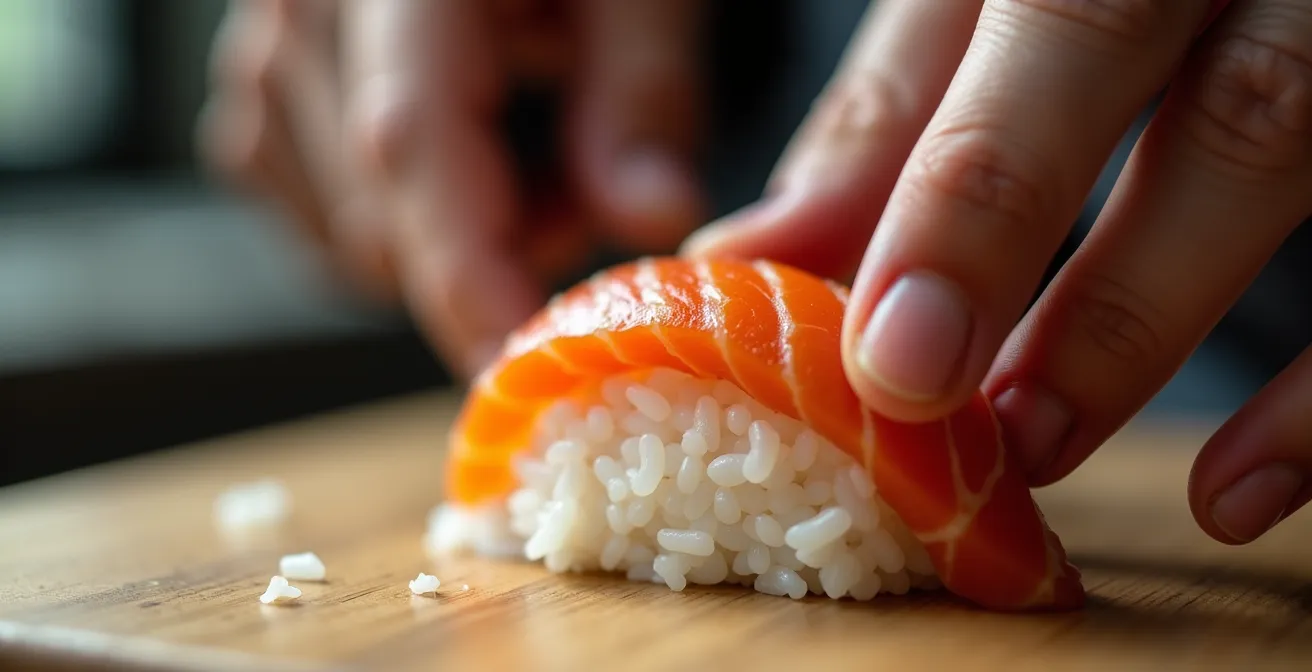
This streamlined process meant a skilled chef could form the rice, add the topping, and serve the piece in well under a minute. The entire transaction, from order to payment, was a rapid-fire exchange. This speed was not just for customer convenience; it was crucial for food safety and a high-volume business model. The goal was to serve as many workers as possible during their short breaks.
Standing Sushi Bars: Are They a Gimmick or a Return to Roots?
In modern Tokyo, a curious trend has emerged: high-end sushi restaurants opening no-frills, standing-only offshoots known as *tachigui*. Customers stand shoulder-to-shoulder at a counter, order a few pieces, eat quickly, and leave. To a Westerner accustomed to sit-down dining, it might seem like a quirky gimmick. In reality, it’s a direct and authentic “return to roots.”
These standing bars are the spiritual successors to the Edo-period *yatai* stalls where sushi was born. The experience is fundamentally the same: no chairs, no elaborate service, just a focus on fresh fish served quickly and affordably. It strips away the pomp and circumstance that has built up around sushi over the last 70 years and takes it back to its functional origin.
This revival is a direct response to the perception of sushi as an expensive, special-occasion meal. As The CEO Magazine notes, this movement is about reconnecting with the past to make great sushi accessible again.
While omakase meals come with hefty price tags, the origins of sushi can be traced to humble food stalls in 19th-century Tokyo. A new generation of standing sushi bars in the Japanese capital, operated by high-end sushi restaurants, is reviving a no-frills style of dining that delivers exquisite seafood at affordable prices.
– The CEO Magazine, standing sushi restaurants in Tokyo
So, far from being a gimmick, the modern standing sushi bar is perhaps the most historically accurate way to enjoy sushi. It’s an acknowledgment that speed, affordability, and quality are not mutually exclusive—a principle that was once the very foundation of the dish.
The Pricing Error That Makes People Think Sushi Can’t Be Cheap and Good
Today, the phrase “cheap sushi” often raises suspicion. We’ve been culturally conditioned to believe that quality sushi must be expensive. This is the “Pricing Illusion”—a modern bias that completely ignores sushi’s economic history. In 19th-century Edo, sushi was fundamentally a food of the people, and its price reflected that. It had to be affordable for the common worker.
So, how cheap was it? According to historical data from Nippon.com, “one piece of sushi was 8 mon… If we take 1 mon as equivalent to ¥12, this means one piece was under ¥100.” That’s less than a dollar for a piece three times the size of today’s nigiri. It was priced to compete with other street foods like soba noodles or tempura, not to be a luxury indulgence. The business model was based on high volume and low margins, the classic fast-food formula.
This comparative table shows just how much the economic model of sushi has shifted from its origins as an accessible street food to its current status as a potential luxury experience.
| Period | Price per piece | Size | Service style |
|---|---|---|---|
| Edo Period (1800s) | 8 mon (~¥100) | 3x larger | Street stall/standing |
| Modern conveyor belt | ¥100-200 | Standard small | Seated casual |
| Modern standing bar | ¥100-400 | Standard | Standing premium |
| High-end omakase | ¥500-2000+ | Standard | Seated luxury |
The illusion that good sushi must be expensive is a modern invention. The standing bar revival and the enduring popularity of conveyor belt sushi are proof that the original spirit of delicious, affordable sushi is very much alive.
How to Set Up a ‘Temaki Bar’ for a Quick Weeknight Family Meal?
Want to channel the fast, fresh, and customizable spirit of Edo-period street sushi at home? The perfect modern equivalent is a *temaki* (hand roll) bar. It captures the essence of quick assembly and eating immediately, making it a fun and engaging meal for a family. Unlike meticulously crafted nigiri, temaki is wonderfully forgiving and all about personal choice. The goal isn’t perfection; it’s participation.
The setup mimics the *yatai* chef’s “fast food engine.” You do all the prep work upfront, laying out bowls of warm sushi rice, sliced vegetables, and various proteins. When it’s time to eat, everyone becomes their own sushi chef. Instead of expensive sashimi-grade tuna, you can use budget-friendly options like smoked salmon, crab sticks, shrimp tempura, or even baked tofu. For vegetables, anything that can be cut into matchsticks works: cucumber, carrots, bell peppers, and avocado are classics.
The most important rule is to eat the temaki the second it’s rolled. This preserves the crucial crispiness of the nori—the “Time-Value of Nori” is real! A soggy hand roll is a sad hand roll. This immediate consumption is a direct link to the stand-and-eat culture of the original sushi stalls.
Your Action Plan: The 5-Step Home Temaki Bar
- Set Your Station: About 30 minutes before eating, prep all your ingredients. Slice fish and vegetables into sticks, and keep the seasoned sushi rice in a covered bowl to maintain its warmth.
- Activate the Nori: A crucial step for crispiness! Just before serving, pass each nori sheet over a low flame for 5-10 seconds until you feel it tighten. Then, cut the sheets in half.
- Build the Assembly Line: Arrange all components on the table in a logical order: warm rice, a selection of proteins, assorted vegetables, and condiments like soy sauce and wasabi.
- Demonstrate the Technique: Show everyone how to take a half-sheet of nori, spread a thin layer of rice, add their fillings diagonally, and roll it into a cone shape.
- Roll and Eat Immediately: Enforce the one rule of temaki: as soon as a roll is finished, it must be eaten. This ensures the nori stays perfectly crisp and delicious.
Yatai Stalls: Were They the True Ancestors of Modern Food Trucks?
Long before the first food truck ever hit the streets, 19th-century Tokyo had its own version of mobile dining: the *yatai*. These were small, wooden carts or stalls, often equipped with a simple awning and a few lanterns, that served quick and inexpensive meals to the city’s bustling population. And among the most popular of these were the sushi yatai.
The roots of standing dining can be traced back to the Edo period (1603–1868), when street vendors and small stalls called yatai served quick meals to busy merchants and travelers.
– Geinokai, The Culture of Standing Restaurants and Bars in Japan
The comparison to modern food trucks is incredibly apt. Yatai were mobile, specialized in a specific type of food, and catered to a clientele looking for a convenient meal on the go. They would set up in busy areas like near theaters, temples, or bridges, serving customers who would eat standing right at the cart. This model was so successful that by September 1923, Tokyo had hundreds of these mobile sushi operations dotting the city.
However, there’s a key difference. While modern food trucks often emphasize gourmet or novel concepts, yatai were all about speed and standardization. They were an essential part of the urban infrastructure, providing a reliable and affordable food source for the working class. They weren’t a trendy novelty; they were a daily necessity. In this sense, they were less like a gourmet burger truck and more like a ubiquitous hot dog stand, deeply woven into the fabric of city life.
Half Sheet or Quarter Sheet: What Size Nori Is Best for Temaki?
When making temaki at home, a seemingly small detail can make a big difference: the size of the nori (seaweed) sheet. The choice between a half sheet and a quarter sheet will completely change the style, size, and feel of your hand roll. It’s a practical question that gets to the heart of what kind of eating experience you want.
A half sheet is the traditional choice for a classic, cone-shaped temaki. It creates a substantial, meal-sized roll that can hold a generous amount of rice and fillings. This is the roll you’d get at a restaurant, one that feels like a complete dish in itself. In contrast, a quarter sheet is perfect for a party or a more snack-like approach. It creates a smaller, “taco-style” fold that’s easier to handle and allows guests to sample many different filling combinations without getting too full.
Regardless of size, the single most important factor is crispiness. This is what provides the satisfying textural contrast to the soft rice and fillings. A key pro-tip is to re-toast the nori sheets right before using them. As one expert guide explains, you must pass the nori over a low flame for 5 to 10 seconds until it tightens up. This “activates” the nori, making it brittle, fragrant, and easy to bite through—a non-negotiable for a good hand roll.
| Nori Size | Dimensions | Roll Style | Rice Amount | Best For |
|---|---|---|---|---|
| Half Sheet | 19cm x 10.5cm | Cone-shaped | 80-100g | Substantial meal-sized roll |
| Quarter Sheet | 10.5cm x 9.5cm | Taco-style fold | 40-50g | Party snack portions |
Key Takeaways
- Size Matters: Original 19th-century nigiri was 3x larger than today’s, designed as a filling worker’s meal, not a delicate delicacy.
- Need for Speed: Sushi’s “fast food” status came from a system of pre-cooked rice and pre-sliced fish, allowing service in under a minute.
- An Economic Shift: Sushi was originally very cheap (under ¥100 per piece). Its modern luxury price tag is a historical anomaly, not the norm.
How Authentic Japanese Hospitality Differs From Western Service Standards?
The fast-food origin of sushi fundamentally shaped the service expectations around it, creating a style of hospitality that can feel very different from Western fine dining. In a high-end Western restaurant, service is often about attentiveness: constant water refills, frequent check-ins, and conversational staff. In a traditional sushi setting, especially a standing bar, hospitality is expressed through efficiency, precision, and quiet anticipation.
The chef’s focus is entirely on the product. They communicate through their craft, preparing each piece perfectly and serving it at the precise moment it should be eaten. There is little room for small talk or elaborate explanations. This isn’t rudeness; it’s a form of respect for the food and the customer’s time. The experience is transactional but not impersonal. It’s a clean, efficient exchange built on a mutual understanding that the star of the show is the sushi itself.
This is perfectly captured by diner experiences at modern standing bars, which echo that original yatai culture. One visitor to a popular Shibuya spot noted:
In the heart of Shibuya, this small, busy, stand up sushi bar was fantastic. We had to wait about 15 minutes to get a space but well worth it. Food was so fresh and prepared in front of you at counter.
– TripAdvisor Reviewer, Tachigui Sushi Uogashi Nihon-ichi
The praise is for the freshness and the directness of the experience, not for the service in the Western sense. The true hospitality was in the quality of the food and the speed of its delivery—a direct legacy of the 19th-century fast food stall.
So, the next time you enjoy a piece of sushi, take a moment to look past the modern veneer of luxury. See it for what it once was: a revolutionary, brilliantly engineered fast food, born on the bustling streets of Tokyo to feed a city on the move.