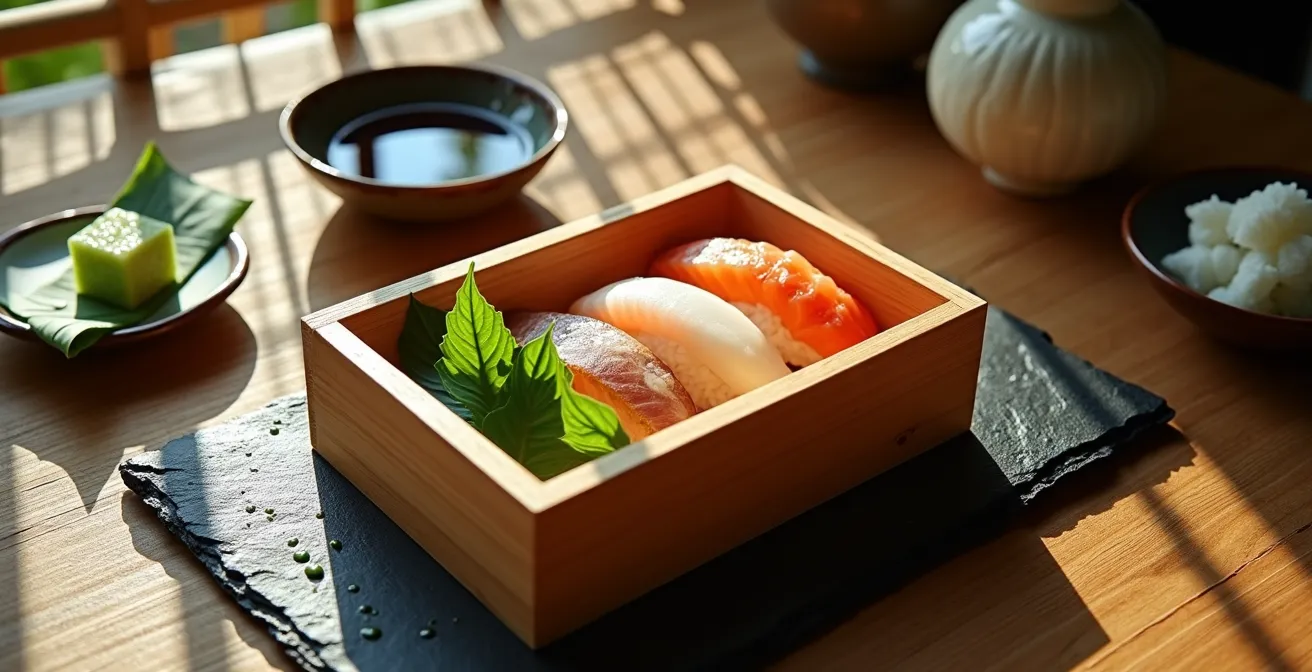
Oshizushi’s superior shelf life is not magic; it’s a deliberate system of Kansai culinary engineering designed for preservation and transport.
- Heavy curing with salt and vinegar drastically reduces water activity, creating an environment hostile to bacteria.
- Intense compression eliminates air pockets and creates a dense, durable structure that protects the ingredients.
Recommendation: Master these Osaka-style techniques to create delicious, travel-ready sushi that holds its form and flavor far longer than its delicate Edo-mae counterparts.
Anyone who has packed sushi for a picnic or a long trip knows the disappointment. The delicate, hand-formed nigiri you so carefully prepared becomes a sad, disheveled mess in a matter of hours, its fresh fish quickly turning questionable. The common wisdom is that sushi is meant for immediate consumption, a fleeting art form born from the fast-paced life of Edo-era Tokyo. This is a truth, but it’s a decidedly Tokyo-centric one. In Kansai, the bustling merchant region centered around Osaka, a more pragmatic and robust solution was perfected long ago: oshizushi, or pressed sushi.
While many see it as just another style, oshizushi is fundamentally different. It’s not just sushi that’s been squashed into a box. It represents a complete philosophy of preservation, a form of culinary engineering designed to be stable, portable, and delicious hours or even a day after it’s made. The secret isn’t a single trick, but a series of deliberate hurdles—heavy curing, strategic layering, and intense compression—that work together to actively combat spoilage and structural failure. This approach stands in proud contrast to the Edo-mae style, which prioritizes the fleeting perfection of a raw, fresh ingredient.
This guide delves into the “why” behind oshizushi’s resilience. We will deconstruct the methods that make it the superior choice for any scenario that doesn’t involve eating it seconds after it’s made. From preparing the wooden press to the science of curing and the physics of slicing, you will learn to master the techniques that have defined Osaka’s practical and delicious contribution to the world of sushi.
To fully grasp this distinct culinary tradition, this article explores the specific techniques and historical context that define oshizushi. The following sections will guide you through the key principles, from tool preparation to the final presentation.
Summary: Why Pressed Oshizushi Lasts Longer Than Nigiri Without Refrigeration?
- How to Prevent Rice From Sticking to Your Wooden Press Box?
- Why Must Fish for Oshizushi Be Cured More Heavily Than for Nigiri?
- Fish on Top or Middle: Which Layering Technique Holds Together Best?
- How to Prep Mackerel for Battera Sushi to Remove the Fishy Smell?
- How to Slice a Rectangular Block Without Crushing the Corners?
- Osaka vs. Tokyo Style: Which Traditional Approach Suits Your Palate?
- Edo-mae vs. Hokkaido Style: Which Offers a Purer Seafood Taste?
- What Edo Period Innovations Still Define Modern Sushi Making Today?
How to Prevent Rice From Sticking to Your Wooden Press Box?
The first step in mastering oshizushi is preparing its essential tool: the *oshibako*, or wooden press box. A common frustration for beginners is having the perfectly compressed rice stick stubbornly to the wood, ruining the block’s clean lines. The solution lies in treating the wood itself as an active ingredient. Unlike plastic molds, traditional wooden boxes, often made from Hinoki (Japanese Cypress), possess natural antibacterial oils and a porous surface that, when properly seasoned, create a non-stick surface. The process isn’t a one-time fix but a ritual that respects the material.
Before its very first use, a new oshibako should be seasoned by submerging it overnight in a mixture of rice vinegar and water. This step helps seal the wood’s pores and imparts a subtle flavor that complements the sushi rice. After this initial seasoning, the key to daily success is moisture. A quick 20-30 minute soak in water before each use causes the wood fibers to swell slightly, creating a slick, hydrated barrier. Immediately before adding the rice, a final brush of pure rice vinegar on all interior surfaces provides the last layer of insurance, preventing any rogue grains from adhering.
Some chefs even add a “sacrificial layer” like plastic wrap or a large shiso leaf at the bottom for guaranteed easy release. According to Yamaco, a respected manufacturer of Hinoki kitchen tools, simply wetting the product with water is a critical step to prevent rice from sticking, confirming that this traditional practice is rooted in sound culinary physics. This preparation transforms the box from a simple container into a functional part of the preservation process.
Why Must Fish for Oshizushi Be Cured More Heavily Than for Nigiri?
The defining difference between the ephemeral nigiri of Tokyo and the robust oshizushi of Osaka lies in the treatment of the fish. While nigiri often celebrates the pure, unadulterated flavor of raw seafood, oshizushi requires a much heavier cure. This isn’t simply a matter of taste; it is the primary engine of preservation. The goal is to fundamentally alter the fish’s chemistry to make it an inhospitable environment for the bacteria that cause spoilage. This is achieved through the powerful combination of salt (*shio-jime*) and vinegar (*su-jime*).
The science behind this is centered on the concept of water activity (aW). Fresh fish has a high water activity, meaning there is plenty of free water available for microbial growth. The generous application of salt draws this moisture out of the fish’s cells through osmosis. Subsequently, marinating in vinegar lowers the fish’s pH, creating an acidic environment where most spoilage bacteria cannot survive. This two-pronged attack drastically reduces the conditions necessary for decay, and as food science research confirms, fish with neutral pH and high water activity spoils with alarming speed if left unpreserved.
This heavy curing does more than just preserve. It also denatures the proteins in the fish, firming up its texture and deepening its flavor into something more complex and savory than its raw counterpart. This transformation is what allows oshizushi to be packed for a journey or left at room temperature for hours without risk, a testament to the Kansai region’s pragmatic approach to creating food that is not just delicious, but also practical and resilient.
Fish on Top or Middle: Which Layering Technique Holds Together Best?
The structural integrity of oshizushi is paramount. Unlike nigiri, which is held together by little more than a gentle squeeze, a block of pressed sushi must withstand transport and slicing without falling apart. The layering technique is crucial to achieving this stability. While it might seem intuitive to place a layer of rice, then fish, then more rice, the traditional and most effective method for creating a solid block is the fish-on-bottom approach, which becomes the top layer once the block is inverted and removed from the mold.
In this classic Osaka method, the cured fillet of fish (like mackerel for *battera*) is placed skin-side down at the bottom of the dampened oshibako. This is often followed by a layer of shiso leaves before the sushi rice is firmly packed on top, filling the box slightly above the rim. The lid is then placed on top and pressed down with significant, even pressure. This act of compression is key. It forces the rice grains to bind tightly together and melds them with the fish, eliminating air pockets that can lead to both structural weakness and faster spoilage. The fish at the bottom acts as a solid foundation during pressing, resulting in a much denser and more cohesive final product.
When the block is turned out, the beautifully patterned fish skin is revealed on top, creating a perfect, self-contained package. This method directly contributes to its longevity, as the tightly packed structure limits oxygen exposure within the block. Indeed, research on fish preservation shows an up to 113% increase in shelf life with proper techniques, and the structural compression of oshizushi is a significant contributor to this effect. It is a masterclass in creating food that is engineered to last.
How to Prep Mackerel for Battera Sushi to Remove the Fishy Smell?
Mackerel, or *saba*, is the quintessential fish for classic Osaka-style *battera* sushi. However, its rich, oily nature also means it can have a strong “fishy” aroma if not prepared correctly. The Kansai method for prepping mackerel is a meticulous, multi-stage process designed not only to preserve the fish but also to neutralize unwanted odors and enhance its deep umami flavor. This goes far beyond a simple dip in vinegar; it’s a deliberate transformation of the ingredient.
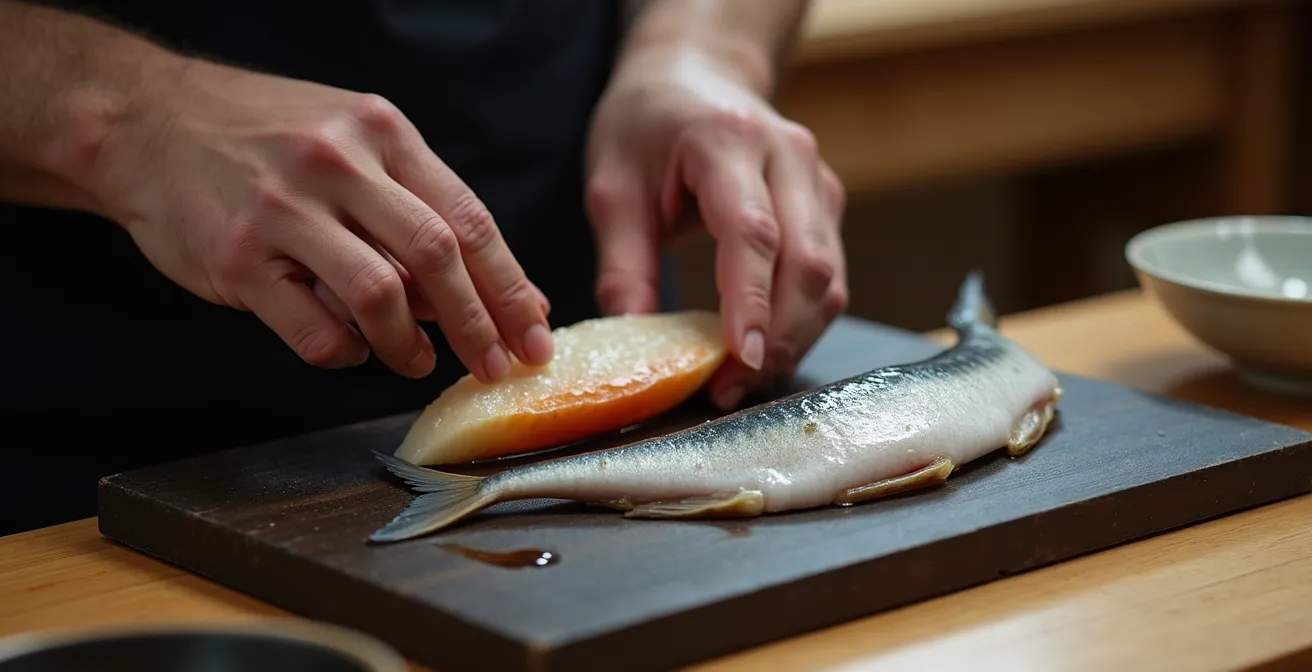
The process begins with a heavy salt cure (*shio-jime*), where fillets are coated generously in salt for a specific period. This draws out excess moisture and the compound trimethylamine, which is a primary source of fishy smells. After the salt cure, the fillets are rinsed. As the experts at Shizuoka Gourmet note in their guide to pressed sushi techniques, “The ice water shock technique helps to instantly firm the skin and wash away surface impurities for a cleaner taste.” This step is crucial for texture and a clean palate.
Next comes the vinegar cure (*su-jime*), where the fish is marinated in rice vinegar. This further neutralizes any remaining odors and begins to “cook” the fish, turning its flesh opaque and firm. For an even deeper flavor, a thin sheet of kombu (kelp) is often placed on the fish after the vinegar cure, imparting its natural glutamic acid. The result is a piece of mackerel that is perfectly seasoned, structurally sound, and free of any off-putting aroma—a testament to the thoughtful culinary engineering of the Kansai region.
Your Action Plan: Two-Stage Mackerel Curing for Battera
- Salt Cure (Shio-jime): Apply a generous, even coating of salt to the mackerel fillets. This step is crucial for drawing out moisture and the primary odor-causing compounds. Let it sit according to your recipe’s specific timing.
- Ice Water Rinse: After salting, briefly shock the fillets in ice water. This immediately firms the skin, removes excess salt, and washes away any surface impurities for a cleaner final taste.
- Vinegar Cure (Su-jime): Submerge the rinsed and dried fillets in a rice vinegar marinade. This step neutralizes any remaining fishiness, lowers the pH for preservation, and firms the texture.
- Kombu Umami Boost: After the vinegar cure, lay a thin, rehydrated sheet of kombu over the fish. This infuses the mackerel with a subtle, savory umami flavor from the kelp’s glutamic acid.
- Optional Searing: For added complexity, you can lightly sear the skin-side of the cured mackerel with a kitchen torch before pressing. This creates a wonderful smoky aroma and a dual-texture experience.
How to Slice a Rectangular Block Without Crushing the Corners?
After the meticulous work of curing, layering, and pressing, the final challenge is to slice the dense oshizushi block into clean, uniform pieces without crushing the delicate corners or smearing the layers. A sloppy cut can undo all the previous effort. The professional technique relies on three key elements: temperature, a proper knife, and a specific cutting motion. This is the final step in ensuring the structural integrity of the sushi is maintained right up to the point of serving.
First, chilling the fully pressed block in the refrigerator for 10-15 minutes is a critical, though often overlooked, step. This brief chill firms up the rice and fish, making the entire structure less prone to compression during slicing. Second, the right tool is essential. A long, thin, and incredibly sharp knife, ideally a traditional single-bevel *yanagiba* (sushi knife), is used. Before each and every cut, the blade must be dipped in a mixture of water and vinegar (*tezu*). This prevents the starchy rice from sticking to the knife and ensures a clean, drag-free slice.
The cutting motion itself is a graceful pull, not a downward press. The tip of the knife is placed at the far edge of the block, and the slice is made in a single, fluid motion, pulling the knife towards you and using its full length. Pushing down or sawing back and forth will inevitably crush the block. Many oshibako boxes even feature precisely positioned slits that act as cutting guides, ensuring perfectly uniform pieces. This combination of preparation, tools, and technique allows for the creation of sharp-cornered, beautifully layered pieces ready for any bento box or picnic basket.
Osaka vs. Tokyo Style: Which Traditional Approach Suits Your Palate?
The contrast between Osaka’s oshizushi and Tokyo’s Edo-mae nigiri is more than just a matter of shape; it’s a reflection of two different regional histories and culinary philosophies. Understanding this difference is key to appreciating why one is built for endurance while the other is designed for immediacy. Tokyo, or Edo as it was known, was a city of samurai and bureaucrats, with a culture that valued speed and freshness. This gave rise to nigiri sushi as a form of “fast food,” consumed on the spot.
In contrast, Osaka was the commercial heart of Japan, a city of merchants where goods, including food, were often transported over long distances. This practical necessity shaped their approach to sushi. As Nubo Kitchen explains, “Oshizushi originated in Osaka as a way to make sushi that could be transported easily and was less perishable than other types.” This led to the development of techniques focused on preservation: sweeter, more heavily seasoned rice that could hold its own over time, and fish that was always cooked or cured.
The result is a fundamental divergence in texture and flavor profile. Edo-mae nigiri is soft, airy, and focuses on the subtle, pure taste of a single slice of pristine, often raw, seafood. It is an art of the moment. Oshizushi is firm, dense, and offers a complex, integrated flavor where the robustly seasoned rice and the cured topping have melded together. It is an art of preservation and practicality. Choosing between them is a matter of context: are you seeking the fleeting perfection of a chef’s counter, or a delicious, reliable meal for the road?
The following table, drawing from an analysis of Japanese pressed sushi traditions, breaks down these core distinctions.
| Feature | Osaka Style (Oshizushi) | Tokyo Style (Edo-mae) |
|---|---|---|
| Origin Period | Edo period (1603-1868) | Late Edo period |
| Primary Purpose | Preservation & transport | Fresh, immediate consumption |
| Rice Seasoning | Sweeter, robust flavor | Delicate, subtle seasoning |
| Texture | Firm, compressed layers | Soft, hand-formed |
Edo-mae vs. Hokkaido Style: Which Offers a Purer Seafood Taste?
While the Osaka-Tokyo divide is the most famous, another regional contrast further highlights why Edo-mae sushi is so dependent on absolute freshness: the comparison with Hokkaido style. Hokkaido, Japan’s northernmost island, is surrounded by cold, nutrient-rich waters that are home to some of the world’s finest seafood. The philosophy of Hokkaido-style sushi is therefore one of extreme minimalism, driven by the unparalleled quality of the local ingredients.
Because the fish and shellfish are often caught and served within hours, there is little need for the preservation techniques that define other styles. Hokkaido sushi is characterized by large, generous cuts of exceptionally fresh, raw seafood served over lightly seasoned rice. The goal is to present the ingredient in its most pure and natural state. There is less emphasis on aging, marinating, or complex cures that were developed in warmer climates like Edo’s, where spoilage was a more immediate concern before the age of refrigeration.
Edo-mae sushi, by contrast, evolved in a warmer, more humid environment. While it celebrates freshness, its tradition also includes subtle preservation techniques like briefly marinating tuna in soy sauce (*zuke*) or simmering clam (*nitsume*). These methods were originally designed to extend the usability of the seafood for a few hours. This highlights a key point: even the “fresh” style of Tokyo has preservation in its DNA. However, Hokkaido’s privileged access to cold-water seafood allows it to bypass many of these steps, offering a taste that is arguably the “purest” expression of the ocean. Modern preservation technology research indicates that fish stored near 3°C can last for many days, a condition naturally approximated by Hokkaido’s environment, further reducing the historical need for heavy-handed cures.
Key takeaways
- Oshizushi’s longevity comes from a system of “hurdle technology”: salt, vinegar, and compression work together to prevent spoilage.
- The heavy curing process is not just for flavor; it chemically alters the fish by reducing water activity and lowering pH.
- Properly preparing the wooden oshibako (press box) by soaking and seasoning it is a critical step for a non-stick, clean release.
What Edo Period Innovations Still Define Modern Sushi Making Today?
The sushi we know today is largely a product of the Edo Period (1603-1868), a time of great cultural and culinary development in Japan. The most significant innovation of this era was the shift away from slow-fermented sushi, known as *narezushi*, to a much faster, vinegar-based preparation. Originally, sushi was a method of preserving fish by packing it in salted, fermenting rice for months or even years. The rice was discarded, and only the preserved fish was eaten. This ancient technique was effective, but incredibly time-consuming.
During the Edo Period, the brilliant idea of adding rice vinegar to freshly cooked rice was born. This mimicked the sour taste of fermented rice but accomplished it in minutes rather than months. As research on food history notes, this transition from fermentation to quick vinegar-curing revolutionized sushi, transforming it from a long-term preservation method into a popular “fast food.” This single innovation is the foundation of all modern sushi, from nigiri to oshizushi. It made sushi accessible, popular, and adaptable.
This period also saw the birth of specific regional styles like oshizushi. The name of one of its most famous forms, *battera*, reflects the international influence of the time. As Just One Cookbook explains, “The name ‘battera’ derived from the Portuguese word bateria or ‘small boat’ as the sushi looked very similar to a small ship from the side.” This Edo-era creativity—combining the new technology of vinegar-seasoned rice with practical needs like transport and a flair for presentation—created the diverse and delicious world of sushi we enjoy today. The principles of preservation and practicality pioneered in Kansai remain just as relevant now for anyone wanting to pack a perfect lunch.
Now that you understand the science and technique behind oshizushi’s resilience, the next logical step is to put this knowledge into practice. By applying these Kansai-honed methods, you can confidently create sushi that is not only delicious but also perfectly suited for picnics, bento boxes, and travel, freeing yourself from the constraints of Tokyo’s “eat-it-now” philosophy.