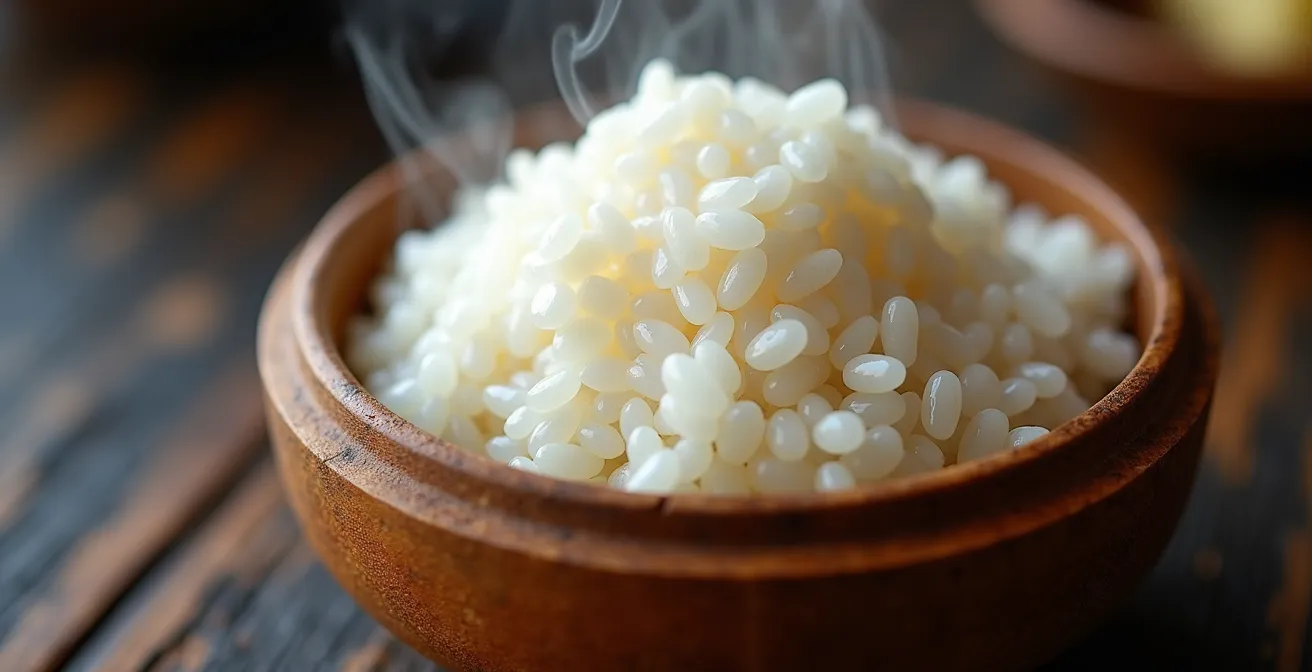
The textural perfection of sushi rice is not an art, but a function of thermal physics; maintaining it at ‘hitohada’ (body temperature) is a deliberate act of controlling starch structure and moisture.
- Cold rice undergoes ‘starch retrogradation’, causing it to harden and taste grainy.
- A wooden ‘ohitsu’ outperforms a thermos by regulating both heat and humidity, preventing the rice from becoming pasty.
- The ‘cut-and-fold’ motion minimizes shear stress on starch granules, preserving texture while cooling.
Recommendation: Instead of guessing, use a food thermometer to target a stable 35-40°C (95-104°F) from mixing to serving for consistently superior results.
The distinction between mediocre and sublime sushi often lies not in the exotic nature of the fish, but in the texture of the rice. Many home cooks and even aspiring professionals focus intently on vinegar ratios and sourcing high-grade grains, only to be disappointed by rice that is either stiff and grainy or unpleasantly gummy. This textural failure is rarely a matter of recipe; it is a failure of thermal management. The pursuit of perfect sushi rice, or shari, is fundamentally an exercise in applied physics.
Conventional wisdom dictates that shari should be served at hitohada, or human skin temperature. This is often treated as a simple aesthetic preference. However, this guideline is a practical proxy for a complex set of physical and chemical states. The true key to unlocking transcendent texture is not merely to follow this rule, but to understand and control the underlying thermodynamics of starch retrogradation, moisture transfer, and the volatility of acetic acid. This is where we move beyond simple cooking instructions and into the realm of material science.
This article deconstructs the thermal journey of sushi rice. We will analyze why cold transforms rice into a dense, unpalatable mass and how specific tools are engineered to prevent this. By understanding the principles of heat retention, moisture regulation, and the physical impact of mixing techniques, you will gain the ability to manipulate the rice’s final texture with scientific precision, ensuring every grain contributes to a perfect, cohesive bite.
To achieve this mastery, it is essential to explore each stage of the process with a physicist’s eye. The following sections break down the critical thermal control points, from the molecular behavior of starch to the final assembly of a roll, providing a clear roadmap to textural perfection.
Summary: A Scientific Approach to Sushi Rice Temperature
- Why Does Cold Rice Feel Hard and Grainy on the Tongue?
- How to Use a Wooden Ohitsu to Regulate Rice Humidity and Heat?
- Thermos or Wood: Which Vessel Keeps Shari at Body Temperature Longer?
- The Reheating Mistake That Makes Vinegar Evaporate From Your Shari
- When Should You Mix the Rice to Have It Ready Exactly at 7 PM?
- How Does 80°C Tea Help Dissolve Fish Fat on the Tongue?
- The Temperature Mistake That Steams Your Nori From the Inside Out
- Why the ‘Cut-and-Fold’ Mixing Motion Prevents Mushy Rice?
Why Does Cold Rice Feel Hard and Grainy on the Tongue?
The pleasant, soft texture of freshly cooked rice is a result of starch gelatinization, a process where heat and water break down the crystalline structure of starch molecules (amylose and amylopectin), allowing them to absorb water and become soft and digestible. However, this state is thermally unstable. As the rice cools, it undergoes a process known as starch retrogradation. This is the primary reason why cold rice develops a hard, stale, and grainy texture that is particularly unpleasant in sushi.
During retrogradation, the linear amylose and branched amylopectin chains that were dispersed during cooking begin to realign and recrystallize. This molecular reordering squeezes out the water that was trapped within the starch matrix, causing the rice grains to become firm and dry. The process is significantly accelerated at refrigeration temperatures (around 4°C or 40°F), but it occurs even at room temperature, albeit more slowly. The goal of maintaining shari at ‘hitohada’ is therefore to arrest this process.
According to scientific analysis, this phenomenon is a critical factor in food texture. Research from the National Center for Biotechnology Information clarifies that retrogradation is defined as the recrystallization or realignment of amylose and amylopectin chains. Storage conditions, especially temperature, are the crucial factors governing the degree to which this textural degradation occurs. By keeping the rice warm, we are actively inhibiting the molecular realignment that leads to hardness, preserving the gelatinized state and ensuring a soft, pleasing mouthfeel.
How to Use a Wooden Ohitsu to Regulate Rice Humidity and Heat?
Once sushi rice is cooked and seasoned, maintaining its ideal thermal and hydric state becomes the next challenge. This is the precise function of a traditional wooden tub called an ohitsu. Far from being a mere decorative vessel, the ohitsu is a sophisticated piece of passive climate-control technology, engineered to maintain the ‘hitohada’ temperature while managing moisture perfectly.
The key lies in the material properties of the unfinished wood, typically Japanese cypress (hinoki) or sawara. Wood is an excellent thermal insulator, meaning it has low thermal conductivity. It slows the rate of heat loss, keeping the rice warm for hours without an external heat source. Simultaneously, the wood is hygroscopic; it naturally absorbs and desorbs moisture from its surroundings. When warm, steamy rice is placed inside, the ohitsu absorbs the excess surface moisture that would otherwise condense and make the rice gummy. As the rice rests, the wood slowly releases a small amount of that moisture back into the container’s micro-environment, preventing the grains from drying out. This creates a stable, breathable humidity buffer that is impossible to replicate in a sealed plastic or metal container.
The Sushi Geek’s Ohitsu Temperature Control Study
An expert analysis highlights the multi-faceted role of this traditional tool. As noted in a deep dive by The Sushi Geek, an ohitsu’s primary purpose is to serve shari at body temperature. A small container made from Japanese cypress is ideal, as it not only keeps the rice at a perfect temperature for several hours but also absorbs excess moisture. Furthermore, the natural antimicrobial properties of the wood help in preserving the rice, adding another layer of functionality beyond simple temperature and humidity control.
Using an ohitsu is simple: transfer the seasoned rice into it, cover with the lid, and let it rest. It creates the ideal equilibrium, holding the rice in that perfect state between mushy and dry, ready for service.
Thermos or Wood: Which Vessel Keeps Shari at Body Temperature Longer?
In modern kitchens, the thermos, or insulated food jar, presents itself as a contemporary alternative to the traditional ohitsu. Both aim to maintain rice temperature, but they operate on fundamentally different principles, leading to drastically different results in texture over time. While a thermos excels at pure heat retention, the ohitsu’s superiority lies in its holistic management of the rice’s environment.
A thermos is a closed system designed for maximum thermal insulation. It minimizes heat loss to the environment, often keeping food hotter for longer than an ohitsu. However, this strength is also its greatest weakness for sushi rice. By sealing in the heat, it also seals in all the moisture. Steam evaporating from the rice has nowhere to go; it condenses on the lid and walls, dripping back down and turning the rice into a pasty, gummy mass. The lack of breathability creates a high-humidity environment that compromises the individual grain structure.
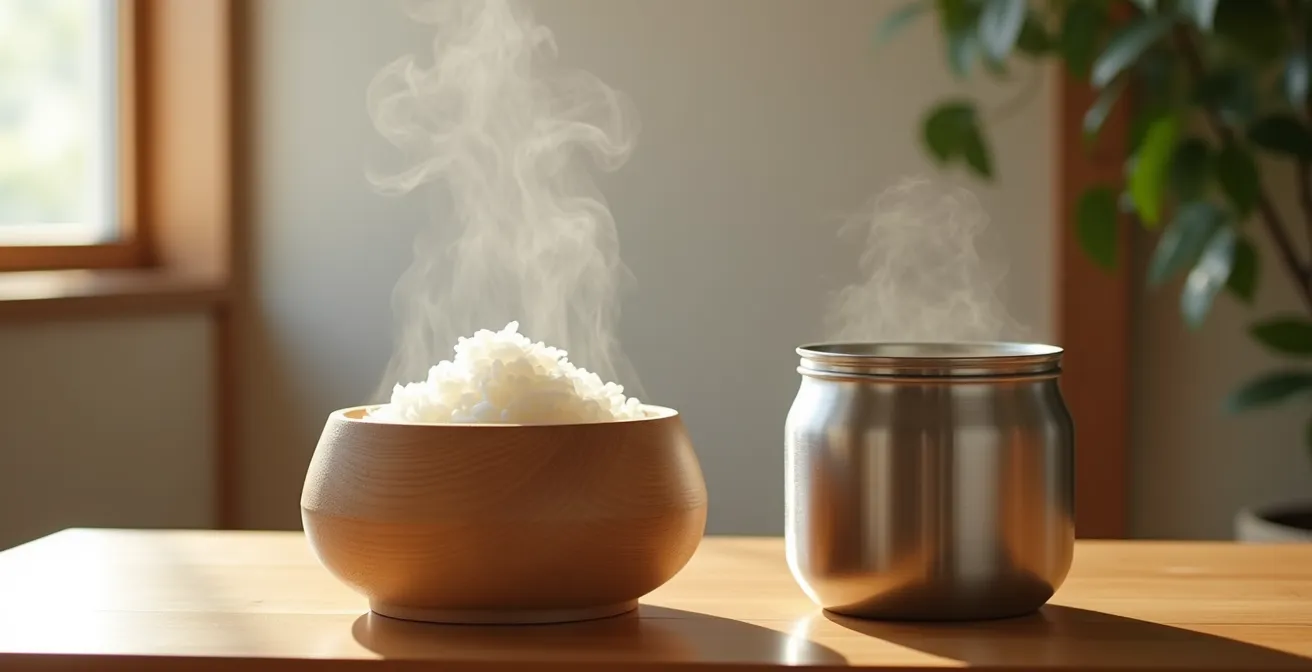
The ohitsu, as discussed, provides a breathable environment. It moderates temperature loss while actively managing humidity. This balance is critical for maintaining not just warmth, but the desired fluffy-yet-distinct texture of perfect shari. The following table breaks down the key differences.
This comparison from an analysis on rice cooling methods shows the clear trade-offs between the two vessels.
| Feature | Wooden Ohitsu | Thermos |
|---|---|---|
| Temperature Range | 30-40°C maintained | Higher initial retention |
| Moisture Control | Natural humidity buffer | Sealed system, traps moisture |
| Texture Over Time | Maintains ideal texture 3-4 hours | Becomes pasty after 2 hours |
| Material Benefits | Cedar/cypress provides antimicrobial properties | Insulation minimizes heat loss |
For short-term transport, a thermos may suffice, but for holding rice in its optimal state for service, the ohitsu is unequivocally the superior scientific instrument.
The Reheating Mistake That Makes Vinegar Evaporate From Your Shari
The delicate, tangy flavor of sushi rice comes from the seasoned vinegar (sushi-zu) that is folded into it while hot. The timing and temperature of this step are critical. A common mistake is to add the vinegar to rice that is either too cool or to reheat seasoned rice too aggressively, which compromises the flavor profile through the volatilization of acetic acid, the primary component of vinegar.
Acetic acid has a boiling point of approximately 118°C (244°F), but it is volatile and will begin to evaporate well below that temperature, especially in the presence of steam. When you add sushi-zu to piping hot rice, the heat helps the grains absorb the liquid seasoning evenly. Guidelines from experts like Mizkan, a major vinegar producer, suggest that the rice temperature should be over 90°C (about 190°F) when adding the seasoning for optimal absorption. At this temperature, the starch is fully gelatinized and porous.
The mistake occurs during reheating. If you have cold, seasoned rice and attempt to bring it back to ‘hitohada’ in a microwave or on a stovetop, you risk heating it unevenly and too quickly. Pockets of the rice can easily exceed the temperature at which acetic acid readily evaporates, driving off the delicate tangy flavor and leaving the rice tasting flat. Furthermore, aggressive reheating can create excess steam, which turns the rice gummy. The correct method is to let the rice cool slowly and naturally after seasoning, holding it at body temperature in an ohitsu, which avoids the need for reheating altogether.
Professional Chef’s Vinegar Retention Technique
To avoid common pitfalls, professional chefs employ specific techniques. For instance, chef Marissa Stevens recommends a gentle post-cooking steam by sliding a kitchen towel under the pot lid for 10 minutes. This finishes the cooking gently and absorbs excess condensation. After transferring to a wide bowl and folding in the vinegar, the rice is covered with a damp cloth while it cools slowly, ensuring even temperature distribution and preventing the volatile acidic notes from flashing off.
When Should You Mix the Rice to Have It Ready Exactly at 7 PM?
Timing is everything in a kitchen, and preparing sushi rice is a process that must be back-timed with precision. To have perfectly seasoned shari at the ideal ‘hitohada’ temperature for a 7:00 PM service, one must account for soaking, cooking, steaming, and a crucial cooling and resting period. A professional workflow follows a clear timeline to ensure the rice is not too hot, not too cold, and has had adequate time for the flavors to meld and the texture to stabilize.
The process begins hours before serving. According to research by food scientists like Naoki Higuchi, the optimal texture and taste are achieved when the rice is soaked for at least 30 minutes, with some studies suggesting up to two hours at 5°C yields the best results. This allows for even hydration of the grains before cooking. After the rice cooker finishes, a 10-15 minute steaming phase is essential to finish the cooking process gently. The most active phase—mixing with vinegar and fanning—should begin approximately 45 minutes before serving. This vigorous fanning is not just for show; it rapidly evaporates excess surface moisture and helps cool the rice to the target temperature while giving it a characteristic sheen.
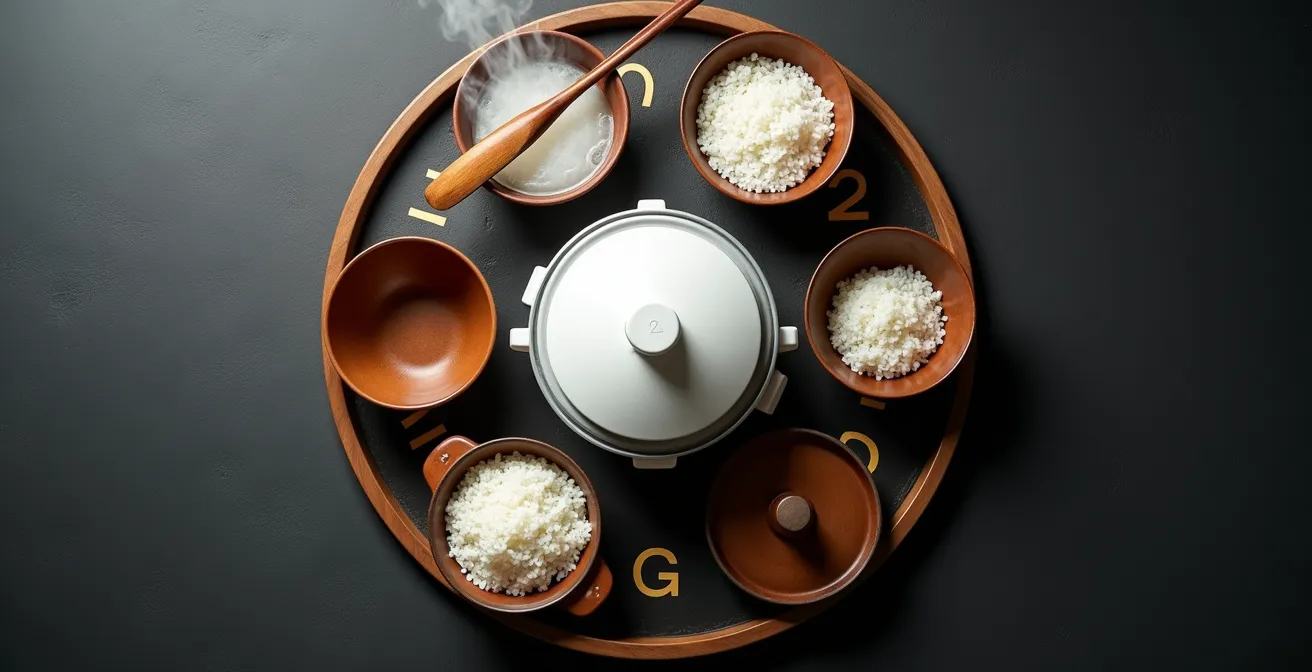
Once cooled to near body temperature, the rice should be transferred to an ohitsu for a final rest. This allows the temperature and moisture to equalize throughout the batch. A final fluff just before service ensures the best possible texture. According to HACCP food safety guidelines, the rice must be cooled to 21°C (70°F) within four hours, but the acidification from the vinegar (dropping the pH below 4.6) makes it safe to hold at a warm ‘hitohada’ temperature for several hours.
Here is a sample professional back-timing schedule for a 7:00 PM service:
- 5:00 PM: Begin soaking the rice.
- 5:45 PM: Start the rice cooker.
- 6:15 PM: Rice cooker finishes. Let it steam, covered, for 15 minutes.
- 6:30 PM: Transfer rice to a hangiri or wide bowl. Begin the ‘cut-and-fold’ mixing with vinegar while fanning vigorously.
- 6:45 PM: Rice should be approaching body temperature. Transfer to an ohitsu to rest.
- 6:55 PM: Perform a final fluff and texture check.
- 7:00 PM: Serve.
How Does 80°C Tea Help Dissolve Fish Fat on the Tongue?
The pairing of sushi with hot green tea is a tradition rooted in sensory science. While the quality of the rice and fish are paramount, the experience of eating sushi is a sequence of flavors. Serving a hot beverage like green tea, specifically at a temperature around 80°C (176°F), serves a critical function as a palate cleanser, particularly by interacting with the fats from the fish.
The mechanism is based on the melting point of lipids. Fish oils and fats, especially those in richer fish like tuna (toro) or salmon, are solid at cold temperatures but liquefy as they warm up. When you eat a piece of nigiri, the fats coat the tongue and mouth. While this is part of the rich flavor experience, it can dull the palate for the next piece, which might have a more delicate flavor profile. A sip of hot tea works as a solvent. The thermal energy from the ~80°C liquid is sufficient to melt and emulsify any residual fats left on the tongue, washing them away cleanly. This is far more effective than a cold beverage, which would cause the fats to congeal.
This palate-cleansing effect ensures that each piece of sushi is experienced with maximum clarity, without the lingering richness of the previous one. It resets the sensory canvas. While the rice itself should be at body temperature, as an expert notes, the accompanying beverage leverages a higher temperature for a different, but complementary, purpose. This interplay of temperatures—warm rice, cool fish, and hot tea—creates a complete and dynamic thermodynamic experience on the palate.
The Temperature Mistake That Steams Your Nori From the Inside Out
One of the most common textural failures in homemade sushi rolls is soggy nori (seaweed). The crisp, slightly brittle texture of a fresh sheet of nori is a crucial counterpoint to the soft rice and fish. This crispness is often lost within minutes of assembly due to a simple but critical temperature error: applying overly warm or steamy rice to the sheet. This mistake effectively steams the nori from the inside out.
Nori is extremely thin and highly hygroscopic, meaning it readily absorbs moisture from its environment. When rice that is significantly warmer than room temperature is spread onto it, the heat causes moisture within the rice to turn into water vapor (steam). Trapped between the rice and the bamboo mat, this steam has nowhere to go but directly into the nori sheet. The seaweed rapidly absorbs this moisture, losing its structural integrity and turning limp and chewy. This is exacerbated by the temperature mismatch, as a case study from Yahoo Lifestyle points out that applying warm shari to the nori can cause moisture to seep into it.
To prevent this, the rice must be cooled to the proper ‘hitohada’ range of 35-40°C (95-104°F) before it ever touches the nori. At this temperature, the rice is still warm enough to have a pleasant texture and for its starches to remain properly gelatinized, but it is not hot enough to produce a significant amount of steam. This thermal equilibrium is the key to preserving the nori’s delicate crispness through the rolling and serving process. Working quickly and with dry hands further minimizes the nori’s exposure to ambient humidity.
Action Plan: Auditing Your Nori Integrity
- Temperature Verification: Use a food thermometer to confirm that seasoned rice has cooled to the 35-40°C (95-104°F) range before contact with the nori.
- Moisture Barrier Control: Handle nori sheets exclusively with dry hands and on a completely dry surface to prevent any premature moisture absorption.
- Exposure Time Audit: Time your rolling process. Minimize the duration the nori is exposed to rice by having all fillings prepped and ready for immediate assembly.
- Storage Environment Review: If holding rice before rolling, check its container. Ensure it is covered with a lightly damp cloth in a warm (not hot) place to maintain temperature without creating excess internal steam.
- Assembly Pressure Analysis: Apply firm but gentle pressure when rolling. Over-compressing can physically squeeze moisture from the rice grains into the nori, contributing to a soggy texture.
Key Takeaways
- The ‘hitohada’ or body temperature standard for sushi rice is a scientific mandate to prevent starch retrogradation, which causes hardness.
- A wooden ohitsu is the superior storage vessel because it regulates both heat and humidity, unlike a sealed thermos which traps moisture and creates a pasty texture.
- The ‘cut-and-fold’ mixing technique is physically designed to minimize shear stress on delicate, gelatinized starch granules, preventing them from breaking and turning to mush.
Why the ‘Cut-and-Fold’ Mixing Motion Prevents Mushy Rice?
The final texture of sushi rice is determined not only by thermal control but also by the physical handling of the grains. The prescribed ‘cut-and-fold’ motion, performed with a rice paddle (shamoji), is a deliberate technique designed to minimize mechanical damage to the cooked starch. Using an aggressive stirring motion is a critical error that imparts excessive shear stress on the delicate, water-swollen grains, causing them to rupture and release their starchy interior, resulting in a mushy, porridge-like consistency.
Imagine each cooked rice grain as a delicate, water-filled balloon. A stirring motion drags and mashes these grains against each other and the sides of the bowl, creating high friction and shear forces that easily break their structure. In contrast, the ‘cut-and-fold’ technique is one of gentle separation and redistribution. By ‘slicing’ into the rice at a 45-degree angle, you separate clumps of grains without crushing them. The subsequent ‘folding’ motion lifts a section of rice and gently places it on top of another, allowing the vinegar to be incorporated through layering rather than forceful mixing. This method coats each grain evenly while preserving its individual integrity.
This technique is performed in a hangiri, a large, flat-bottomed wooden tub. The wide surface area maximizes exposure to the air, which, when combined with simultaneous fanning, accelerates evaporative cooling. This rapid cooling wicks away excess moisture and helps the vinegar to be absorbed, setting the exterior of each grain and giving the shari its characteristic glossy sheen. The entire process is a perfect synergy of gentle mechanical action and thermodynamic principles.
Use a spatula to very gently fold the rice — slicing at a 45-degree angle, then lifting and folding the rice on top of itself, rather than stirring and smooshing — until the vinegar is evenly mixed and the initial steam has escaped.
– Gimme Some Oven, Sushi Rice Recipe Guide
Ultimately, this careful choreography ensures the final product is a collection of distinct, perfectly seasoned grains, not a homogenous starchy paste.
Achieving textural perfection in sushi rice is a testament to the idea that culinary art is often underpinned by precise science. By understanding and controlling the thermodynamic principles of starch behavior, moisture migration, and acid volatility, you elevate your practice from simply following a recipe to engineering a desired outcome. This scientific approach provides the consistency and quality that defines truly exceptional sushi. Begin experimenting with these thermal principles in your own kitchen to transform your results.