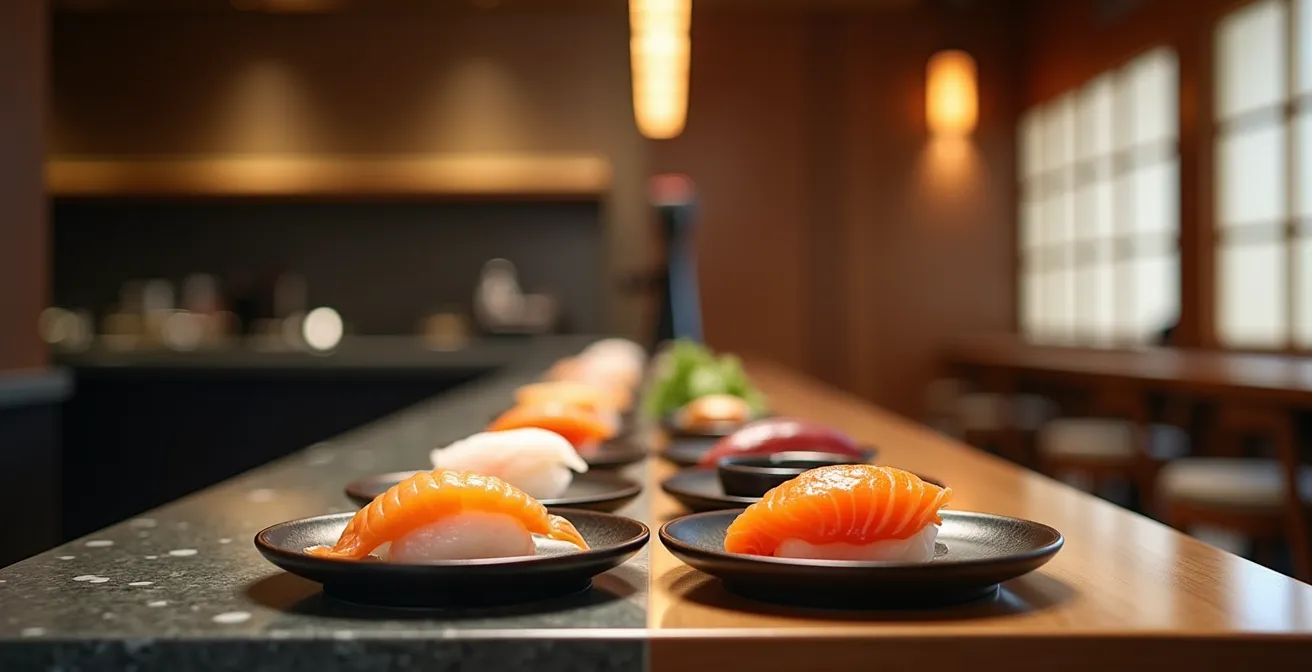
The steep price of a New York omakase is not arbitrary markup; it’s a direct reflection of quantifiable costs embedded in a transatlantic supply chain, specialized talent acquisition, and non-negotiable real estate pressures.
- Ingredient costs are magnified by sophisticated cold-chain logistics required to transport premium fish like bluefin tuna from Tokyo to New York.
- Salaries for master sushi chefs (itamae) are inflated by visa sponsorship costs and the high cost of living, representing a significant operational expense.
- A substantial portion of the bill services the high commercial rent of a prime Manhattan location, a cost largely absent in Tokyo’s neighborhood establishments.
Recommendation: To understand your bill, view it not as a simple charge for food, but as a detailed invoice for global logistics, expert craftsmanship, and a slice of metropolitan real estate.
The moment the bill arrives at a high-end New York City omakase restaurant can be startling. A price tag of $300, $400, or even more per person often elicits the same question: why is this so much more expensive than in Japan? While diners often assume it’s simply “for the experience” or due to the quality of the fish, these are only surface-level explanations. The reality is far more complex, rooted in a series of specific, interlocking economic factors that create a significant price disparity between a sushi counter in Tokyo and one in Manhattan.
To truly understand the cost, one must stop thinking like a diner and start thinking like a restaurant economist. The final price is not a monolith; it is a carefully constructed sum of distinct and often inflated cost components. From the logistical nightmare of transporting a single fish across the Pacific to the fierce competition for both real estate and human talent, every element of the operation carries a premium. This analysis will deconstruct that bill, moving through the supply chain, operational costs, and cultural economic factors to provide a clear financial breakdown of what you are truly paying for.
This article dissects the key economic drivers behind the high cost of omakase in New York. By examining each cost center, from ingredient logistics to service models, we will build a clear picture of the financial architecture supporting this pinnacle of dining.
Summary: The Financial Anatomy of a New York Omakase
- How Much Does It Cost to Fly Bluefin Tuna from Toyosu to JFK?
- Visa Sponsorship vs. Local Talent: Why Are Itamae Salaries So High Abroad?
- How Much of Your Bill Pays for the Manhattan Real Estate?
- What Local Ingredients Do NYC Chefs Use to Replace Japanese Rarities?
- How Does the Tipping Culture in the US Change the Service Model?
- The ‘Market Price’ Trap: How to Avoid Surprise Bills at the End?
- Why Spending $10 More on Nori Changes the Dish More Than Expensive Rice?
- How Sushi Evolved into Refined Gastronomy Worth $300 Per Person?
How Much Does It Cost to Fly Bluefin Tuna from Toyosu to JFK?
The largest and most visible cost driver for any high-end sushi restaurant is the raw product itself, particularly bluefin tuna. The journey of a top-grade tuna from the waters off Japan to a New York sushi counter is a masterclass in global logistics, where each step adds significant expense. The process begins at auction, where prices can reach astronomical levels. For instance, a record was set when a sushi chain owner paid $3.24 million for a 536-pound bluefin tuna at Tokyo’s famous New Year’s auction, establishing an extreme upper boundary for the value of the raw fish.
Beyond the initial purchase price, the primary cost inflator is the sophisticated cold chain required to preserve the tuna’s quality. This is not a simple matter of packing fish on ice. Top-tier suppliers use an ultra-low temperature (ULT) freezing process. Immediately after being caught, the tuna is bled, gutted, and frozen to -60°C (-76°F). This specialized method, which retains the fish’s texture and flavor profiles perfectly, requires cryogenic containers and continuous, costly monitoring throughout its trans-Pacific flight and ground transport to a restaurant in NYC.
This complex logistical chain—combining auction volatility, specialized freezing technology, air freight charges, import duties, and last-mile refrigerated delivery—creates significant supply chain arbitrage. The cost of simply moving the product from its origin to its destination can multiply its base price several times over, forming the first major component of the final bill before a chef even touches the fish.
Visa Sponsorship vs. Local Talent: Why Are Itamae Salaries So High Abroad?
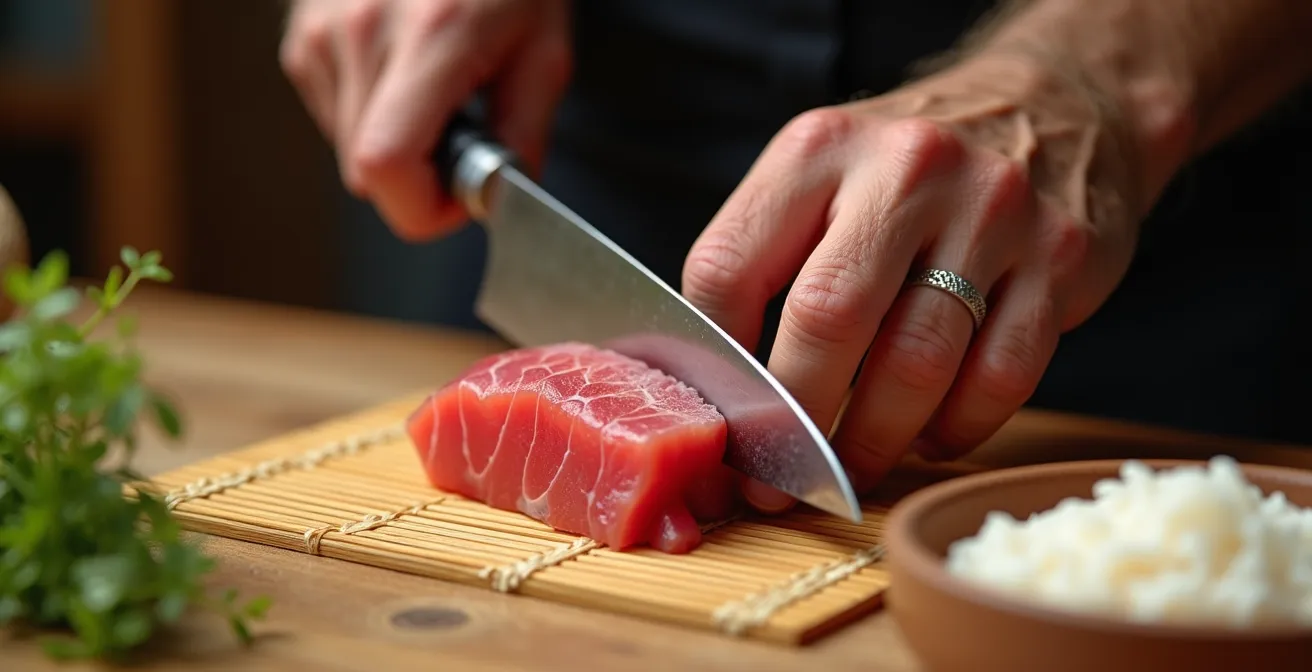
The second pillar of omakase cost is human capital. An omakase experience is defined by the skill of the itamae (sushi chef), a profession that requires decades of apprenticeship to master. In New York, securing this level of talent comes at a steep premium compared to Japan. Restaurants have two primary options, both expensive: sponsoring a visa for a master chef from Japan or hiring from the small pool of highly skilled, locally-based itamae.
The image below captures the essence of this craft—the precision, experience, and focus that command a high salary.
Sponsoring a chef from Japan involves significant legal fees, paperwork, and uncertainty associated with the O-1 visa for “Individuals with Extraordinary Ability or Achievement.” This process can cost a restaurant thousands of dollars per employee before salary is even discussed. Once in New York, the restaurant must offer a salary competitive enough to attract the talent and cover Manhattan’s high cost of living, which is substantially greater than in most Japanese cities. This creates a talent scarcity premium, where a limited supply of qualified individuals drives up labor costs across the entire high-end sector.
Hiring locally does not necessarily reduce costs. Top-tier itamae in the U.S. are well aware of their market value and can command six-figure salaries, especially in a competitive market like New York. This labor expenditure is a fixed operational cost that is directly factored into the price per seat, making the chef’s expertise one of the most significant non-ingredient-related expenses on the restaurant’s profit and loss statement.
How Much of Your Bill Pays for the Manhattan Real Estate?
An omakase restaurant’s address is a critical component of its business model and, by extension, its pricing. Unlike in Tokyo, where celebrated sushi counters can be found in quiet residential neighborhoods or nondescript office building basements, high-end NYC establishments often occupy prime commercial real estate in areas like Midtown, the West Village, or the Upper East Side. This location is not just for diner convenience; it is a signal of luxury and exclusivity.
However, this signal comes with a staggering price tag. The cost of commercial rent in these high-traffic areas is a major operational burden. According to industry data, prime Manhattan restaurant spaces can command rents from $150 to $400 per square foot annually. For a small, intimate 10-seat sushi counter occupying even a modest 800 square feet, this can translate to an annual rent of $120,000 to $320,000. This fixed overhead must be covered by the revenue generated from a very limited number of seats, drastically increasing the price per customer.
This stark contrast in real estate pressure is clearly visible when comparing prices directly. The following table, based on an analysis of market pricing, illustrates how the baseline and ceiling for omakase are fundamentally different in the two cities.
| Location | Entry-Level Omakase | Mid-Range Omakase | High-End Omakase |
|---|---|---|---|
| Tokyo | ¥10,000-20,000 ($65-130) | ¥20,000-30,000 ($130-195) | ¥30,000+ ($195+) |
| New York City | $70-100 | $200-300 | $400-950 |
The table shows that a high-end experience in New York can cost more than four times its Tokyo equivalent. A significant portion of that difference is allocated to simply paying the landlord, an economic reality that fundamentally reshapes the restaurant’s financial structure.
What Local Ingredients Do NYC Chefs Use to Replace Japanese Rarities?
While the narrative of omakase often revolves around fish flown directly from Tokyo’s Toyosu Market, the economic reality is more nuanced. To manage costs and ensure consistency, the most astute NYC chefs practice a form of ingredient fungibility. They build relationships with elite local and international suppliers to source alternatives that meet their exacting standards without always incurring trans-Pacific freight charges. This doesn’t mean compromising on quality, but rather making strategic sourcing decisions.
For example, while some specific fish like kinmedai (golden eye snapper) or certain seasonal delicacies may be irreplaceable imports, other staples can be sourced from different waters. High-quality uni (sea urchin) might come from Santa Barbara, scallops from Maine, or other varieties of tuna from the Atlantic. This sourcing strategy is crucial for maintaining a viable business model. As The Resy Guide to Omakase in New York notes, top restaurants still maintain deep connections to Japan, observing that some “work closely with Yamayuki, a renowned tuna wholesaler from Japan, who sources tuna for the restaurant year-round.” This highlights a hybrid approach: importing the irreplaceable while sourcing the replaceable locally.
The key is an uncompromising commitment to quality control. For example, the distributor Yama Seafood, which supplies many of NYC’s Michelin-starred restaurants, employs a rigorous grading process. As their business model shows, they are “very strict in how we grade tuna, not accepting more than a third of the tuna we receive.” This selectivity demonstrates that whether the fish is from Japan or elsewhere, the standard remains absolute. The cost, therefore, is not just in the ingredient’s origin but in the labor and expertise required to select only the finest product available on any given day.
How Does the Tipping Culture in the US Change the Service Model?
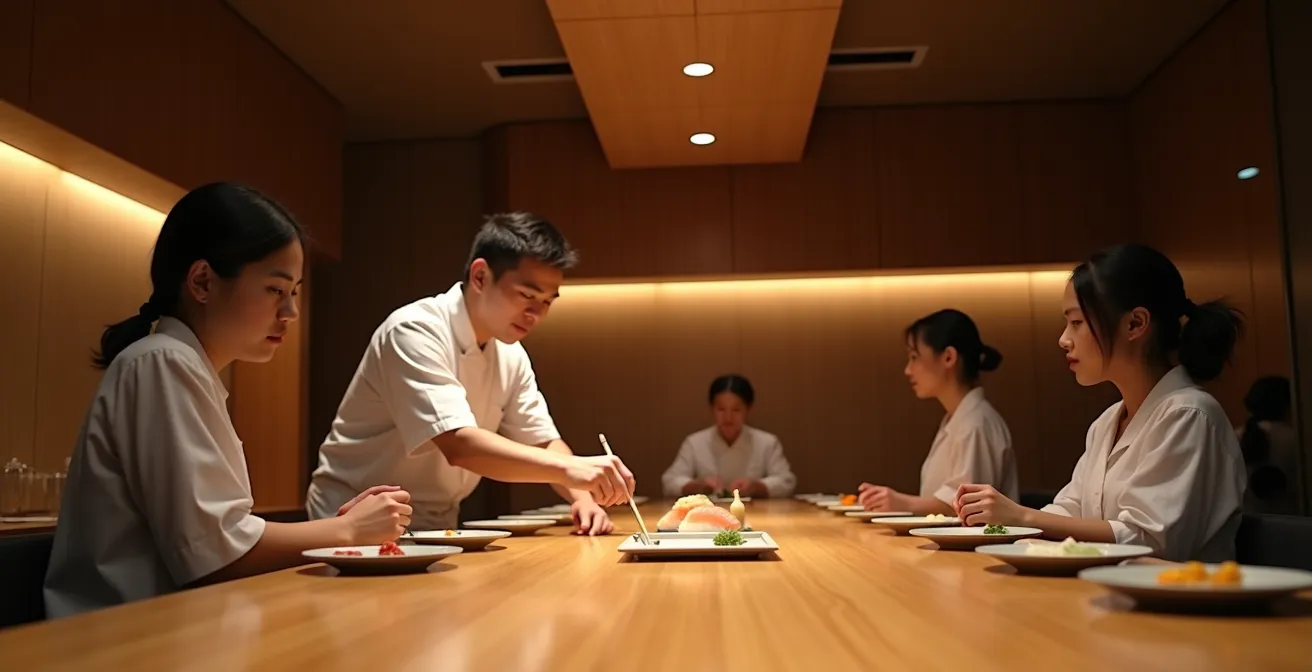
A uniquely American factor that alters the omakase economic model is the culture of tipping. In Japan, tipping is not customary; service staff are paid a full, stable salary, and the cost of their labor is built directly into the menu price. In the United States, the traditional restaurant model relies on tips to supplement wages for both front-of-house and, in some cases, back-of-house staff. This introduces a different financial structure for a high-end omakase restaurant.
The theatrical, highly personal service at an omakase counter, as seen in the image below, is a central part of the value proposition, and in the US, such service is expected to be rewarded with a significant gratuity.
While many top-tier omakase establishments in NYC have moved to a “service included” or “hospitality included” model to align with Japanese customs and provide their staff with stable salaries, this does not eliminate the cost. Instead, it formalizes it. The restaurant calculates the equivalent of a 20-25% gratuity and bakes it directly into the base price of the omakase menu. So, a $320 menu might become $400 to cover service. For the diner, the final out-of-pocket cost is the same, but the menu price appears higher.
For restaurants that still follow a traditional tipping model, the high base price of the meal means that a standard 20% tip can add $60-$80 per person to the final bill. This cultural and economic difference in how service labor is compensated is a significant, though often overlooked, reason for the perceived price gap between New York and Tokyo. In one city, the full cost of service is transparently included in the price; in the other, it appears as an additional charge at the end of the meal.
The ‘Market Price’ Trap: How to Avoid Surprise Bills at the End?
For diners, one of the most stressful aspects of high-end dining can be the ambiguity of “market price” items. These are typically daily specials or ultra-premium ingredients offered as supplements to the base omakase menu. While they represent an opportunity to taste something truly rare, they can also lead to a significantly higher bill than anticipated. The price volatility in this category is extreme; as one market report highlights, a restaurant like Ash Room at Kono saw its price jump from $295 to $495 in May 2022, illustrating how quickly the high-end market can escalate.
The “market price” is determined by the same factors that drive the base menu cost—scarcity, import logistics, and demand—but applied to a much smaller, more volatile supply. An offering of rare Hokkaido uni or a special cut of aged tuna is a classic example. The chef offers it because it’s exceptional on that particular day, but its cost can be double or triple that of a standard piece.
Managing these potential costs without sacrificing the experience requires a proactive approach from the diner. It is not considered rude to inquire about the price of supplemental items; in fact, it is fiscally prudent. A simple, “That sounds wonderful, what is the price for that supplement?” allows you to make an informed decision. By understanding the cost structure, diners can better navigate the menu and control the final check.
Action Plan: Strategies to Control Omakase Costs
- Research Pricing: Before booking, verify the restaurant’s base omakase price online, as most high-end NYC spots now list it.
- Set a Beverage Budget: Clearly communicate your budget to the sommelier for sake or wine pairings before they begin pouring.
- Inquire About Market Price: When offered a supplemental item, politely ask for the specific price or a price range upfront.
- Consider Lunch Service: Opt for a lunch omakase, which is often 50-70% less expensive than the dinner service for a comparable quality level.
- Seek “Service Included” Venues: Choose restaurants that include hospitality in the price to avoid ambiguity and the stress of calculating a large tip.
Key Takeaways
- The price of omakase is a direct function of a global supply chain, with cold-chain logistics for items like tuna being a primary cost driver.
- Securing elite chef talent in a high-cost city like New York requires significant investment in salaries and visa sponsorships, which is passed on to the customer.
- American service culture, particularly tipping, fundamentally alters the pricing model compared to Japan, either by inflating the final bill or being baked into a higher menu price.
Why Spending $10 More on Nori Changes the Dish More Than Expensive Rice?
While macro-cost drivers like tuna and rent explain the bulk of the price, the philosophy of high-end omakase is also defined by an obsession with marginal gains from seemingly minor components. A master itamae understands that the perceived quality of a dish is not just about the most expensive ingredient, but about the perfection of every element. This is why significant attention and budget are allocated to items like nori (seaweed), wasabi, and vinegar for the rice.
For example, a chef might choose to spend a premium on high-grade, single-origin nori that is crisper, more aromatic, and has a deeper umami flavor. This small upgrade can dramatically change the texture and taste of a hand roll or a piece of gunkanmaki, providing a more significant impact on the final bite than a marginally more expensive grade of rice. The rice itself, however, is far from an afterthought. As noted by one guide, Chef Takuya Kubo of Sushi Ginza Onodera exemplifies this focus on detail:
Kubo also uses Yukitsubaki rice, a premium koshihikari rice from Niigata, as well as two different types of red vinegar (akazu), one dark and one light.
– Chef Takuya Kubo, Sushi Ginza Onodera New York
This use of multiple vinegars—blended to perfectly complement different types of fish—demonstrates an extraordinary level of detail. The cost of these premium vinegars, specialty rices, and artisanal nori accumulates. While each individual component may only add a few dollars to the overall cost of goods sold (COGS), their combined effect is essential to creating a dish that justifies a three-figure price tag. This philosophy of compounding quality is central to the economics of luxury dining: the final price reflects not one expensive item, but the sum of dozens of small, deliberate, and costly decisions.
How Sushi Evolved into Refined Gastronomy Worth $300 Per Person?
The high price of omakase in New York cannot be understood solely through a cost-component analysis. It must also be viewed within the cultural and historical context of sushi’s transformation from a form of street food in Japan to a globally recognized symbol of refined gastronomy. This evolution created the market conditions where a restaurant like Masa can set a benchmark with a price of $950 per person (gratuity included), establishing a ceiling for what the luxury market will bear.
A key part of this transformation was the elevation of the sushi counter into a theatrical stage. The experience became about more than just food; it became a performance rooted in the Japanese concept of omotenashi, or anticipatory hospitality. As one guide explains, this concept is foundational: “It’s not just about the food, but about having service that’s practically too perfect to even notice. Every little detail counts, from the carefully selected serving vessels for every course to the chef’s meticulous pacing of your meal.” This turns the restaurant into an immersive environment, creating a sense of transportation.
This transformation from a service counter to a stage is what allows diners to feel as though they have left the city behind. It is this feeling of complete immersion that top restaurants sell. As one reviewer eloquently put it when describing the experience at an elite NYC establishment:
It’s a transformative feeling; step in from the United States, emerge in Japan.
– The Sushi Legend, Review of Sushi Noz Upper East Side
This “experience” is not an intangible bonus; it is a meticulously designed and expensive-to-produce asset. The cost of the minimalist interior design, the custom-made ceramics, the hinoki wood counter, and the flawless service are all factored into the price. You are paying not just for dinner, but for a ticket to a two-hour immersive performance, an economic reality that provides the final justification for the high price.
Ultimately, the 40% premium on New York omakase is the sum of global logistics, a competitive talent market, and the inescapable cost of prime urban real estate. Understanding this financial reality transforms the shock of the bill into an appreciation for the complex economic engine required to deliver this level of culinary art.