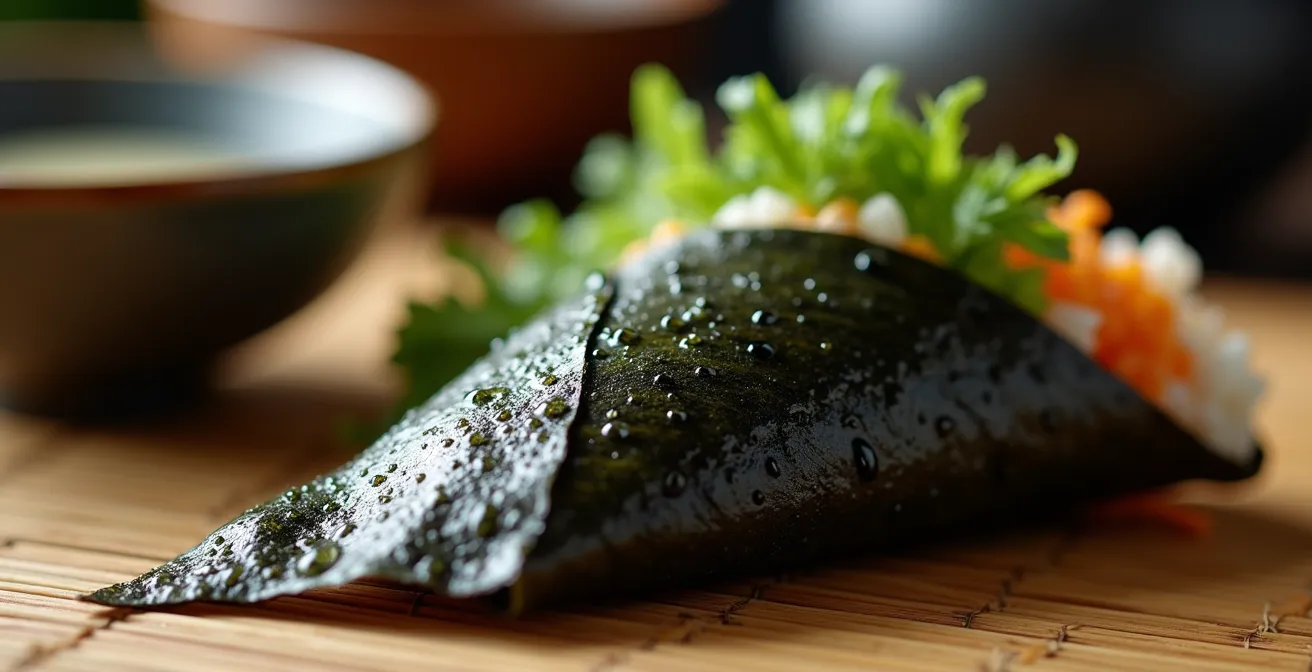
The dreaded soggy temaki cone is not a random event; it’s a rapid, predictable failure of physics caused by uncontrolled moisture migration from the rice and the air.
- Hot rice releases steam, which instantly compromises the nori’s structural integrity, increasing moisture absorption by 300%.
- Ambient humidity attacks the nori’s hygroscopic structure even before assembly, making crispness impossible to maintain.
Recommendation: Victory lies not in eating faster, but in deploying a multi-layered defense system: control rice temperature, use physical barriers, and manage the environment from storage to assembly.
There is no greater disappointment for a temaki party host than watching a guest bite into a hand roll, only to be met with a silent, leathery chew. You’ve sourced beautiful fish, perfected the sushi rice, and arranged a vibrant platter of fillings. Yet, within seconds of assembly, the star of the show—the crisp, crackling nori—undergoes a catastrophic structural failure, turning into a damp, unappealing wrapper. The common advice to “eat it immediately” is a frustratingly inadequate solution when you’re trying to serve a group.
The problem is often misdiagnosed. It’s not just about speed; it’s about physics. The enemy is moisture, and it wages a two-front war. The first assault comes from within: hot, steamy rice releasing water vapor that directly attacks the nori. The second front is the air itself; nori is intensely hygroscopic, meaning it aggressively absorbs ambient humidity from the moment the package is opened. To serve consistently crispy temaki, you must stop thinking like a cook and start thinking like a texture physicist, actively managing moisture at every stage of the process.
This isn’t about a single magic trick. It’s about implementing a system of countermeasures. We will dissect the science of moisture migration and arm you with a strategic arsenal to defend your nori’s integrity. From selecting the right grade of seaweed and creating physical barriers to precise thermal regulation of your rice and a disciplined assembly timeline, you will learn how to win the war against sogginess and ensure every single hand roll served is a masterpiece of texture.
This guide provides a complete strategic framework, breaking down each critical control point in the battle for crispness. Follow this roadmap to transform your temaki from a source of anxiety into a resounding success.
Summary: A Host’s Battle Plan for Perfectly Crisp Temaki
- Gold vs. Blue Grade Nori: Which Thickness Withstands Moisture Longer?
- How to Use a Shiso Leaf Barrier to Keep Rice Moisture Away From Nori?
- When Should You Toast the Nori Relative to Guest Arrival?
- The Temperature Mistake That Steams Your Nori From the Inside Out
- How to Reseal Nori Packages to Prevent Humidity Damage in 24 Hours?
- When Should You Assemble the Roll to Keep the Nori Crisp?
- How to Use a Wooden Ohitsu to Regulate Rice Humidity and Heat?
- How to Host a DIY Temaki Cone Party for 10 Guests on a Budget?
Gold vs. Blue Grade Nori: Which Thickness Withstands Moisture Longer?
The first line of defense in your fight against moisture is the nori itself. Not all seaweed is created equal. The grading system—often denoted by colors like gold, silver, or blue—directly correlates to the sheet’s thickness, density, and ultimately, its resistance to moisture. Gold Grade nori is the superior choice for temaki, not for its flavor alone, but for its physical structure. It is thicker, harvested from the first picking of the season, and possesses a more tightly woven cellular structure. This density creates a more robust physical barrier against the onslaught of steam from the rice.
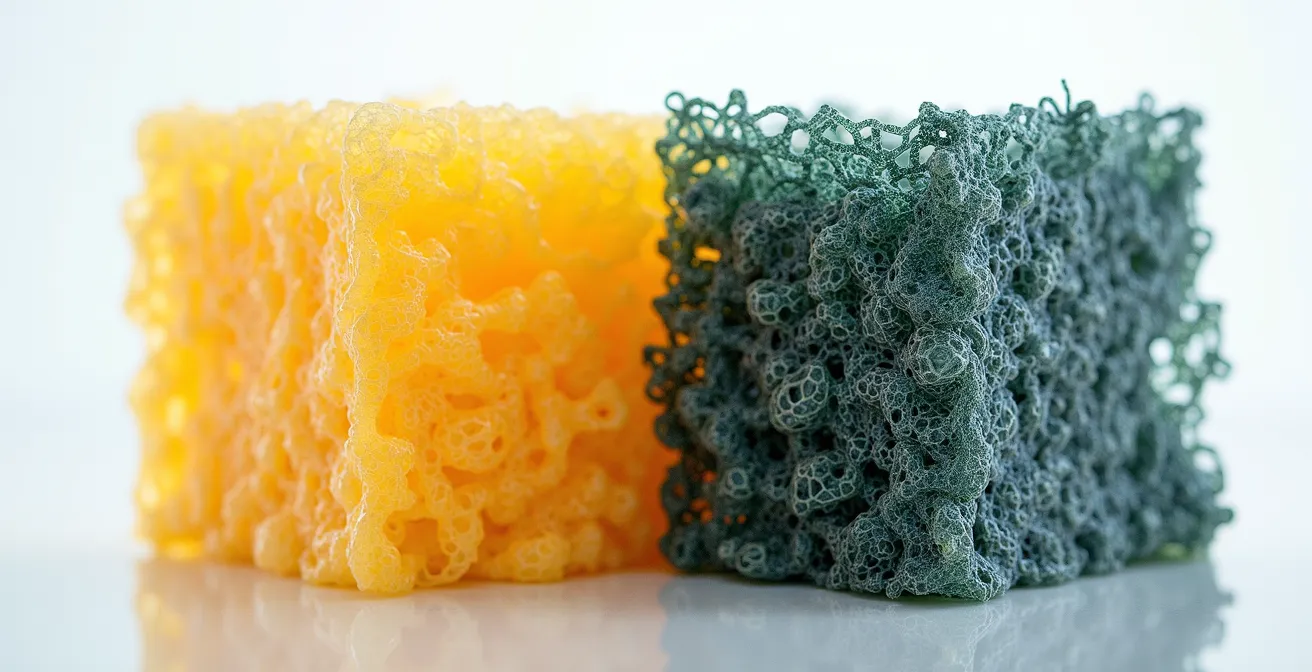
In contrast, lower grades like Blue or Green are thinner and more porous. While perfectly suitable for sushi rolls (makizushi) that are consumed quickly, they lack the structural integrity to withstand the high-moisture, high-heat environment of a hand roll for more than a few seconds. When choosing nori, think of it as selecting armor. A thicker, denser sheet simply buys you more time before moisture can penetrate and break down its crisp texture. You can often feel the difference by hand; premium nori feels more substantial and less brittle. Don’t compromise on this foundational element.
Your Action Plan: The At-Home Snap Test for Nori Quality
- Hold a nori sheet vertically and listen for a sharp, high-pitched ‘snap’ when breaking it; this indicates premium quality and low moisture content.
- Check for a uniform, deep black color throughout the sheet. Greenish or purplish tints are signs of lower, more porous grades.
- Test the thickness by holding the sheet up to a light source. A premium Gold Grade sheet will show minimal light penetration due to its density.
- Feel the texture with your fingertips. High-quality nori for temaki should feel dry and slightly rough, never smooth, oily, or flimsy.
- Confront the existing nori in your pantry. Perform the snap test. If it bends before it breaks, it has already absorbed too much humidity to be salvaged for a crispy temaki experience.
Investing in Gold Grade nori is the single most important upfront decision you can make. It provides the foundational resilience upon which all other techniques will build, giving you a crucial head start in the race against sogginess.
How to Use a Shiso Leaf Barrier to Keep Rice Moisture Away From Nori?
Once you have your high-quality nori, the next strategic move is to create a physical barrier between it and its primary enemy: the moist rice. Even perfectly cooled rice contains residual moisture that immediately begins migrating into the dry, hygroscopic nori upon contact. A simple, elegant, and traditional solution is to use a barrier leaf. A shiso leaf is the classic choice, prized not only for its moisture-blocking properties but also for its refreshing, minty-basil flavor that complements the seafood.
The technique is straightforward: place the shiso leaf on the nori first, then spread the rice on top of the leaf. The natural oils and waxy surface of the shiso act as a hydrophobic layer, physically repelling water molecules and significantly slowing down the process of the nori becoming saturated. This simple step can more than double the crispness window. For a more advanced approach, a professional technique involves a dual barrier. A study by The Japanese Pantry demonstrated that layering shiso with crispy tempura flakes (tenkasu) can extend nori crispness to over three minutes, as the flakes absorb excess moisture while the shiso repels it.
The following table, based on extensive testing by home cooks and chefs, quantifies the dramatic impact of using a barrier. It clearly shows that leaving the nori unprotected is a recipe for rapid failure, while simple additions can create a powerful defense.
| Barrier Type | Crispness Duration | Flavor Impact | Difficulty |
|---|---|---|---|
| No barrier | 30-45 seconds | Neutral | Easy |
| Shiso leaf only | 90-120 seconds | Herbal, refreshing | Easy |
| Shiso + tempura flakes | 3-4 minutes | Herbal + crunchy | Moderate |
| Thin egg crepe | 2-3 minutes | Sweet, rich | Advanced |
| Kewpie mayo smear | 2-3 minutes | Creamy, tangy | Easy |
While other options like a thin layer of Kewpie mayonnaise or a piece of lettuce work, the shiso leaf remains the champion for its combination of effectiveness, flavor, and ease of use. It is a small step that yields a disproportionately large return in textural quality.
When Should You Toast the Nori Relative to Guest Arrival?
Toasting nori is a non-negotiable step. It drives out any ambient moisture the sheet has already absorbed and awakens its nutty, umami flavor. However, the critical variable that most hosts get wrong is not *if* but *when* to toast. Nori’s hygroscopic nature means it begins reabsorbing moisture from the air almost immediately after cooling. Toasting all your nori an hour before the party starts is a wasted effort; it will be soft again by the time guests assemble their first roll.
The only effective method for a party setting is a staggered toasting workflow. Think of yourself as the manager of a just-in-time production line. The goal is to minimize the time between toasting and consumption. As Sylvia Wakana of the “Temaki Sushi Guide” notes, “The nori can get soggy quickly…Soggy nori can make temaki hard to eat so you want to eat the hand roll immediately after making it.” Your job as a host is to make this possible systemically.
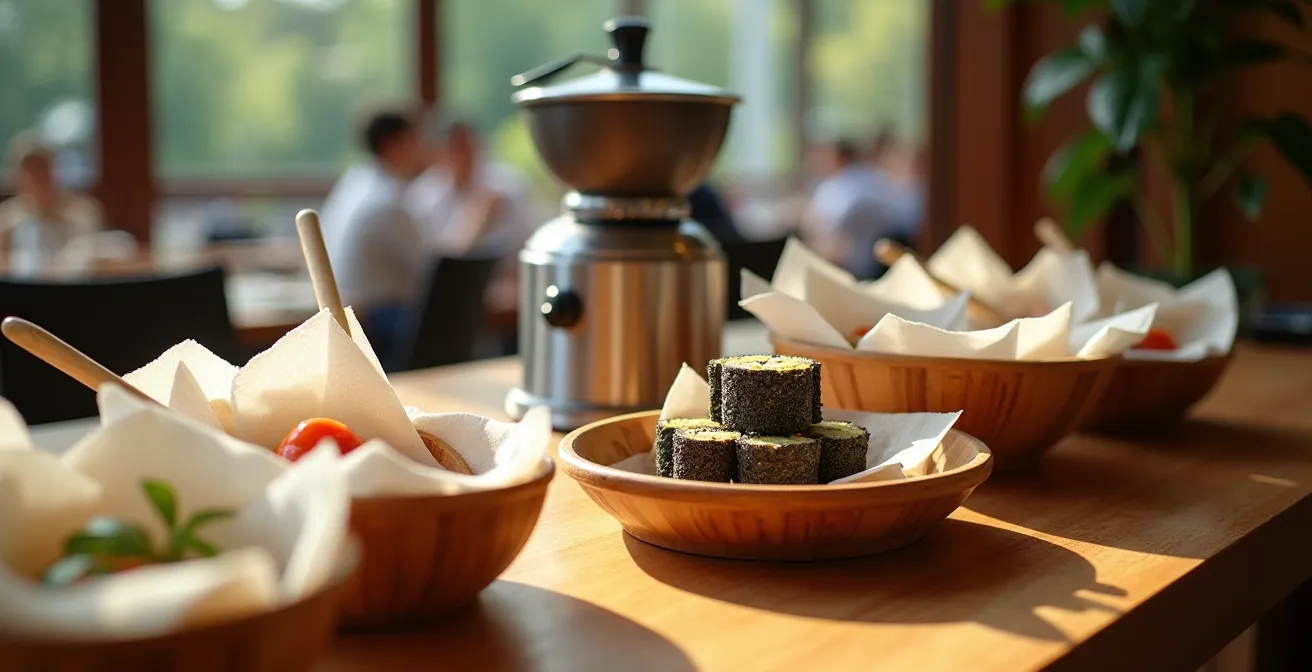
Set up a dedicated toasting station with a small gas burner or a dry skillet. Toast the first small batch just as guests are arriving and place them in a bamboo basket lined with a paper towel to absorb any residual steam. As that batch is consumed, you or a designated helper toasts the next. This ensures a constant supply of perfectly crisp, warm nori. It transforms the act of toasting from a prep task into an interactive, ongoing part of the party experience.
- 15 minutes before guests arrive: Set up your toasting station with a gas burner or a dry pan, along with tongs and bamboo baskets lined with paper towels.
- Upon guest arrival: Toast your first batch of 5-6 sheets, passing them over the flame until fragrant and slightly greener. Store them in the basket.
- Every 15-20 minutes: As the first batch dwindles, toast a fresh batch to replenish the supply. This ensures no one is ever using a sheet that has been sitting out for too long.
- Create a rotation system: If using multiple baskets, discreetly mark them to ensure the oldest toasted batch is always used first.
- Maintain an emergency backup: Keep a pack of untoasted sheets ready for immediate toasting if demand suddenly surges.
This dynamic approach is the only way to guarantee that every single hand roll, from the first to the last, starts with a nori sheet at its absolute peak of crispness.
The Temperature Mistake That Steams Your Nori From the Inside Out
The most violent and rapid assault on nori’s integrity comes from a single, often overlooked source: hot rice. Spreading steaming rice directly onto a sheet of nori is the equivalent of placing it in a sauna. The heat releases a concentrated blast of water vapor that instantly permeates the nori’s structure, causing it to wilt. This isn’t a slow process; it’s a catastrophic failure that occurs in seconds. The science is definitive: a scientific analysis shows that rice temperature above 40°C (104°F) creates condensation that increases nori moisture absorption by 300% within 60 seconds.
The ideal temperature for sushi rice in temaki is just above body temperature, around 37°C (98.6°F). At this temperature, the rice is still pleasantly warm but is no longer emitting a significant amount of steam. Achieving this precise temperature requires an active cooling process immediately after the rice is cooked and seasoned. Simply letting it sit is not enough, as the trapped heat will continue to generate moisture.
The traditional method involves a *hangiri* (a wooden sushi oke) and a *shamoji* (paddle), but the principles can be replicated with a wide, non-metallic bowl. The key is to spread the rice to maximize surface area and to use a cutting-and-folding motion while fanning it. This encourages rapid evaporation of surface moisture rather than trapping it. You must cool the rice with a sense of urgency, understanding that every degree above the target temperature is a direct threat to the final texture of your temaki.
Checklist: Sushi Chef’s Fan & Fold Cooling Technique
- Immediately after cooking, transfer the hot rice to a wooden hangiri or a wide, shallow bowl to maximize surface area for cooling.
- While the rice is still hot, pour the seasoned sushi vinegar over a shamoji (rice paddle) to distribute it evenly without oversaturating any one area.
- Use the shamoji to “cut” through the rice in a slicing motion, then gently fold the rice over. Do not stir or mash, which would crush the grains and release starch.
- Simultaneously, use a fan (a dedicated uchiwa or even a piece of cardboard) to blow cool air across the surface of the rice as you fold. This accelerates evaporation.
- Continue this fan-and-fold process for 3-5 minutes, or until the rice no longer steams and the surface grains appear glossy, not wet. The target temperature is just above body temperature, feeling barely warm to the touch.
Ignoring this step is the most common reason for soggy temaki. By mastering rice temperature control, you neutralize the most potent weapon in moisture’s arsenal.
How to Reseal Nori Packages to Prevent Humidity Damage in 24 Hours?
The battle against moisture begins long before the first hand roll is assembled. From the moment you break the seal on a package of nori, it starts a relentless process of absorbing humidity from the surrounding air. A bulldog clip or simply folding over the bag is an entirely inadequate defense. Research on nori storage has shown the dramatic speed of this degradation. One study revealed that while commercial nori starts at a crisp 9.73% moisture content, exposure to ambient humidity can cause this to skyrocket to over 20% within just 24 hours, rendering it soft and leathery.
The same study found that using a simple zip-lock bag was not enough to halt this process, allowing moisture levels to climb to 15%. The only truly effective methods were those that created an airtight seal. Vacuum-sealing was the gold standard, maintaining optimal moisture levels for over a week. For home use, the best practice is to place the leftover nori sheets back in their original bag, press out as much air as possible, and then place that bag inside a larger, high-quality, airtight zip-top bag or container.
Crucially, you must always include the silica gel desiccant packet that came with the nori. This small packet is your active soldier in the fight against trapped moisture, continuously absorbing any water vapor inside the container. If you’ve lost the original, they are widely available for purchase online. Storing the container in a cool, dark pantry is sufficient; refrigeration is not necessary and can sometimes introduce condensation if not handled properly. If despite your best efforts, your nori has softened, there is an emergency revival technique.
- Preheat your oven to its absolute lowest setting, typically around 150°F or 65°C.
- Place a wire cooling rack on top of a baking sheet.
- Arrange the softened nori sheets in a single, non-overlapping layer on the wire rack.
- Bake for just 2-3 minutes with the oven door propped slightly ajar to allow moisture to escape.
- Remove them immediately and let them cool on the rack for 30 seconds. They will crisp up as they cool.
- Test with a snap. If still soft, repeat for another minute. Use them immediately or transfer to a truly airtight container with a desiccant.
Treat your nori like the delicate, moisture-sensitive ingredient it is. Proper storage is the only way to ensure the sheets you start with are in a defensible, pristine condition.
When Should You Assemble the Roll to Keep the Nori Crisp?
You’ve controlled every variable: you have premium nori, a barrier leaf, perfectly cooled rice, and a just-in-time toasting system. Now comes the final, frantic sprint: assembly. This is the moment of direct contact, where the clock starts ticking with merciless speed. There is no way to hold a fully assembled temaki for later; it is a creature of the moment. As FeedMi Recipes succinctly puts it, “It is important to roll as quickly as possible and equally important to eat as you go.”
The goal is a sub-30-second assembly timeline. This requires having all your ingredients prepped and arranged for maximum efficiency—a concept known in professional kitchens as *mise en place*. Your fillings should be cut, your sauces in squeeze bottles, and your rice perfectly regulated in its *ohitsu*. The process should be a fluid, practiced motion, not a hesitant, creative exploration. Speed and efficiency at this final stage are paramount.
The key is to minimize the contact time between the wet ingredients (rice, fish, sauces) and the nori. This means adding the driest ingredients first to act as a final, small-scale barrier. A disciplined, timed approach transforms assembly from a chaotic scramble into a controlled, repeatable process that guarantees a perfect textural experience for your guest.
- 0-5 seconds: Place the shiny-side-down nori sheet on your flat palm. Immediately scoop a small ball of rice (about 2-3 tablespoons) and place it on the top left corner.
- 5-15 seconds: Quickly spread the rice in a diagonal square, leaving a clear border on the top and right edges. Do not press down or compact the rice; use a light touch.
- 15-20 seconds: Immediately add your driest ingredients, like cucumber sticks or avocado slices, directly onto the rice. They act as a final buffer.
- 20-25 seconds: Place your wettest ingredients, like the fish and any sauces, on top of the dry ingredients, not directly on the rice.
- 25-30 seconds: Lift the bottom left corner of the nori, rolling it up and over the fillings towards the top right corner to form a cone. Use a single grain of rice to seal the edge, and serve immediately. The roll must be eaten within 60 seconds for optimal crispness.
This disciplined timeline is not about rushing your guests; it’s about respecting the physics of the ingredients and delivering the hand roll at its absolute peak of textural perfection.
How to Use a Wooden Ohitsu to Regulate Rice Humidity and Heat?
While active fanning cools the rice initially, maintaining its perfect temperature and moisture level throughout a multi-hour party is another challenge. Leaving it in the rice cooker’s “keep warm” mode is a fatal error; this function gently steams the rice, making it progressively wetter and hotter—a death sentence for nori. Leaving it at room temperature causes it to become cold, hard, and unpalatable. The traditional, and scientifically ideal, solution is the wooden *ohitsu*.
An *ohitsu* is a traditional Japanese container made from unfinished cypress or cedar wood. Its brilliance lies in its passive regulation properties. The uncoated wood absorbs any excess moisture that evaporates from the rice, preventing it from becoming gummy or wet. Simultaneously, the wood’s natural insulating properties keep the rice at the perfect, slightly warm temperature for hours. It is a masterpiece of material science, creating the ideal microclimate for sushi rice.
For hosts on a budget, an expensive *ohitsu* isn’t the only option. The principles can be replicated. A study by Just One Cookbook tested a DIY method using a simple wooden salad bowl lined with a *fukin* (a clean, damp, but thoroughly wrung-out kitchen cloth). This setup successfully maintained the rice at the optimal 37°C for two hours. In contrast, rice left on ‘keep warm’ became 40% wetter and completely unsuitable for temaki in the same period. The data below illustrates why the storage vessel for your rice is a critical piece of equipment.
| Storage Method | Temperature | Moisture Level | Suitability for Temaki |
|---|---|---|---|
| Wooden Ohitsu | 35-38°C | Optimal | Excellent |
| DIY Bowl + Cloth | 34-37°C | Good | Very Good |
| Rice Cooker ‘Keep Warm’ | 60-65°C | Too Wet | Poor |
| Room Temperature Bowl | 20-25°C | Drying Out | Fair |
Whether using a traditional *ohitsu* or a clever DIY alternative, taking active control of your rice’s environment is an advanced technique that separates an anxious host from a confident one, ensuring the core ingredient remains perfect from start to finish.
Key takeaways
- The primary cause of soggy nori is moisture migration from hot rice and ambient air, a problem of physics that requires a systematic defense.
- Success depends on a multi-layered strategy: using thick Gold Grade nori, creating a physical barrier like a shiso leaf, and precise temperature control of the rice.
- Timing is critical. Nori must be toasted in staggered batches during the party, and final assembly must be completed in under 30 seconds to preserve crispness.
How to Host a DIY Temaki Cone Party for 10 Guests on a Budget?
Armed with the science of textural preservation, you can now host a fantastic DIY temaki party without breaking the bank. The key to a budget-friendly event is focusing on a curated selection of low-moisture, high-impact fillings and empowering your guests to “roll as they go.” This interactive format is not only fun but is also the practical application of our core principle: minimizing the time between assembly and consumption. As the guide from Hungry Huy advises, “Make a hand roll, and finish eating it before you start another. This prevents pre-making multiple cones that sit and get soggy.”
Instead of expensive sashimi-grade tuna, opt for more affordable and equally delicious proteins. Well-drained canned spicy tuna, imitation crab sticks (kanikama), and homemade tamagoyaki (Japanese rolled omelet) are excellent low-cost, low-moisture options. For vegetables, focus on crunchy, non-watery items. Cucumbers and carrots cut into matchsticks, creamy avocado, and radish sprouts provide great texture and flavor without releasing excess liquid that would compromise the nori.
The setup is part of the fun. Arrange all your fillings on a large central platter. Have your perfectly regulated rice in its *ohitsu* or DIY bowl, and your just-toasted nori in a bamboo basket. Small bowls of water for hand-wetting are also essential. This “station” approach encourages guests to experiment and assemble their own creations, ensuring every single roll is eaten at its absolute peak. A successful, budget-friendly temaki party is the ultimate expression of your mastery over moisture.
- Proteins: Opt for 2 cans of high-quality spicy tuna (drained thoroughly), 1 lb of imitation crab, and 4 eggs to make a simple tamagoyaki.
- Vegetables: Choose 2 large cucumbers, 3 avocados, a pack of radish sprouts, and a few large carrots. Julienne the cucumbers and carrots for a crunchy texture.
- Rice & Nori: 3 cups of dry short-grain sushi rice will be ample. A pack of 20 Gold Grade nori sheets, cut in half, will yield 40 potential hand rolls.
- Condiments: A small bottle of Kewpie mayo, some sriracha, and a shaker of furikake seasoning provide huge flavor for a low cost.
- Station Supplies: You’ll need paper towels for your toasting station, a bamboo basket for the warm nori, and small bowls of water for guests to wet their hands. The total estimated cost for this setup for 10 guests is a remarkable $35-45.
By applying these strategic principles, you transform from a frantic cook into a confident host, orchestrating a delicious, interactive, and perfectly crispy temaki experience for everyone.