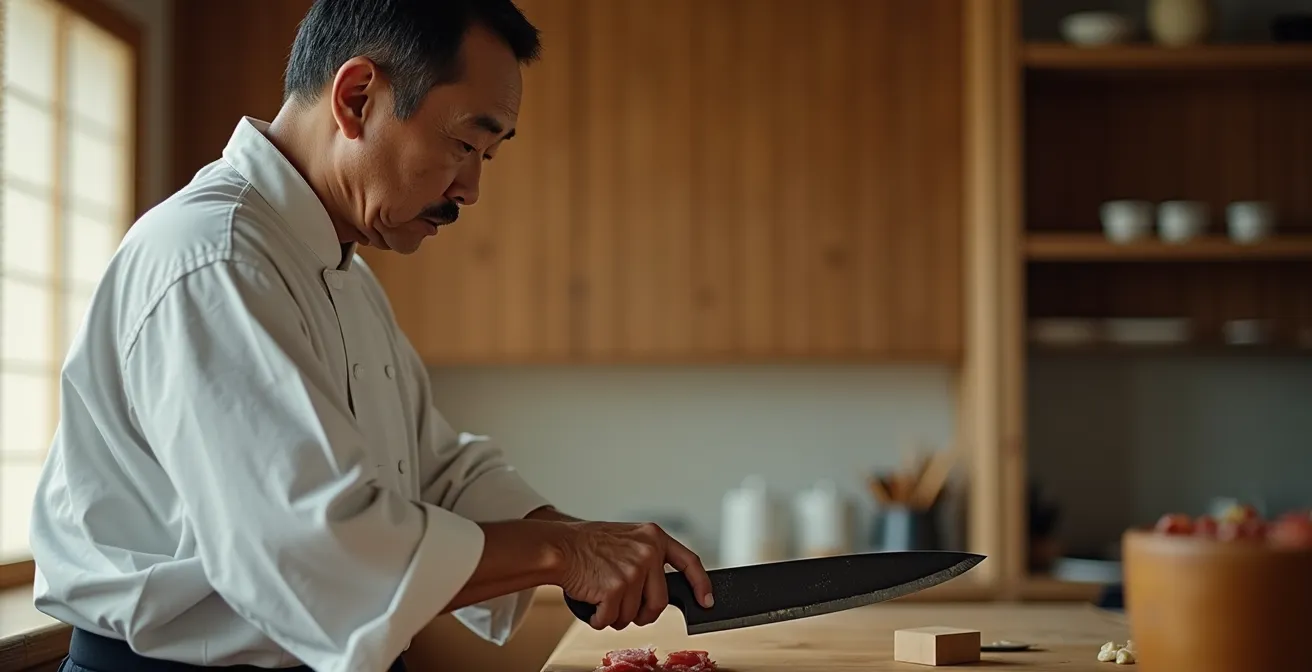
Contrary to the popular Western belief that Japanese cuisine is solely obsessed with ‘freshness,’ its true discipline lies in a much deeper philosophy forged in the Edo period. This is not a world of sterile rules but a dynamic interplay of science, like the flavor-enhancing aging of fish (jukusei), and a profound artisan spirit (shokunin-kishitsu). The meticulous practices seen in a sushi kitchen are a living dialogue with history, designed to achieve the pinnacle of flavor, not just the illusion of newness.
We look at the Japanese kitchen with a sense of awe, seeing a world of uncompromising standards and silent, focused discipline. From the razor-sharp knives to the minimalist presentation, every element seems to whisper of a tradition steeped in perfection. For many in the West, this discipline is distilled into a single, seemingly obvious concept: the absolute, unwavering pursuit of freshness. We are told that the best sushi is made with fish practically still swimming, that the ultimate virtue is proximity to the sea.
This common understanding, however, is a fundamental misinterpretation. While quality is paramount, the obsession with ‘immediacy’ is a Western projection. The true discipline of the Japanese culinary arts, particularly in the world of sushi, is far more complex and intellectually rigorous. It is a system built not on the simple metric of ‘new,’ but on a deep understanding of transformation, history, and aesthetics. The real craft lies in controlling time, not just defeating it.
But if the key isn’t just ‘freshness,’ then what is it? The answer lies in a collection of philosophies and scientific practices that crystalized during Japan’s vibrant Edo period (1603-1868). This article will dismantle the prevailing myths and explore the true pillars of Japanese culinary discipline. We will delve into the counter-intuitive science of aging fish, the profound social and spiritual obligations of the artisan, and the specific historical innovations that define the sushi we eat today.
By exploring these core tenets, we can move beyond the surface-level appreciation of a “fresh” meal and begin to understand the deep, intentional philosophy embedded in every single grain of rice and slice of fish. This guide will walk you through the historical, philosophical, and aesthetic principles that truly govern the Japanese kitchen, revealing a world far richer than common platitudes suggest.
Summary: The Real Discipline of the Japanese Kitchen
- Why the Myth That Sushi Must Always Be Fresh Is Historically Inaccurate?
- How to Apply the Shokunin Spirit to Your Daily Cooking Routine?
- Osaka vs. Tokyo Style: Which Traditional Approach Suits Your Palate?
- The Historical Error Most Tourists Make When Describing Sushi Origins
- When to Expect Specific Fish Varieties According to the Traditional 24 Seasons?
- Why Doesn’t the Waiter Ask ‘Is Everything Okay’ Every 5 Minutes in Japan?
- Why Do Japanese Chefs Always Serve Sashimi Slices in Odd Numbers?
- What Edo Period Innovations Still Define Modern Sushi Making Today?
Why the Myth That Sushi Must Always Be Fresh Is Historically Inaccurate?
The single most pervasive myth about sushi is that its quality is directly proportional to its freshness. The romantic image of a fish pulled from the ocean and served moments later is powerful, but it is fundamentally at odds with the science and history of sushi. The truth is far more complex and interesting: the pinnacle of flavor is often achieved through a controlled process of aging known as jukusei.
Immediately after a fish is caught, its muscles enter rigor mortis, becoming stiff and flavorless. The components that create the savory, sought-after taste of umami have not yet developed. As Sushi University Research explains, true Edomae (Edo-style) technique involves a period of maturation. In their words, “the fish used in sushi is generally salted or soaked in vinegar then matured for several days while the umami Inosinic acid component increases.” For certain fish like tuna, this process can extend for weeks, transforming the flesh into something exceptionally tender and deeply flavorful.
This is not decay; it is a highly controlled enzymatic breakdown. The process often begins with the ikejime technique, a swift and humane method of dispatching the fish that minimizes stress and preserves the flesh’s quality. Over time, enzymes naturally present in the fish break down large, flavorless molecules into smaller, savory ones, most notably glutamic and inosinic acids—the very building blocks of umami. For instance, an analysis from The Japanese Food Lab notes that white-fleshed fish like flounder and sea bream reach their peak after 3 to 5 days of aging.
This practice is a direct refutation of the ‘freshness’ cult. The discipline lies not in a race against the clock, but in a chef’s profound understanding of biochemistry and his ability to guide each specific fish to its absolute peak of flavor. This transforms the chef from a mere slicer into a true custodian of taste.
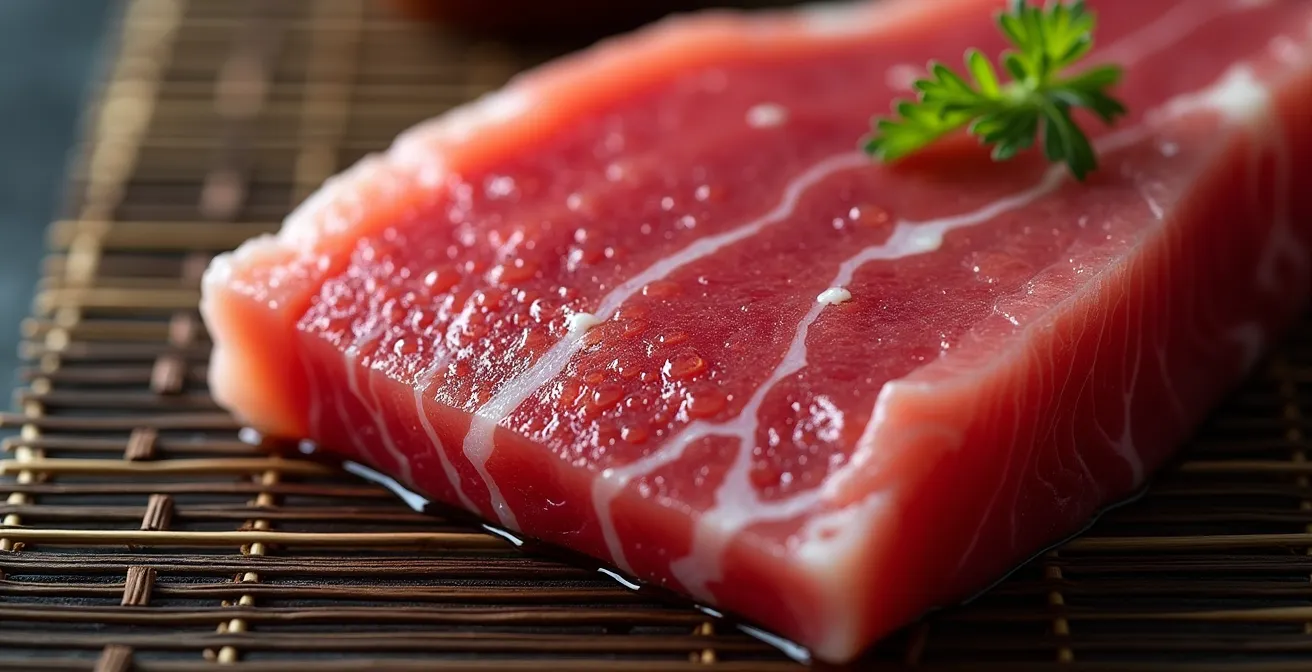
The intricate marbling and deep color seen in aged tuna are visual testaments to this transformative process. What appears to be simply ‘old’ fish is, in fact, a carefully crafted ingredient, brought to its zenith of flavor through patience and scientific understanding.
How to Apply the Shokunin Spirit to Your Daily Cooking Routine?
Behind the technical mastery of Japanese cuisine lies a guiding philosophy: shokunin-kishitsu, or the artisan spirit. To a Western ear, *shokunin* is often translated simply as “craftsman,” but this fails to capture its depth. It is not merely about possessing a high level of skill; it is a spiritual and social disposition. As Japanese woodworking master Tasio Odate articulated, a shokunin has a “social obligation to work his/her best for the general welfare of the people.” It is a commitment to excellence for the benefit of others.
This philosophy demands a lifetime of dedication to a single craft, constantly seeking improvement not for fame or fortune, but for the sake of the work itself. It is a mindset that prioritizes deep, incremental mastery over fleeting novelty. This spirit is visible in every corner of Japanese culinary tradition, from the swordsmith-turned-knife-maker to the chef who dedicates a decade to perfecting rice.
Jiro Ono’s 70-Year Dedication to Sushi Mastery
Perhaps the most famous modern embodiment of the shokunin spirit is Jiro Ono. As documented in studies of Japanese craftsmanship, his apprentices spend years just learning to cook rice perfectly before being allowed to handle fish. This seemingly arduous process is the essence of *shokunin*: mastering the absolute fundamentals through endless, mindful repetition. Jiro’s decades-long pursuit of the perfect piece of sushi, regardless of the accolades it brought him, is a pure expression of this philosophy—the work itself is the reward.
While most of us will not dedicate 70 years to a single dish, the core principles of the shokunin spirit can be profoundly transformative in our own kitchens. It is about shifting focus from the outcome (a quick meal) to the process (the act of cooking). It means treating tools with respect, understanding ingredients deeply, and finding satisfaction in the small, repeated actions that build skill over time.
Action Plan: Applying Shokunin Principles to Home Cooking
- Start with one technique: Choose a single fundamental skill, like knife work or rice cooking, and practice it mindfully for at least one month.
- Document your progress: Keep a cooking journal, noting what you learned from each attempt and identifying areas for improvement. This is the heart of kaizen (incremental improvement).
- Embrace tool monogamy: Select one good knife and strive to master all tasks with it rather than accumulating a drawer full of specialized gadgets.
- Practice mise en place as meditation: Treat the preparation of all ingredients as a vital ritual. Mindfully wash, chop, and arrange everything before cooking begins.
- Focus on incremental improvement: Aim to make your process just 1% better each day. Don’t seek dramatic breakthroughs; find joy in small, consistent refinements.
Osaka vs. Tokyo Style: Which Traditional Approach Suits Your Palate?
The idea of a monolithic “Japanese cuisine” dissolves upon closer inspection, revealing a rich tapestry of regional styles, philosophies, and historical influences. Nowhere is this more apparent than in the traditional rivalry between the sushi of Tokyo (formerly Edo) and Osaka. These two styles are not simply variations on a theme; they are distinct culinary languages born from the unique character of their respective cities.
Edo-mae sushi, the style born in Tokyo, is a product of its environment: a busy, samurai-dominated capital. It was originally street food, designed to be eaten quickly. Its philosophy is one of minimalist elegance—a direct dialogue between a single slice of expertly prepared topping and a small mound of sharp, vinegared rice. The discipline here is in subtraction, creating the most profound flavor with the fewest possible elements. It is a meditative, ingredient-focused experience.
In contrast, Osaka, the historical “kitchen of Japan,” was a bustling hub of merchants. Its culture was more flamboyant, and its sushi reflects this. Osaka-style sushi is often more complex, layered, and visually ornate. This includes oshizushi (pressed sushi) made in wooden molds and decorative kazarisushi. The rice is typically milder and sweeter, serving as a canvas for a combination of ingredients. The artistry is in the composition, creating a visual and gustatory feast.
This table from Sushi University highlights the core philosophical and practical differences, offering a guide to which style might better suit your personal taste.
| Aspect | Tokyo (Edo-mae) Style | Osaka Style |
|---|---|---|
| Rice Preparation | Strongly vinegared to balance rich fish oils | Milder, sweeter rice as a canvas for ingredients |
| Philosophy | Minimalist dialogue between rice and single topping | Complex, layered flavors with visual artistry |
| Historical Origin | Fast food for samurai capital | Merchant city’s flamboyant expression |
| Presentation | Simple, focused on ingredient quality | Elaborate kazarisushi with decorative elements |
| Best For | Those seeking meditative, nuanced experience | Those who enjoy culinary creativity and visual feast |
Ultimately, neither style is superior. They are two different, equally valid expressions of Japanese culinary philosophy. Understanding their historical and cultural origins allows you to appreciate each on its own terms, choosing not between ‘good’ and ‘bad’, but between different forms of artistry.
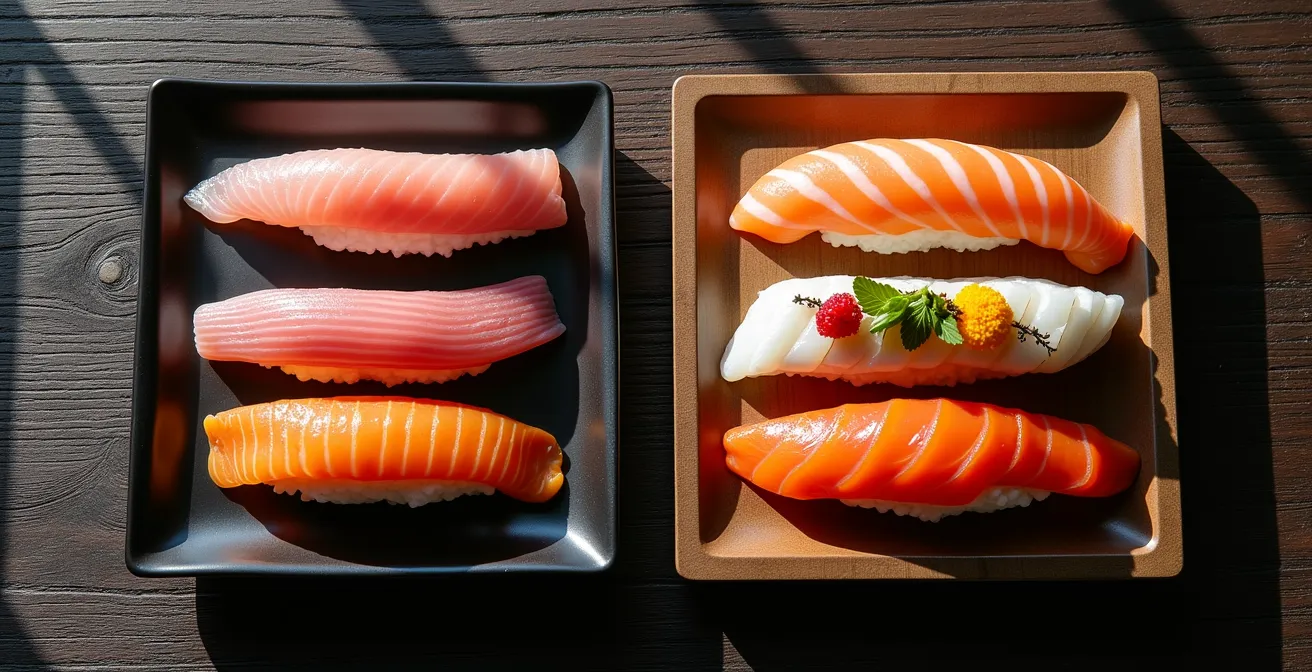
The visual contrast between the austere lineup of Tokyo-style nigiri and the colorful, composed presentation of Osaka’s pressed sushi perfectly illustrates their divergent philosophies.
The Historical Error Most Tourists Make When Describing Sushi Origins
When asked about the origins of sushi, many people picture an ancient culinary tradition stretching back thousands of years. While the earliest forms of preserving fish in fermented rice did originate in Southeast Asia and arrived in Japan centuries ago, this preservation method has almost nothing to do with the dish we know and love today as “sushi.” The original form, known as narezushi, involved aging fish in rice for months or even years; the rice was then discarded, and only the fermented fish was eaten. It was a technology of survival, not gastronomy.
The historical error is equating this ancient preservation technique with modern sushi. The sushi counter, the skilled chef, the swift preparation—these are all relatively recent inventions from the Edo period. The true father of modern sushi is a man named Hanaya Yohei, who, in the early 19th century, revolutionized the concept entirely.
His innovation was groundbreaking in its simplicity. Instead of waiting months for fish to ferment, Yohei combined freshly caught fish from Edo Bay with freshly cooked, vinegared rice. This “fast sushi,” or haya-zushi, could be prepared and eaten in minutes. It was a philosophical paradigm shift: sushi was no longer about preserving food for the future but about celebrating the peak flavor of an ingredient in the present moment, enhanced by the chef’s skill.
This single innovation transformed sushi from a pungent, fermented foodstuff into a light, sophisticated fast food for the busy citizens of Edo. It created the very format of the sushi experience: a customer, a chef, and a direct, immediate transaction of craft and taste over a counter. The discipline was no longer in the patience of fermentation, but in the speed, precision, and knowledge of the chef.
When to Expect Specific Fish Varieties According to the Traditional 24 Seasons?
The Japanese relationship with nature is not defined by four broad seasons, but by a far more granular and poetic calendar: the Nijūshi Sekki, or the 24 micro-seasons. This ancient system, with poetic names like Keichitsu (Insects Awaken) and Kanro (Cold Dew), divides the year into periods of roughly 15 days, each marking a subtle shift in the natural world. This deep attunement to time and nature is the true heart of Japanese seasonality, or shun.
For a traditional sushi chef, shun is a sacred text. It dictates what is served, when it is served, and how it is celebrated. The discipline is not merely to serve what is available, but to serve it at the precise moment of its absolute peak. This goes beyond simple availability and encompasses a narrative of an ingredient’s life cycle. There are three key concepts to understand:
- Hashiri: The first of the season. This is the exciting, early appearance of an ingredient. It might not be at its peak flavor, but it is prized for its novelty and the promise of the coming season.
- Sakari: The peak of the season. This is when an ingredient is most abundant, at its most flavorful, and often at its most affordable. This is the true moment of glory for the ingredient.
- Nagori: The last vestiges of the season. This is the reluctant farewell to an ingredient, often carrying a nostalgic, slightly altered flavor profile. Appreciating nagori is a poignant reminder of the transient nature of all things.
To eat at a traditional sushi-ya is to take part in this drama. The arrival of shinko (young gizzard shad) in early summer is a major event, its notoriously difficult preparation serving as a benchmark of a chef’s skill. The rich, fatty tuna of deep winter tells a different story from the lean, clean flavors of spring’s white fish. The chef is a narrator, telling the story of the year through the ever-changing menu. This is a discipline of observation, patience, and perfect timing—a dance with the rhythms of the earth.
Why Doesn’t the Waiter Ask ‘Is Everything Okay’ Every 5 Minutes in Japan?
For visitors from the West, service in a high-end Japanese restaurant can feel almost unnervingly hands-off. There are no constant check-ins, no interruptions to ask “How are those first few bites tasting?” This absence of questioning is not a sign of inattentive service; it is the hallmark of a far more profound and disciplined philosophy of hospitality: omotenashi.
Omotenashi is often translated as “hospitality,” but it is more accurately described as anticipatory service. The core principle is to anticipate a guest’s needs before the guest is even aware of them. It is a silent, observant, and deeply empathetic form of care. The goal is to create a seamless, frictionless experience, allowing the guest to become fully immersed in the moment—the food, the company, the atmosphere—without any jarring interruptions.
This philosophy is deeply connected to the concept of ichi-go ichi-e, which translates to “one time, one meeting.” It is a reminder, rooted in Zen Buddhism and the tea ceremony, that each encounter is unique and will never happen again. Therefore, the host must devote their entire being to making that single moment perfect. Asking “Is everything okay?” would, in this context, imply that the host doubts their own ability to have already ensured that everything is, indeed, perfect. It would break the spell.
The Philosophy of Omotenashi Service
At a top-tier establishment, the staff is trained to observe body language, the pace of eating, and the level of a guest’s water or sake glass. A new napkin appears seemingly by magic if one is dropped. A glass is refilled with a subtle, silent gesture. The service flows around the guest like water, present but invisible. As detailed in explorations of the principles of anticipatory hospitality, this creates an environment where the guest’s focus remains entirely on the culinary experience, undisturbed by unnecessary logistical interactions.
This level of service requires immense discipline and training. It is not a script to be followed but a state of heightened awareness. The quiet confidence of the staff comes from the same place as the chef’s skill: a master-apprentice system where, as noted by researchers of Japanese craftsmanship, trainees spend years “learning foundational skills before they are considered fully qualified.” Service, like cooking, is a craft to be honed over a lifetime.
Why Do Japanese Chefs Always Serve Sashimi Slices in Odd Numbers?
When a plate of sashimi arrives, a careful observer might notice a peculiar consistency: the slices of fish are almost always presented in an odd-numbered group, most commonly three, five, or seven. This is not a coincidence or a matter of portion control. It is a direct and deliberate expression of a core principle in Japanese aesthetics: fukinsei, or asymmetry.
In many Western aesthetic traditions, symmetry is equated with beauty, balance, and perfection. In contrast, traditional Japanese aesthetics, deeply influenced by Taoism and Zen Buddhism, often find beauty in imbalance and imperfection. Odd numbers are considered more dynamic and visually interesting than even numbers, which can appear static and complete. An arrangement of five slices feels more natural and alive than an arrangement of four or six. It creates a visual tension that engages the eye and implies movement and continuation.
This preference for odd numbers is rooted in a wider philosophical worldview. In Taoist thought, odd numbers are associated with yang (active, dynamic energy), while even numbers are associated with yin (static, passive energy). A plate of food is meant to be a vibrant, life-giving experience, and the use of odd numbers subtly reinforces this sense of dynamism. It’s a small detail that connects the meal to a much larger cosmological framework.
This principle of fukinsei is a cornerstone of the broader aesthetic of wabi-sabi, which finds beauty in things that are imperfect, impermanent, and incomplete. The discipline, therefore, is not to create a geometrically perfect, symmetrical plate. Instead, the chef’s artistry lies in creating a balanced composition out of asymmetrical elements, one that feels natural, harmonious, and alive. Every element on the plate—from the number of slices to their placement next to a sprig of shiso—is a considered part of this aesthetic whole. For example, traditional guidelines, like those referenced by Sushi University, specify serving sashimi in 3, 5, or 7 slices as a foundational rule of presentation.
Key takeaways
- Aging, Not Freshness, Creates Flavor: The true science of sushi lies in jukusei, a controlled aging process that develops deep umami flavors, debunking the myth that “fresher is always better.”
- The Artisan’s Spirit (Shokunin): Mastery in the Japanese kitchen is not just technical skill but a lifelong, spiritual commitment to incremental improvement for the good of the community.
- Modern Sushi is an Edo Innovation: The sushi we know today is not an ancient food, but a relatively recent “fast food” innovation from 19th-century Tokyo, created by Hanaya Yohei.
What Edo Period Innovations Still Define Modern Sushi Making Today?
While we have dismantled the myth of sushi’s “ancient” origins, it’s crucial to appreciate the specific historical context that gave birth to it. The modern sushi experience is not just influenced by the Edo period (1603-1868); it is a direct product of it. This era of peace, prosperity, and burgeoning urban culture in Japan was a crucible for culinary innovation, and its inventions still form the very foundation of sushi making today.
The single most important innovation was, as we’ve seen, the invention of haya-zushi (“fast sushi”) by Hanaya Yohei. As culinary research confirms, the invention of ‘haya-zushi’ using rice vinegar instead of fermentation was the critical leap. This allowed sushi to become an immediate craft. This not only changed the flavor profile but also created the economic and social model of the sushi-ya. The chef became a performer, a craftsman working directly in front of his customers from a cart or stall, a tradition that continues at the modern sushi counter.
The Edo period also saw the refinement of key ingredients that are now indispensable. Soy sauce (shoyu) and rice vinegar (komezu) were mass-produced and perfected during this time, becoming fundamental components of the sushi flavor profile. Furthermore, the development of specialized tools, including the high-quality steel knives (hocho) that evolved from the samurai sword-making tradition, allowed for the precision and artistry that define sushi preparation. The discipline of the kitchen is inseparable from the discipline of its tools.
From the vinegar in the rice to the very concept of the sushi counter, the grammar of modern sushi was written during the Edo period. Every time a chef presses a piece of nigiri or makes a precise cut with a yanagiba knife, they are participating in a tradition that is not ancient, but is a distinct, brilliant, and enduring product of one of Japan’s most dynamic historical eras.
The next time you sit at a sushi counter, you are not just a customer; you are participating in a conversation centuries in the making. Approach it with curiosity, observe the details, and you will taste not just fish and rice, but history itself.