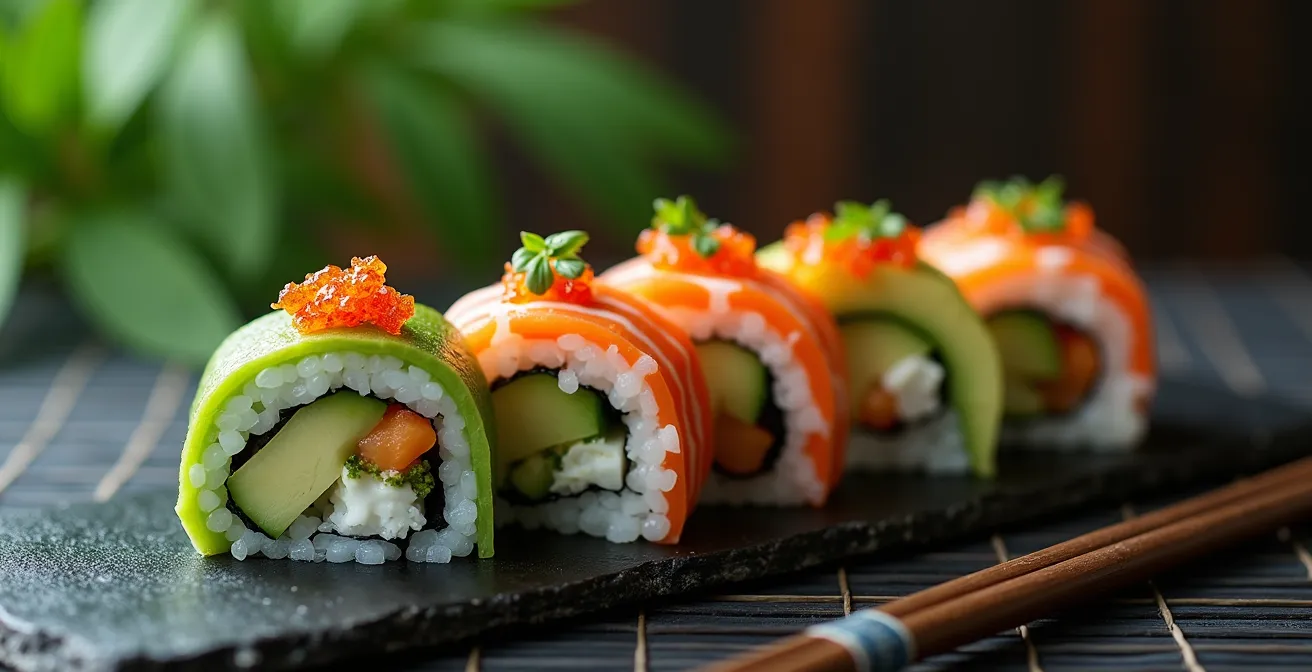
The secret to a perfect sushi roll isn’t the recipe, but the deliberate engineering of texture and moisture.
- Contrast is non-negotiable: Every soft filling like avocado or cream cheese requires a crunchy counterpart to satisfy the palate’s need for textural complexity (shokkan).
- Moisture is the enemy: Ingredients like cucumber and mayonnaise must be chemically managed (salted, or chosen for high-fat content) to prevent water from migrating and turning the nori soggy.
Recommendation: Think like a flavor chemist. Before adding an ingredient, analyze its textural contribution and potential for moisture release to build a structurally sound and sensorially balanced roll.
You’ve followed the recipe meticulously. The sushi rice is seasoned to perfection, the fish is fresh, and the avocado is perfectly ripe. Yet, minutes after rolling, your masterpiece begins to fail. The nori, once crisp, turns limp and chewy. The roll lacks that satisfying bite, becoming a texturally monotonous affair. This is a frustration every creative home cook has faced. The common advice is to use less filling or to roll tighter, but these are merely surface-level fixes that ignore the root cause of the problem.
The issue isn’t about the quantity of ingredients, but the chemistry between them. Crafting an exceptional sushi roll is less about a static recipe and more about dynamic flavor engineering. It involves managing moisture migration at a molecular level, understanding the crucial role of textural contrast, and balancing the five fundamental tastes with scientific precision. The true art lies not in what you put inside, but in understanding *why* you put it there.
This guide abandons generic ingredient lists to delve into the core principles of roll construction. We will dissect the science of why a crunchy element is essential, how to chemically prep wet ingredients to prevent sogginess, and where the line is drawn in flavor theory when incorporating unconventional ingredients like fruit. By adopting the mindset of a flavor chemist, you will learn to move beyond imitation and begin to invent your own structurally sound, balanced, and delicious sushi rolls.
This article explores the fundamental principles of constructing the perfect sushi roll, from ingredient preparation to final assembly. The following sections provide a detailed roadmap for mastering each critical component.
Summary: A Scientific Approach to Sushi Roll Construction
- Why You Always Need a Crunchy Element in a Soft Avocado Roll?
- How to Julienne Cucumbers So They Don’t Release Water Into the Rice?
- Raw Fish or Cooked Shrimp: Which Filling Is Easier to Handle for Beginners?
- The Mayonnaise Mistake That Makes Nori Soggy From the Inside Out
- When Should You Assemble the Roll to Keep the Nori Crisp?
- Mango and Strawberry: Where Do Japanese Chefs Draw the Line?
- Tamari or Ponzu: Which Dipping Sauce Should Accompany a Varied Platter?
- How to Roll Uramaki Without Rice Sticking to Your Mat or Hands?
Why You Always Need a Crunchy Element in a Soft Avocado Roll?
The addition of a crunchy element to a soft roll is not merely a preference; it’s a foundational principle in Japanese cuisine rooted in the concept of shokkan (食感), or food texture. While Western cooking primarily focuses on flavor and aroma, shokkan is considered an equally critical component of the dining experience in Japan. This cultural emphasis is so profound that, according to research from Japan’s Institute of Food Research, there are over 445 Japanese terms to describe food texture, compared to just a handful in English.
A roll filled exclusively with soft ingredients like avocado, cream cheese, and raw fish becomes texturally one-dimensional. The palate quickly fatigues, and the flavors, lacking a contrasting texture to highlight them, can meld into an indistinct whole. Introducing a crunchy component—such as julienned cucumber, crispy tempura flakes (tenkasu), or toasted sesame seeds—creates a dynamic sensory experience. The initial soft, yielding quality of the avocado is suddenly punctuated by a sharp, audible crunch. This contrast resets the palate with each bite, making the softness of the other ingredients feel more luxurious and their flavors more distinct. It’s an engineered textural interplay that adds complexity and keeps the eater engaged from the first bite to the last.
Ultimately, the crunchy element serves as the structural and sensory backbone of the roll, preventing it from becoming a forgettable, mushy experience.
How to Julienne Cucumbers So They Don’t Release Water Into the Rice?
Cucumber is a classic sushi filling, prized for its fresh, clean flavor and satisfying crunch. However, its high water content makes it a primary culprit in causing the dreaded “soggy nori syndrome.” The scientific process at play is moisture migration: water naturally moves from an area of high concentration (the cucumber) to areas of lower concentration (the rice and nori). To prevent this, professional sushi chefs employ a specific preparation method designed to remove excess water before the cucumber ever touches the rice.
The key is a two-step process: de-seeding and salting. First, the watery seed core of the cucumber must be completely removed, as this is where most of the moisture resides. The remaining firm flesh is then sliced into thin julienne strips. The image below demonstrates the precision required for this technique. The second, and most critical, step is to lightly salt these strips and let them sit for 5-10 minutes. The salt draws out a significant amount of water through osmosis. After this curing period, the cucumber should be rinsed to remove the excess salt and, crucially, patted thoroughly dry with paper towels. This pre-treatment creates a cucumber filling that retains its crunch and flavor without compromising the structural integrity of the roll.
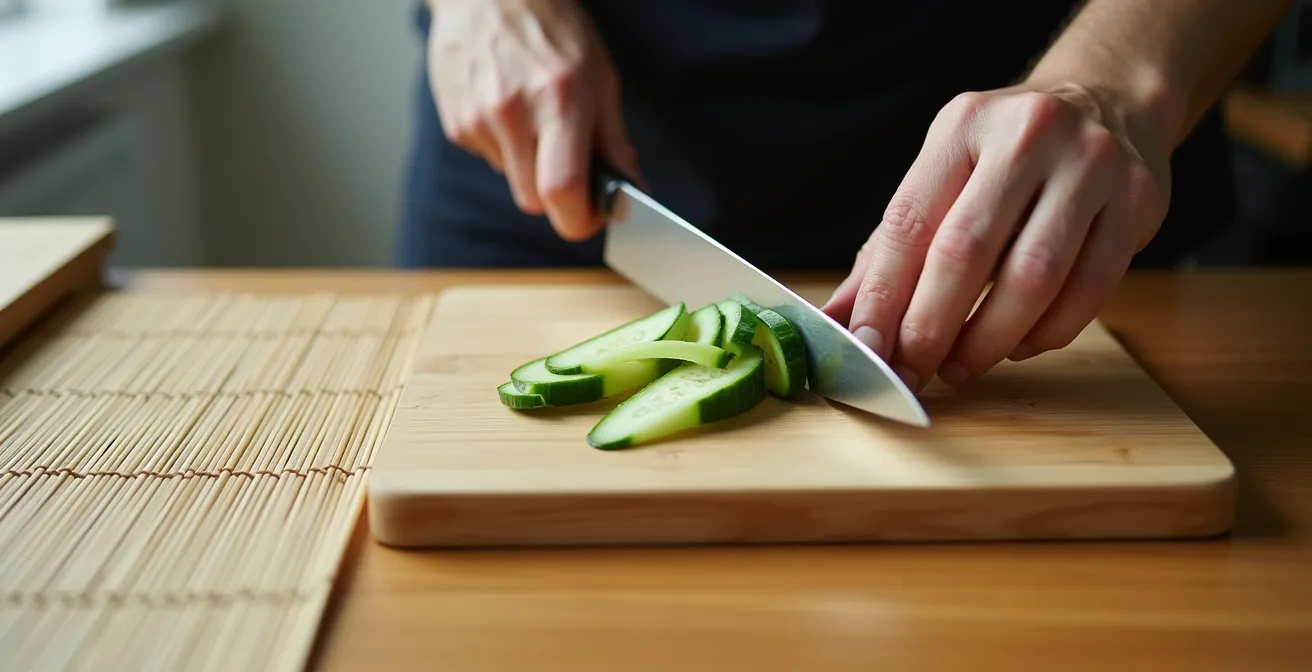
By controlling the water content at the source, you are not just preparing an ingredient; you are engineering a stable component for your final construction. This ensures the rice remains fluffy and the nori stays crisp.
This small investment in preparation time pays massive dividends in the final quality and texture of your sushi roll.
Raw Fish or Cooked Shrimp: Which Filling Is Easier to Handle for Beginners?
For a home cook venturing into sushi making, the choice of protein is a critical decision that impacts both the ease of rolling and food safety. While glistening raw tuna or salmon might seem like the ultimate goal, cooked shrimp offers a far more forgiving and practical starting point. The primary reason lies in its superior structural integrity. Raw fish, especially if not cut correctly, can be soft and prone to shifting or tearing during the rolling process. In contrast, a butterflied cooked shrimp provides a firm, stable core that acts as a guide, making it mechanically easier for a novice to achieve a tight, uniform roll.
This principle is at the heart of professional training methods for aspiring sushi chefs. A clear example of this is the beginner’s program designed by Kvarøy Arctic, a producer of high-quality salmon.
Kvarøy Arctic’s Beginner’s Progression Guide
The sushi training program from Kvarøy Arctic explicitly recommends that beginners start with cooked ingredients like shrimp or surimi (imitation crab). Their three-level progression model is designed to build skills incrementally: Level 1 focuses on these structurally sound cooked items, which carry zero food safety risk. Level 2 introduces more complex vegetable preparations, and only at Level 3 do students graduate to handling firm, less-oily raw fish like tuna loin. The program emphasizes that cooked shrimp’s firmness makes the physical act of rolling significantly easier for novices to master before they have to worry about the delicacy of raw fish.
Beyond the mechanical advantage, cooked shrimp eliminates the significant food safety concerns associated with raw fish. Handling sushi-grade fish requires strict temperature control and an understanding of its limited shelf life. Starting with cooked shrimp allows the home cook to focus entirely on mastering the techniques of rice preparation and rolling without the added pressure of food safety protocols.
Once you are confident in your rolling technique, you can then graduate to the challenge and reward of using high-quality raw fish.
The Mayonnaise Mistake That Makes Nori Soggy From the Inside Out
Spicy tuna and California rolls are perennial favorites, but they introduce a significant risk factor: mayonnaise. Standard American-style mayonnaise is an emulsion with high water and vinegar content. When mixed into a filling, this moisture inevitably begins to migrate, seeping into the rice and eventually turning the nori wrapper into a soggy, unappealing mess. The common mistake is to treat all mayonnaise as equal, but from a food science perspective, the type of mayonnaise used is critical. This is where Japanese Kewpie mayonnaise offers a distinct chemical advantage.
The difference lies in its composition. Kewpie is a thicker, richer, and more stable emulsion, which is a direct result of its ingredients and production process. As an expert from Chilli No. 5 notes, its properties make it far superior for sushi applications:
Japanese Kewpie mayonnaise is made with only egg yolks, rice vinegar, and has a higher fat content, making it a thicker, more stable, and less ‘sog-inducing’ sauce
– Chilli No. 5, Best Sushi Sauce Guide 2024
This higher fat content is the key. Fat acts as a natural moisture barrier. By using Kewpie, you are introducing less water into your filling from the start. Furthermore, you can enhance this barrier effect by applying a thin layer of a high-fat ingredient, like a slice of avocado or a whole shiso leaf, directly against the rice before adding the mayonnaise-based filling. This creates a protective shield, slowing down moisture migration and significantly extending the crisp life of your nori. Using mayo sparingly is also crucial; a little goes a long way for both flavor and structural integrity.
By switching to a high-fat mayonnaise and employing a barrier, you are actively engineering a roll that can withstand the internal threat of its own ingredients.
When Should You Assemble the Roll to Keep the Nori Crisp?
In the world of sushi, time is the ultimate enemy of texture. The moment moist rice touches a sheet of dry, toasted nori, a countdown begins. The process of moisture migration is immediate and relentless, and the crisp, brittle texture of the nori is the first casualty. While we’ve discussed controlling moisture within the fillings, the timing of the final assembly is perhaps the most critical factor of all. There is a very narrow window of opportunity to serve a roll while the nori retains its intended crispness.
Professional sushi chefs work with remarkable speed and efficiency, born from an innate understanding of this ticking clock. They confirm that there’s only a very brief 5 to 10-minute window for optimal nori crispness after assembly. After this point, the nori will have absorbed enough moisture from the rice to soften, losing its satisfying snap. This is why sushi is made to order in restaurants and served immediately. For the home cook, this means that sushi rolls cannot be made hours in advance. The principle of mise en place—having all your ingredients prepped and ready before you begin—is paramount.
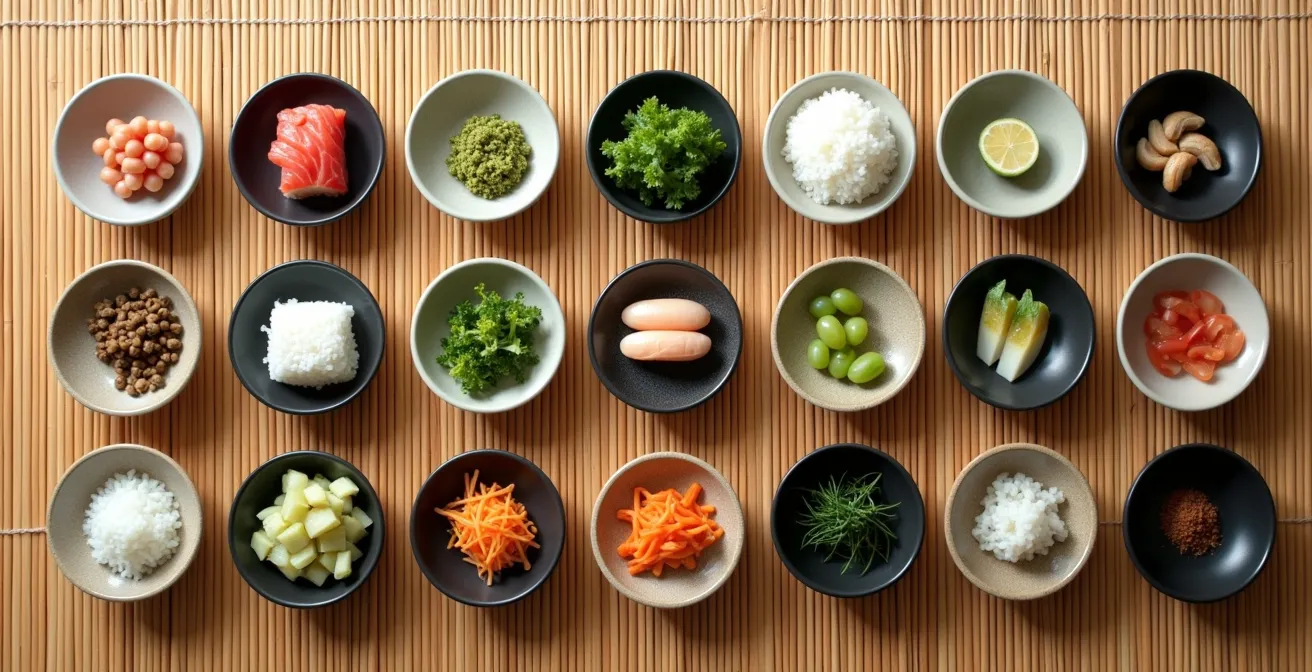
As the image above illustrates, every filling should be chopped, every sauce mixed, and every tool at hand before the first grain of rice is spread. The assembly process should be the final, swift step before serving. If you are making multiple rolls, serve them in batches as they are completed rather than waiting for all of them to be finished. This ensures that every roll is enjoyed as the chef intended: a harmonious blend of soft, yielding fillings and a crisp, toasty nori wrapper.
Treating assembly as the final sprint, not a leisurely activity, is the secret to preserving that perfect, crispy texture.
Mango and Strawberry: Where Do Japanese Chefs Draw the Line?
The inclusion of sweet fruits like mango and strawberry in sushi rolls is a hallmark of Western-style “fusion” cuisine, but it often stands in stark contrast to traditional Japanese culinary philosophy. The issue is not that fruit is forbidden, but how it impacts the overall balance of the dish. A traditional Japanese meal is built around the harmonization of the five tastes (gomi – 五味): sweet, salty, savory (umami), bitter, and sour. A well-constructed dish should contain a complex interplay of these elements, not be dominated by one.
Many fusion rolls that heavily feature fruit fall into this trap. As noted in an analysis by Metropolis Japan, a roll packed with mango or strawberry often becomes a “sweetness bomb,” overpowering the subtle, savory umami of the seafood and the delicate sourness of the seasoned rice. It ceases to be a balanced savory course and transforms into a dessert-like experience. The line, for most Japanese chefs, is drawn at the point where the fruit stops being an accent and becomes the star of the show. True mastery in fusion is about using fruit to enhance, not overwhelm.
Successful examples from modern sushi trends demonstrate this principle in action. A 2024 trend report highlights pairings like a few thin slivers of tart green apple with fatty tuna (otoro). Here, the apple’s acidity and crispness cut through the richness of the fish, cleansing the palate. Another example is using a hint of yuzu (a Japanese citrus) zest with delicate scallop; the fruit’s volatile aromatic compounds enhance the scallop’s natural sweetness without adding significant sweetness itself. In these cases, the fruit is a tool used to balance or accentuate another ingredient, perfectly aligning with the philosophy of gomi.
The goal is to use fruit as a scalpel, not a sledgehammer, to create a new yet harmonious flavor profile.
Tamari or Ponzu: Which Dipping Sauce Should Accompany a Varied Platter?
The dipping sauce is the final touch that completes the sushi experience, but choosing the right one is a critical decision that can either elevate or overwhelm your carefully constructed rolls. Presenting a platter with a variety of fillings—from delicate whitefish and vegetables to rich, fatty tuna—requires a versatile sauce. The two best contenders for this role are tamari and ponzu, each offering a different flavor profile suited to different components of the platter. Regular soy sauce, with its high salt content, can often be too aggressive for a varied selection.
Ponzu is a citrus-based sauce, typically made with soy sauce, rice vinegar, and the juice of a Japanese citrus fruit like yuzu or sudachi. Its bright acidity and lighter umami profile make it an ideal partner for richer, oilier ingredients. The citrus cuts through the fat of salmon or tuna, cleansing the palate and preventing the flavor from feeling too heavy. It also pairs beautifully with the oiliness of tempura-based rolls. However, this same acidity can easily overpower the subtle, delicate flavors of whitefish like snapper or fluke.
Tamari, on the other hand, is a type of soy sauce that is typically gluten-free and brewed with a higher concentration of soybeans. This results in a sauce that is darker, less salty, and richer in umami than regular soy sauce. Its smooth, complex flavor enhances the natural taste of ingredients without overpowering them, making it the perfect choice for delicate whitefish, vegetable rolls, or simple sashimi where the quality of the fish is meant to shine. The following table provides a clear guide for pairing.
This comparative analysis, based on a guide to Japanese sauces, helps illustrate the ideal pairings for each sauce type.
| Sauce Type | Best For | Flavor Profile | Not Recommended For |
|---|---|---|---|
| Ponzu | Fatty fish (tuna, salmon), tempura rolls | Citrus + umami, cuts through richness | Delicate whitefish |
| Tamari | Sashimi, delicate fish, vegetable rolls | Rich umami, less salty than soy | Already salty preparations |
| Regular Soy | All-purpose, nigiri | Balanced salt + umami | Overpowering subtle flavors |
For a truly versatile platter, offering small, separate dipping bowls of both ponzu and tamari allows your guests to customize their experience and perfectly match their sauce to each individual roll.
Key Takeaways
- Embrace Textural Contrast: A roll’s appeal is halved without a crunchy element. Always pair soft ingredients like avocado with a contrasting texture like cucumber or tempura flakes.
- Master Moisture Control: The primary cause of soggy nori is water from fillings. Pre-salt watery vegetables and choose high-fat, low-water sauces like Kewpie mayonnaise to create internal moisture barriers.
- Timing Is Everything: Nori begins to soften within 5-10 minutes of assembly. Prepare all ingredients in advance (mise en place) and roll just before serving for maximum crispness.
How to Roll Uramaki Without Rice Sticking to Your Mat or Hands?
The uramaki, or inside-out roll, presents a unique challenge: a sticky layer of sushi rice is in direct contact with your hands and the rolling mat (makisu). Without the proper technique, the process can quickly devolve into a sticky, frustrating mess. The secret lies not in force, but in creating non-stick surfaces through moisture and gentle handling. Professionals use two key techniques: preparing a hand-dipping liquid called Tezu (手酢) and properly prepping their bamboo mat.
Tezu is a simple mixture of water and rice vinegar. The vinegar has slight antibacterial properties, but more importantly, it prevents the rice from sticking to your hands. Keeping your hands consistently damp with Tezu is non-negotiable. For the mat, the solution is to wrap it tightly in plastic wrap. This creates an impermeable, non-stick surface that the rice won’t adhere to. A light spritz of water on the plastic-wrapped mat before spreading the rice provides an additional layer of lubrication.
The final piece of the puzzle is the application of pressure. Many beginners make the mistake of pressing or smashing the rice onto the nori. This not only crushes the delicate grains but also releases more starch, increasing stickiness. Professional sushi training emphasizes that using a single, delicate layer of rice instead of a dense wall can reduce sticking by up to 80%. The rice should be spread with a gentle tapping or patting motion, using just enough pressure for it to adhere. This light touch, combined with consistently moist hands and a prepped mat, is the key to a clean, stress-free rolling process.
Action Plan: The Non-Stick Uramaki Method
- Prepare Tezu: Mix equal parts cool water and rice vinegar in a small bowl. This will be your hand-dipping station to prevent rice from sticking to your fingers.
- Wrap Your Mat: Tightly cover your bamboo rolling mat (makisu) with a layer of plastic wrap. This creates a reusable, non-stick surface.
- Moisten Surfaces: Before you begin, dip your hands in the Tezu and lightly wet the surface of the plastic-wrapped mat. Keep your hands consistently damp throughout the process.
- Spread Rice Gently: Use a light, tapping motion with your fingertips to spread the rice over the nori. Never press or smash the grains; use just enough pressure for it to adhere in a single, even layer.
- Roll with Confidence: With your surfaces properly lubricated, the rice will not stick, allowing you to focus on tucking and rolling a tight, clean uramaki roll.
Mastering these fundamental techniques transforms uramaki from an intimidating task into an enjoyable part of your sushi-making repertoire.