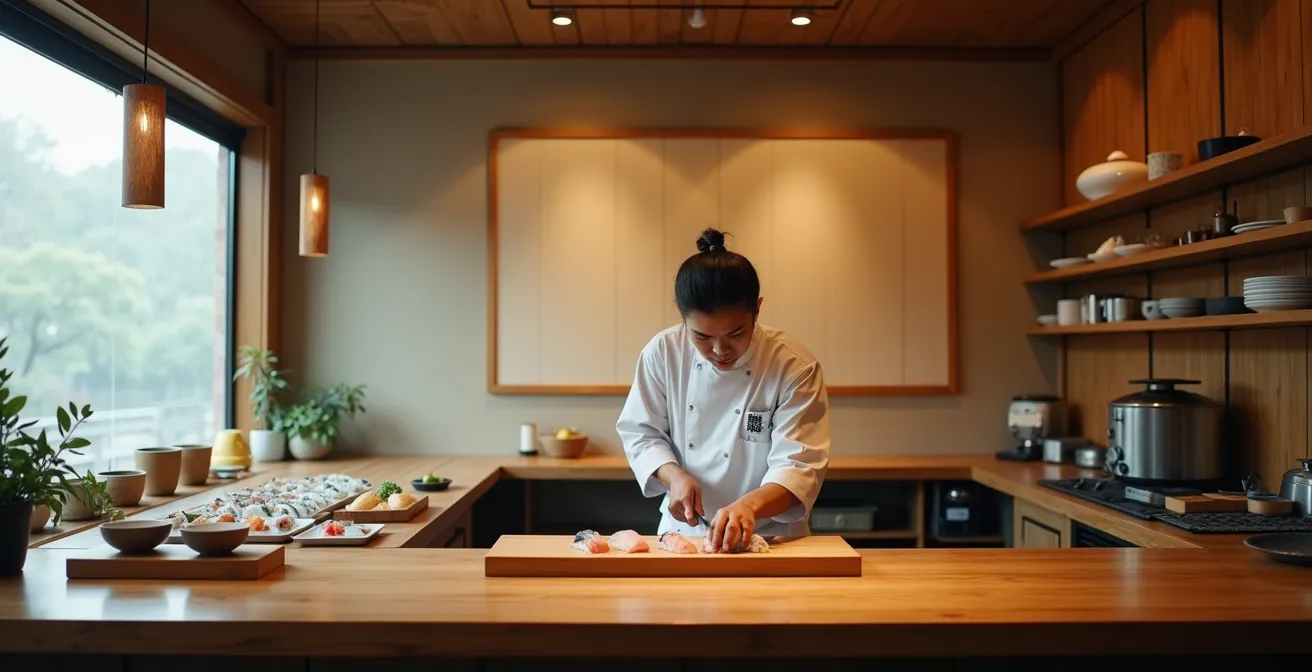
True sushi etiquette is not about memorizing rules, but about showing respect for the chef’s carefully crafted sensory balance.
- Handle nigiri gently (often with fingers) and dip only the fish side to preserve the rice’s delicate texture and temperature.
- Never mix wasabi into soy sauce; apply it directly to the fish to complement, not overwhelm, the chef’s intended flavor profile.
Recommendation: Observe the chef’s hands and the quiet atmosphere to participate in the culinary performance, not just consume a meal.
Stepping up to an authentic sushi counter can feel like entering a sacred space. The quiet focus, the gleaming blade of the itamae’s knife, the artful presentation—it’s an experience that can be as intimidating as it is enticing. For the uninitiated, a wave of anxiety often follows: “Am I holding my chopsticks correctly? How much soy sauce is too much? Am I offending the chef right now?” The internet is filled with simple lists of “dos and don’ts,” but these often create more fear than understanding. They tell you the rules but fail to explain the philosophy behind them.
The truth is, genuine sushi etiquette is not a rigid test you must pass. It is an invitation to participate in a culinary performance. The key to avoiding offense is not to robotically follow a set of instructions, but to develop an appreciation for the chef’s intent. Every piece of nigiri is a delicate balance of temperature, texture, and flavor, meticulously crafted in seconds. The “rules” are simply guidelines designed to protect that balance and show respect for the artist who created it.
This guide moves beyond mere instructions. We will explore the reasoning behind each tradition, transforming your anxiety into confident appreciation. By understanding the *why*, you will learn not just how to eat, but how to become a respectful guest whom any traditional sushi chef would be pleased to serve. You will learn to see the experience not as a minefield of potential mistakes, but as a dialogue between you and the chef.
To help you navigate this culinary art form with grace, this article breaks down the essential principles of sushi counter conduct. The following sections will guide you through each critical aspect of the experience, from handling the sushi to understanding the unique nature of Japanese hospitality.
Summary: Decoding the Unspoken Rules of the Sushi Counter
- Chopsticks or Fingers: Which Is the Correct Tool for Eating Nigiri?
- How to Dip Nigiri Into Soy Sauce Without Soaking the Rice?
- Why You Should Never Mix Wasabi Into Your Soy Sauce Dish?
- The Conversation Mistake That Distracts the Chef During Service
- Why You Must Eat Nigiri Within 3 Seconds of It Being Served?
- How to Watch the Itamae’s Hands to Anticipate the Texture of Your Next Bite?
- How to Signal for More Tea Without Shouting Across the Counter?
- How Authentic Japanese Hospitality Differs From Western Service Standards?
Chopsticks or Fingers: Which Is the Correct Tool for Eating Nigiri?
One of the first moments of hesitation at a sushi counter is deciding how to pick up the nigiri. The answer is simpler and more flexible than you might think: both chopsticks and your hands are perfectly acceptable. In fact, at many high-end sushi-ya, eating nigiri with your fingers is not just allowed; it is often the preferred method. This is a direct reflection of the chef’s craft. A master itamae presses the vinegared rice (shari) with just enough force to hold its shape, but lightly enough that it melts in your mouth. This delicate structure can easily crumble under the pressure of chopsticks, especially for a novice.
Using your hands allows for a more controlled and gentle grip, preserving the integrity of the piece from the counter to your mouth. Sushi connoisseurs often use their hands for this very reason, as it demonstrates an understanding of the food’s delicate nature. To do so correctly, gently grip the nigiri on the sides with your thumb and middle finger, while your index finger rests lightly on top of the fish (neta). However, there is no shame in using chopsticks if you feel more comfortable or wish to keep your hands clean. The exception is for pieces that have a sauce, where chopsticks can help avoid transferring the scent to your fingers.
It is critical to note that this rule applies only to rolled sushi and nigiri. Sashimi, which is simply sliced raw fish without rice, must always be eaten with chopsticks. Attempting to eat sashimi with your hands is a significant breach of etiquette. The choice between fingers and chopsticks for nigiri is a matter of preference and practicality, but the tools for sashimi are non-negotiable.
How to Dip Nigiri Into Soy Sauce Without Soaking the Rice?
The most common and disruptive mistake foreigners make is dipping the wrong side of the nigiri into the soy sauce. Drowning the rice in shoyu is considered a major offense, not out of arbitrary strictness, but because it completely destroys the sensory balance the chef has worked to create. The shari is porous and acts like a sponge; dipping it will cause it to absorb too much soy sauce, overpowering the subtle flavor of the fish and making the rice fall apart. Research on common sushi etiquette mistakes consistently highlights that many diners dip the rice side, leading to a compromised flavor and messy experience.
The correct method is to turn the nigiri on its side and briefly dip only the edge of the fish side into the soy sauce. This technique seasons the main topping without affecting the perfectly seasoned rice. It maintains the structural integrity and ensures a harmonious blend of flavors in your mouth. For gunkan-maki (battleship-style sushi with loose toppings like roe), you should never dip it directly. Instead, use a piece of pickled ginger (gari) as a small brush, dip the ginger in soy sauce, and then lightly paint the sauce onto the topping.
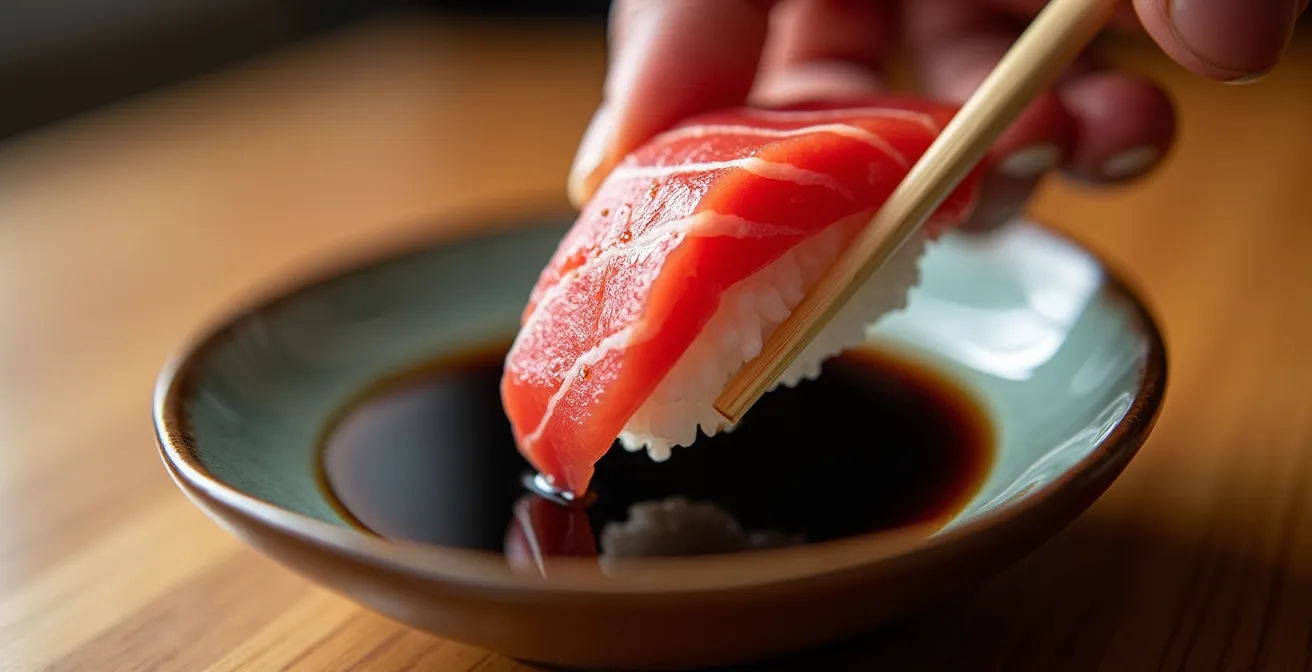
This image perfectly illustrates the precise, delicate motion required. Notice how only the fish makes contact with the sauce, leaving the rice pristine. This single action is a powerful sign of a knowledgeable and respectful diner. It communicates to the itamae that you understand and appreciate the subtle equilibrium of their creation. Mastering this simple turn of the wrist is one of the most significant steps you can take to elevate your dining etiquette.
Action Plan: The Perfect Nigiri Dip
- Grip the nigiri: Use your fingers or chopsticks to securely hold the piece.
- Rotate the piece: Turn the nigiri 90 degrees onto its side or nearly upside down.
- Dip the topping only: Lightly touch just the edge of the fish (neta) into the soy sauce. Avoid the rice entirely.
- Consume in one bite: Place the nigiri in your mouth with the fish side down on your tongue to experience the flavor first.
- Apply to all nigiri: Use this technique for every piece to ensure a consistent, balanced, and respectful experience.
Why You Should Never Mix Wasabi Into Your Soy Sauce Dish?
Creating a muddy green slurry of wasabi and soy sauce is a habit for many diners around the world, but in a traditional sushi setting, it is a significant misstep. This practice, known as *wasabi joyu*, is considered a violation of etiquette because it fundamentally disrespects the two distinct flavor profiles and, more importantly, the chef’s own seasoning. An expert itamae has already placed the perfect amount of wasabi between the rice and the fish, calibrated specifically for that type of topping. Adding more indiscriminately muddies the water, both literally and figuratively.
As noted by experts at Sushi Sasaya Korin and Itamae Sushi Edo, the two condiments should be enjoyed separately. Their rationale is clear: wasabi’s role is to cut through the richness of the fish and provide a sharp, clean counterpoint. This is especially true for fatty cuts like chutoro and otoro, where the wasabi’s pungency helps to neutralize the fat. Mixing it into the soy sauce dilutes this effect and creates a single, blunt flavor that overwhelms the delicate taste of the fish. Interestingly, while etiquette experts are firm, a comprehensive survey of over 15,000 Japanese diners shows that only about 41% strictly adhere to this rule, while others mix depending on the situation. Nonetheless, in a high-end establishment, deferring to the purist approach is the most respectful path.
Wasabi joyu is a violation of etiquette not only when it comes to sushi but all Japanese food in general as the two should always be enjoyed separately. Itamae Sushi Edo believes wasabi should be applied directly to the fish itself, especially in the case of fatty fish like chutoro and otoro, as the wasabi helps to neutralize the fat.
– Sushi Sasaya Korin and Itamae Sushi Edo, Japan Today
If you feel a piece needs more wasabi, the proper way to add it is to place a tiny amount directly onto the fish before you dip it in soy sauce. This maintains the separation of flavors and shows you are making a conscious choice to enhance the flavor, not mask it.
The Conversation Mistake That Distracts the Chef During Service
A traditional sushi bar is not a typical restaurant; it is a stage for a culinary artist. The itamae is in a state of deep concentration, managing timing, temperature, and technique for multiple guests simultaneously. The most disruptive mistake a guest can make is to shatter this focus with loud conversation or boisterous behavior. The atmosphere in a high-end sushi-ya is intentionally quiet and contemplative. This is not to be stuffy, but to allow both the chef and the diners to focus entirely on the food. Your role as a guest is to be part of this respectful, quiet audience.
Keep your conversations at a low volume and be mindful of the space. The counter is the chef’s workspace, and they are performing a delicate, time-sensitive craft. Engaging them in long, distracting conversations or shouting to your companions across the bar disrupts their rhythm and can impact the quality of the meal for everyone. In this environment, silence is a sign of respect and appreciation. It signals that you are fully engaged in savoring the flavors and textures the chef has presented.
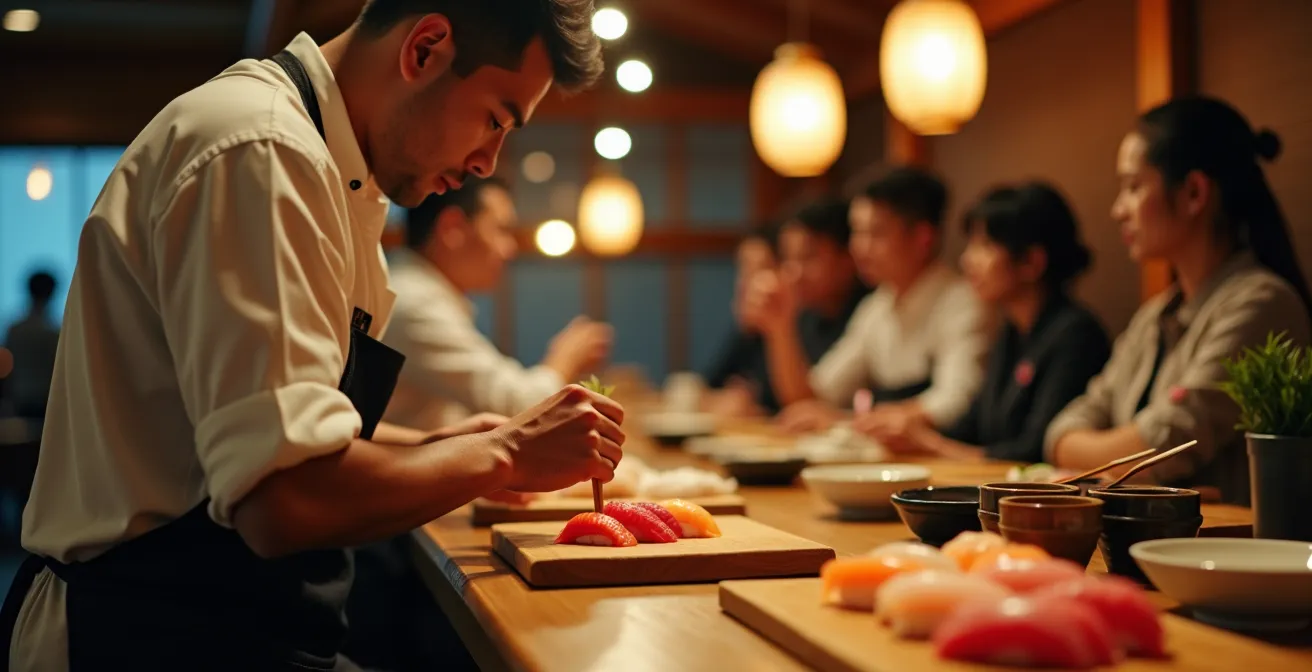
Think of it as attending a concert or a play. You wouldn’t speak loudly during a key solo, and the same principle applies here. The chef is the performer, and the nigiri is their art. By maintaining a calm and respectful demeanor, you contribute to the serene atmosphere that makes the experience so unique and memorable. If you do wish to ask the chef a question, wait for a lull in the service and speak clearly but quietly.
Why You Must Eat Nigiri Within 3 Seconds of It Being Served?
When the itamae places a piece of nigiri on the counter or your plate, a silent clock starts ticking. You are expected to consume it almost immediately, ideally within a few seconds. This isn’t a race; it’s a matter of profound respect for the ephemeral nature of perfect sushi. The chef has served that piece at its absolute peak—the moment when the temperature and texture are in perfect harmony. The fish is often at a cool, specific temperature, while the rice beneath it is slightly warm, at body temperature. This contrast is a critical component of the sensory experience.
Letting the piece sit has disastrous consequences for this delicate balance. The longer it waits, the more the heat from the rice begins to cook the fish, altering its texture. The ideal temperature of both elements is lost, and the flavor profile diminishes significantly. As the OMAKASE Editorial Department notes, “The order in which sushi is served is carefully planned as part of the course. Therefore, it’s important to eat the sushi as soon as it’s served.” To hesitate is to allow a miniature work of art to decay before your eyes.
This principle of immediate consumption is also why you should be prepared and avoid distractions. This includes photography. While capturing a beautiful meal is tempting, many high-end sushi restaurants prohibit photography precisely because it causes delays. Fumbling with your phone for the perfect shot means you are disrespecting the chef’s timing and serving yourself a suboptimal product. If you must take a photo, ask for permission first and be incredibly quick. The priority is always the food. When the nigiri arrives, the world should stop for a moment. Pick it up, dip it correctly, and savor it as the chef intended: now.
How to Watch the Itamae’s Hands to Anticipate the Texture of Your Next Bite?
A seasoned sushi diner doesn’t just eat; they observe. The itamae’s hands are not merely tools; they are instruments that communicate the story of each piece before it even reaches you. By paying close attention to their movements, you can anticipate the texture and character of your next bite, deepening your appreciation for the craft. This transforms a passive meal into an interactive and insightful shared performance. The chef is preparing the food, and you are preparing your palate.
Begin by watching how the chef forms the shari. The number of times they press the rice is a direct indicator of its final texture. A few quick, light presses? Expect a very airy, melt-in-your-mouth feel that requires a gentle touch. More deliberate, firmer presses? The rice will be more compact, perhaps to support a heavier or oilier topping. Notice the final flourish—is there a quick brush of dark nikiri (a sweet soy-based glaze)? If so, this piece should not be dipped in soy sauce at all, as it has already been seasoned to perfection.
Observing the slicing of the neta is also revealing. A long, single, fluid stroke with the knife indicates a tender cut of fish. If the chef scores the surface of the fish with a series of shallow cuts, they are doing so to help it absorb the soy sauce better and to make a tougher piece more tender. Watching these preparations is like getting a sneak preview. It builds anticipation and allows you to understand the chef’s intent, so when the piece arrives, you are ready to appreciate the specific qualities they worked to highlight. This level of engagement is a silent compliment to the chef, showing you are a diner who truly sees their art.
How to Signal for More Tea Without Shouting Across the Counter?
In the quiet, focused environment of a sushi bar, shouting “Tea, please!” is the equivalent of a fire alarm. It’s jarring, disruptive, and shows a complete lack of awareness. As with everything else at the counter, communication should be subtle, non-verbal, and respectful of the chef’s concentration. The head chef, or itamae, should never be bothered with service requests like drinks. Their focus must remain on the sushi. Instead, your communication should be directed toward an assistant chef (wakiita) or a server.
The most effective method is a silent gesture. If you need a refill of your agari (green tea), follow this discreet protocol. It is a simple yet elegant way to communicate your needs without disrupting the flow of the restaurant. The key is to be subtle and patient; the staff in a good restaurant is trained to be observant and will notice your cue. This silent communication is a cornerstone of the dining experience, allowing service to happen fluidly and almost invisibly around the central performance of the itamae.
Here are the proper, silent methods for requesting more tea:
- Place your empty cup slightly forward on the counter, just outside of the chef’s immediate workspace. This is often the most effective and least intrusive signal.
- Make brief, gentle eye contact with a server or an apprentice chef. Never stare or try to flag them down aggressively.
- Once you have their attention, offer a slight nod and gesture subtly toward your cup.
- Always direct these non-verbal requests to the support staff, not the head chef. Their concentration is paramount.
Key Takeaways
- Respect the Balance: Every action, from dipping to eating, should aim to preserve the chef’s intended balance of flavor, texture, and temperature.
- Observe and Appreciate: Watch the chef’s hands and respect the quiet atmosphere. You are the audience for a culinary performance.
- Communicate with Subtlety: Use non-verbal cues for service requests. Never distract the head chef from their craft.
How Authentic Japanese Hospitality Differs From Western Service Standards?
To truly feel at ease in a traditional sushi bar, one must understand the fundamental difference in service philosophy: Omotenashi versus Western-style service. In the West, good service is often defined by responsiveness: the server checks on you, asks if you need anything, and responds to your explicit requests. The customer is in charge. In Japan, hospitality is defined by anticipation. Omotenashi is the art of anticipating a guest’s needs before they are even aware of them, and providing for them silently and seamlessly.
The itamae is not a service provider; they are a host in their own space. They are observing you, gauging your reactions, and planning your next course based on what they perceive you will enjoy. This is why it is considered respectful to “trust the chef” (omakase). You are placing yourself in the hands of an expert who is dedicated to crafting the best possible experience for you. This requires a shift in mindset from being a “customer who is always right” to being a “guest who is in good hands.”
This table illustrates the core philosophical differences:
| Aspect | Japanese Omotenashi | Western Service |
|---|---|---|
| Approach | Anticipate needs silently | Respond to explicit requests |
| Chef Role | Host in their sacred space | Service provider to customer |
| Communication | Non-verbal, intuitive | Verbal, explicit |
| Atmosphere | Quiet contemplation | Social interaction |
Understanding this concept is the final key to unlocking a confident and enjoyable experience. The chef is not ignoring you; they are intensely focused on serving you. As a guest, your role is to be receptive and appreciative of this silent, thoughtful care. As the team at KuruKuru Sushi Hawaii explains, the expertise of the chef is a central part of the experience, and trusting their judgment is a form of respect for their years of training.
Armed with this understanding, you are now prepared to step into any sushi bar not as an anxious customer, but as a respectful guest. Embrace the experience with confidence and mindfulness.