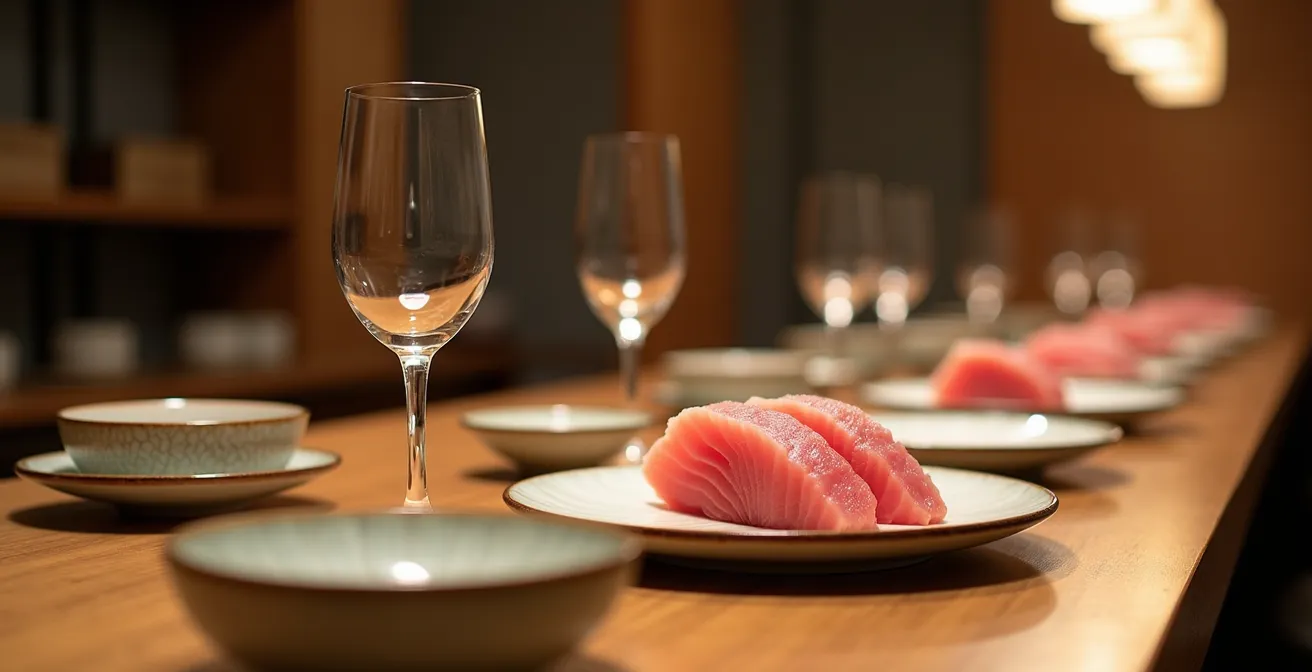
The perfect drink pairing for sushi isn’t about a single “best” choice, but about a strategic progression that respects the meal’s flavor arc.
- Lean fish demands delicate drinks (like Daiginjo sake), while rich, fatty cuts require robust partners (like Junmai sake) to manage lipid interaction on the palate.
- Temperature, carbonation, and acidity are critical tools for resetting your palate and enhancing, not overpowering, each piece of sushi.
Recommendation: Think of your beverage as the co-pilot to your meal. Start with a light, palate-priming drink and escalate the body and complexity of your beverage to match the increasing richness of the food.
The moment arrives in every fine Japanese restaurant. The cedar counter gleams, the chef’s knife is a whisper of steel, and a leather-bound menu is placed in your hands. It’s filled with exotic names: Junmai, Ginjo, Daiginjo. You’ve ordered the omakase, a journey of flavors you’ve been anticipating all week, crowned by the promise of meltingly rich o-toro. Yet, a wave of uncertainty washes over you. Which bottle will elevate this experience? Which will accidentally sabotage it?
The common advice is a set of rigid, often unhelpful rules: “pair light with light,” or the blanket statement that only sake works with sushi. While well-intentioned, these platitudes fail to capture the dynamic, living conversation between food and drink. The truth is that the world of beverage pairing for Japanese cuisine is far richer and more flexible, encompassing not just sake but also specific wines, beers, and even non-alcoholic teas. To navigate it is not to memorize a list of pairings, but to understand the fundamental principles of palate dynamics.
But what if the secret wasn’t in the *what*, but in the *how* and *when*? What if the key to unlocking the perfect pairing for that fatty tuna wasn’t a specific brand, but a deeper understanding of flavor, temperature, and timing? This guide is built on that very premise. We will move beyond the simple question of Junmai versus Daiginjo to build a complete strategy. We will explore the traditional sequence of drinks, decode the science behind wine and soy sauce interactions, and reveal why the temperature of your drink is as important as the temperature of your fish. This is not another list of rules; it’s a new way of thinking about your meal, empowering you to become your own sommelier.
This article provides a comprehensive framework for navigating your beverage choices during a Japanese meal. Follow along to discover how to strategically sequence your drinks, make informed decisions on wine or sake, and master the art of pairing from the first course to the last.
Summary: A Strategic Guide to Pairing Drinks with Japanese Cuisine
- Beer First, Sake Later: Why Is This the Traditional Drinking Sequence?
- Chardonnay or Riesling: Which White Wine Doesn’t Clash With Soy Sauce?
- Hot Sake or Cold Sake: Which Pairs Better With Warm Eel vs. Cold Sashimi?
- The Cocktail Mistake That Numbs Your Palate Before the O-Toro Arrives
- What Non-Alcoholic Tea Pairings Match the Complexity of Aged Sake?
- Why You Should Eat Lean Tuna Before Fatty Tuna in a Sashimi Platter?
- How Long Should a 20-Course Omakase Dinner Actually Take?
- Why Extremely Hot Powdered Tea Is Essential for Sushi Digestion?
Beer First, Sake Later: Why Is This the Traditional Drinking Sequence?
The tradition of starting a Japanese meal with a beer, or “toriaezu biiru” (beer for now), is more than just a cultural habit—it’s a strategic culinary decision. The practice serves as the perfect overture for the intricate symphony of flavors to follow. A light, crisp Japanese lager like an Asahi or Sapporo acts as an ideal palate reset. Its clean profile, moderate bitterness, and lively carbonation work in concert to awaken and cleanse the taste buds, preparing them for the delicate nuances of the first sushi courses without leaving a lingering aftertaste.
This initial beer sets the stage but knows when to exit. The transition to sake is a deliberate one. The conventional wisdom is to allow a brief interlude of 10-15 minutes after finishing the beer. This pause allows any residual bitterness from the hops to fade, ensuring the palate is a neutral canvas ready to appreciate the complex aromatics and umami notes of sake. The first sake introduced is typically a lighter style, such as a crisp Honjozo or a gentle Junmai, which acts as a bridge from the simplicity of the beer to the greater complexity of the sakes that will follow as the meal progresses in richness.
This structured sequence is a foundational element of the flavor arc of a traditional Japanese meal. It acknowledges that the first sip is as important as the first bite. By starting with a beverage that primes rather than overwhelms, you establish a baseline of sensory clarity. This methodical approach ensures that each subsequent course and its paired beverage can be appreciated to its fullest potential, building layers of flavor in a logical and satisfying progression. It is this thoughtful pacing that transforms a simple dinner into a curated gastronomic experience.
Chardonnay or Riesling: Which White Wine Doesn’t Clash With Soy Sauce?
While sake is the classic partner for sushi, the allure of wine is undeniable. However, this is where many diners make a critical error, particularly concerning soy sauce. The high sodium and potent umami in shoyu can create a disastrous, metallic taste when combined with the wrong wine. The primary culprits are oak and tannins. An oaked Chardonnay, for instance, may seem like a safe choice, but its vanillin compounds and wood tannins react negatively with soy and seaweed, resulting in a harsh, unpleasant finish that masks the delicate flavor of the fish.
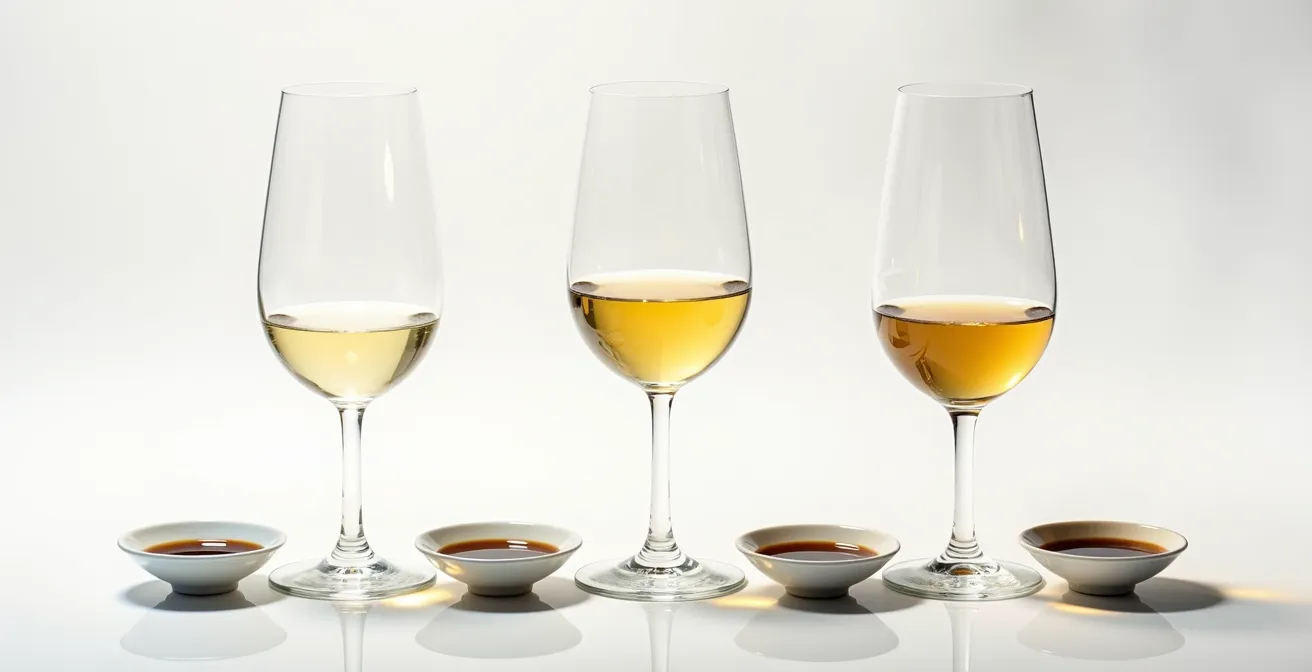
The key to a successful wine pairing lies in finding structural harmony. You need a wine with high acidity, no tannins, and a clean mineral profile. A dry German Riesling (Trocken) is often an excellent choice; its racy acidity cuts through the saltiness of the soy sauce and the richness of certain fish, while its subtle fruit notes complement the vinegar in the sushi rice. However, expert sommeliers often turn to a lesser-known champion: Muscadet. Specifically, a Muscadet Sèvre et Maine sur Lie offers a unique, almost perfect match. Its hallmark is a distinct saline or briny minerality, coupled with razor-sharp acidity, which doesn’t just coexist with soy sauce—it actively harmonizes with it, creating a seamless bridge between the wine and the food.
The following table breaks down the compatibility of common white wines with the powerful flavors of soy sauce, illustrating why characteristics like acidity and tannin content are far more important than brand or price.
| Wine Type | Acidity Level | Tannin Content | Soy Sauce Compatibility |
|---|---|---|---|
| Dry Riesling (Trocken) | High | None | Excellent – cuts through salt |
| Off-dry Riesling (Kabinett) | High | None | Good – balances sweet sauces |
| Muscadet sur Lie | Very High | None | Outstanding – saline match |
| Unoaked Chardonnay | Medium | Low | Good – clean profile |
| Oaked Chardonnay | Low-Medium | Medium | Poor – creates metallic taste |
Ultimately, choosing a wine for sushi requires you to disregard typical Western pairing logic. Instead of focusing on fruit-forward profiles, prioritize structure. Look for wines that are lean, mineral-driven, and high in acid. These are the wines that will act as a refreshing counterpoint, cleansing your palate and preparing you for the next exquisite bite, rather than competing with it.
Hot Sake or Cold Sake: Which Pairs Better With Warm Eel vs. Cold Sashimi?
The question of sake temperature is one of the most misunderstood aspects of Japanese dining. The Western notion that hot sake is inherently inferior is a damaging oversimplification. The truth is that temperature is a tool, used by a skilled sommelier to modulate the flavor profile of the sake to create a perfect pairing. The guiding principle is simple: match the temperature of the drink to the temperature of the food. This creates a sense of harmony on the palate, avoiding a jarring thermal contrast that can distract from the flavors.
For cold, delicate dishes like white fish sashimi (hirame or tai), serving a premium sake like a Daiginjo chilled (a practice known as reishu, around 5-10°C) is essential. The cold temperature preserves the sake’s fragile and complex floral and fruity aromas, known as ginjo-ka. Warming such a delicate brew would be an act of culinary vandalism, causing these beautiful aromatic esters to evaporate instantly. When chilled, the sake’s clean acidity and subtle notes mirror the pristine quality of the raw fish, cleansing the palate gently without overwhelming it.
Conversely, for a hot, rich dish like grilled eel (unagi) glazed in a sweet soy-based sauce, warm sake (atsukan or nurukan) is not just appropriate; it’s ideal. As sake expert Natsuki Kikuya explains, warming sake changes its very structure.
Warming sake volatilizes its delicate esters but amplifies its lactic and cereal notes, making it a perfect complement to the rich, caramelized flavors of warm unagi
– Natsuki Kikuya, WSET School London Sake Webinar
Heating a robust Junmai or Honjozo to around 40°C (nurukan) softens its texture, reduces its perceived acidity, and brings forward its savory, rice-driven umami and sweetness. This warm, rounded profile envelops the rich, fatty eel, and its amplified sweetness resonates with the caramelized tare sauce, creating a deeply comforting and synergistic pairing.
Your Action Plan: Mastering Sake Temperatures
- Assess the dish: Is it served hot or cold? Is it delicate or rich?
- For cold sashimi (especially white fish): Choose a premium Ginjo or Daiginjo and serve it chilled (5-10°C) to preserve its floral aromas.
- For room-temp or richer fish (like tuna): Opt for a Junmai at room temperature (15-20°C) to highlight its umami character.
- For hot, grilled dishes (like eel): Select a robust Junmai or Honjozo and warm it to 40-45°C to amplify its sweetness and savory notes.
- Never heat a premium Daiginjo: This destroys the delicate ginjo-ka aromas that you are paying a premium for.
The Cocktail Mistake That Numbs Your Palate Before the O-Toro Arrives
Starting a refined dining experience with a traditional Western cocktail—think a Negroni, Old Fashioned, or a fruity margarita—is the fastest way to sabotage your palate before the first piece of sushi even arrives. The high sugar content, intense bitterness, or overpowering botanicals in these drinks act like a sensory sledgehammer. They coat your taste buds, numbing them to the subtle, delicate flavors that define high-quality Japanese cuisine. The lingering sweetness of a sugar-laden cocktail makes it nearly impossible to appreciate the gentle sweetness of the sushi rice or the nuanced flavor of a piece of lean flounder.
This is a critical misstep in managing the meal’s flavor arc. An omakase is designed as a gradual crescendo of taste and texture, and your beverage choice must respect that progression. Instead of a palate-numbing cocktail, the Japanese tradition offers a brilliant alternative: the Highball. Consisting of nothing more than high-quality Japanese whisky, crystal-clear soda water, and a twist of lemon, the Highball is a model of elegant simplicity. It is bone-dry, with no sugar to coat the tongue. Its high carbonation provides a vigorous palate reset, scrubbing the taste buds clean between bites. The subtle smoky and honeyed notes of the whisky are present but not overpowering, offering a refreshing counterpoint without interfering with the food.
The growing appreciation for such thoughtful pairings is reflected in dining trends, where an increasing amount of sake consumption happens in a restaurant setting. In fact, a recent report highlighted that 45% of total sake sales in 2024 came through restaurants, underscoring the importance for diners to understand how to navigate these menus. Choosing a Highball or a light beer over a complex cocktail is the first decision that separates a novice from a seasoned diner. It shows an understanding that at a sushi counter, the drink’s primary role is to support and elevate the food, not to be the star of the show. It is a choice that prioritizes the delicate artistry of the chef over a momentary craving for something sweet and potent.
What Non-Alcoholic Tea Pairings Match the Complexity of Aged Sake?
For those abstaining from alcohol, the beverage pairing experience at a Japanese restaurant need not be a compromise. In fact, the world of premium Japanese and Chinese teas offers a spectrum of complexity, texture, and flavor that can rival even the most sophisticated aged sake (koshu). Just as with sake, the key is to match the profile of the tea to the character of the food. Moving beyond the standard-issue green tea reveals a universe of non-alcoholic pairings that demand the same thoughtful consideration as their alcoholic counterparts.
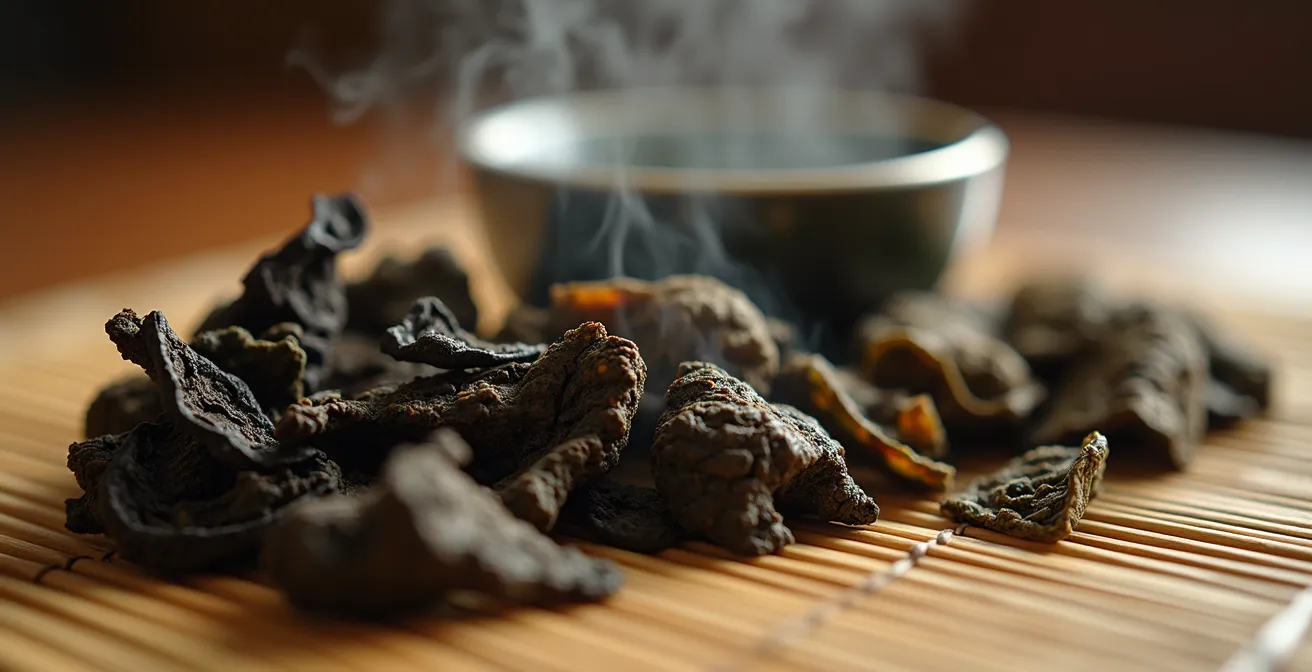
To parallel the nutty, sherry-like, and caramelized notes of an aged koshu, one can turn to roasted and oxidized teas. Hojicha, a Japanese green tea that has been roasted over charcoal, is a superb choice for fatty tuna or grilled items. Its toasty, nutty, and slightly sweet caramel notes provide a beautiful complement to the richness of the fish without any bitterness. For an even deeper, more complex pairing, an aged Pu-erh tea from China offers earthy, mushroom-like depths and a smooth, full body that stands up wonderfully to rich, savory dishes like braised pork belly or eel. For shellfish, a high-quality rock oolong like Da Hong Pao provides a distinct mineral complexity and long, lingering finish that mirrors the qualities of a fine white wine.
The preparation method can further enhance this pairing. Cold-brewing these teas for 6 to 8 hours in the refrigerator is an excellent technique. This process gently extracts the aromatic compounds and flavors without drawing out the bitter tannins, resulting in a brew that is remarkably smooth, complex, and refreshing. Serving these cold-brewed teas in a wine glass at a similar temperature to how a sake would be served completes the experience, providing the same visual and tactile ritual. It demonstrates that a sophisticated, engaging beverage pairing is not contingent on alcohol, but on an appreciation for flavor, aroma, and structural harmony.
Why You Should Eat Lean Tuna Before Fatty Tuna in a Sashimi Platter?
The progression of a sashimi or nigiri platter is not arbitrary; it is a carefully orchestrated journey designed to maximize the pleasure of each bite. The cardinal rule, especially with tuna, is to proceed from lean to fatty. This means starting with akami (the lean, ruby-red back meat) before moving on to chu-toro (medium-fatty belly) and culminating with o-toro (the prized, intensely marbled fatty belly). This sequence is dictated by the physiological reality of our taste buds and the powerful effect of lipid interaction. The high concentration of rich, flavorful fat in o-toro coats the palate, creating a luxurious but persistent barrier. If you were to eat the o-toro first, the delicate, subtle, and slightly acidic flavors of the leaner akami would be completely lost, tasting muted and bland in comparison.
This principle of escalating intensity applies directly to the question posed in our title: Junmai or Daiginjo for fatty tuna? The answer is both, but at different times. With the delicate akami, you need a sake that will not overpower it. This is the perfect moment for a premium Daiginjo. Its light body, elegant floral aromas, and clean finish respect the subtle flavor of the lean fish, cleansing the palate without stripping its taste. The popularity of such premium pairings is growing, with market research showing that 34% of all sake exports in 2023 were premium varieties like Junmai Ginjo and Daiginjo.
However, when you arrive at the magnificent o-toro, that same delicate Daiginjo would be washed away, its subtleties obliterated by the sheer richness of the fat. This is where a more robust sake is required. A full-bodied, earthy Junmai, especially one made with the yamahai or kimoto method, is the ideal partner. Its higher acidity, richer texture, and more pronounced rice-forward umami have the structure and power to cut through the lipids. It doesn’t just cleanse the palate; it engages with the fat, creating a new, harmonious flavor in the mouth. The sake’s acidity refreshes the palate, preparing you for the next bite, while its savory notes complement the deep umami of the tuna. This is the ultimate expression of the meal’s flavor arc—matching the peak of the food’s richness with a beverage of corresponding power and structure.
How Long Should a 20-Course Omakase Dinner Actually Take?
An omakase, which translates to “I leave it up to you,” is an intimate culinary dialogue between chef and diner, and its pacing is a critical, non-verbal part of that conversation. A rushed omakase is a paradox; the experience is fundamentally about surrendering to the chef’s rhythm. For a substantial 20-course meal, a duration of two to three hours is not just common but ideal. This deliberate pacing is not about inefficiency; it is about respecting the food, the diner’s physiology, and the overall narrative of the meal.
As the Japan Food Guide notes in its analysis, the timing is deeply intentional.
A 2-hour, 20-course meal means a new piece roughly every 6 minutes. The deliberate slow progression works with your body’s natural hunger signals
– Japan Food Guide, Omakase Dining Experience Analysis
This rhythm allows for a moment of appreciation for each piece—to observe its beauty, inhale its aroma, and savor its flavor before the next one arrives. It also gives your palate and stomach time to process, preventing the sensory overload that would occur in a faster-paced meal. This measured flow is the practical application of the flavor arc, ensuring that the diner’s ability to perceive and enjoy is at its peak from the first course to the last.
The beverage service must be in lockstep with this pacing. Pouring a full bottle of sake at the beginning of a 20-course omakase is a mistake. The sake will either be consumed too quickly, or its temperature will drift, making it a poor partner for later courses. Instead, the service should mirror the meal’s progression, as outlined in the guidelines below.
| Meal Duration | Courses | Sake Service Style | Recommended Volume |
|---|---|---|---|
| 90 minutes | 10-12 courses | By the glass (60ml) | 3-4 glasses total |
| 2 hours | 15-20 courses | Small carafe (180ml) | 2-3 carafes |
| 2.5-3 hours | 20+ courses | Pairing flight | 30ml per course |
Opting for a pairing flight or ordering by the small carafe allows you to change your sake selection as the food evolves—a light Daiginjo for the white fish, a sturdier Junmai for the tuna, and perhaps a special aged koshu for the tamago finale. This approach ensures that every drink is served at its ideal temperature and is perfectly matched to the dish in front of you, fully integrating the beverage experience into the unhurried, artful flow of the omakase.
Key Takeaways
- The goal of pairing is not to find one “perfect” drink, but to create a dynamic progression of beverages that follows the meal’s flavor arc from light to rich.
- Understand the science: high-acidity drinks cut through fat (lipid interaction), carbonation cleanses the palate, and temperature dramatically alters a sake’s aroma and flavor (aromatic volatility).
- Beyond sake, consider high-acidity, non-oaked white wines like Muscadet or dry Riesling, and complex, non-alcoholic options like cold-brewed hojicha or pu-erh tea.
Why Extremely Hot Powdered Tea Is Essential for Sushi Digestion?
The small cup of searingly hot, green tea served at the end of a sushi meal, known as agari, is often mistaken for a simple, comforting palate cleanser. While it does serve that function, its true purpose is far more scientific and integral to the dining experience. This is not the delicate, ceremonial matcha or gyokuro; agari is typically made from konacha—a powdered tea composed of the buds, dust, and small leaves left over from the processing of higher-grade teas. Its role is not one of complex flavor appreciation but of powerful digestive assistance, especially after consuming rich, fatty items like o-toro or unagi.
The secret lies in the combination of tea type and extreme temperature. Research from Japanese culinary institutions has shown that konacha served at a very high temperature (around 80-85°C) is rich in catechins, a type of antioxidant. The extreme heat is crucial as it increases the extraction of these catechins by a significant margin. These compounds play a vital role in lipid interaction post-consumption. They actively help to break down and emulsify the rich fats from the fish, essentially kick-starting the digestive process. That hot flush you feel isn’t just from the temperature; it’s the physiological effect of the tea aiding your body in processing the rich meal you’ve just enjoyed.
This practice is gaining global recognition as the appreciation for authentic Japanese dining customs spreads. With North America now accounting for a significant portion of the sake market—a recent study found that North America accounts for 29% of total sake export value in 2024—diners are becoming more attuned to these crucial details. The agari is the final, logical step in a meal structured around the management of flavors and fats. It concludes the flavor arc by vigorously resetting the palate and provides a functional benefit that leaves the diner feeling satisfied and balanced, not heavy and overwhelmed. To skip it, or to request it lukewarm, is to miss the final, clever chapter of the culinary story.
By moving beyond a simple list of rules and embracing the principles of the flavor arc, palate dynamics, and lipid interaction, you transform from a passive consumer into an active, knowledgeable participant in your dining experience. The next time you are presented with a sake menu, you will see not a test, but an opportunity to curate a journey of flavor, armed with the confidence to choose wisely at every step.