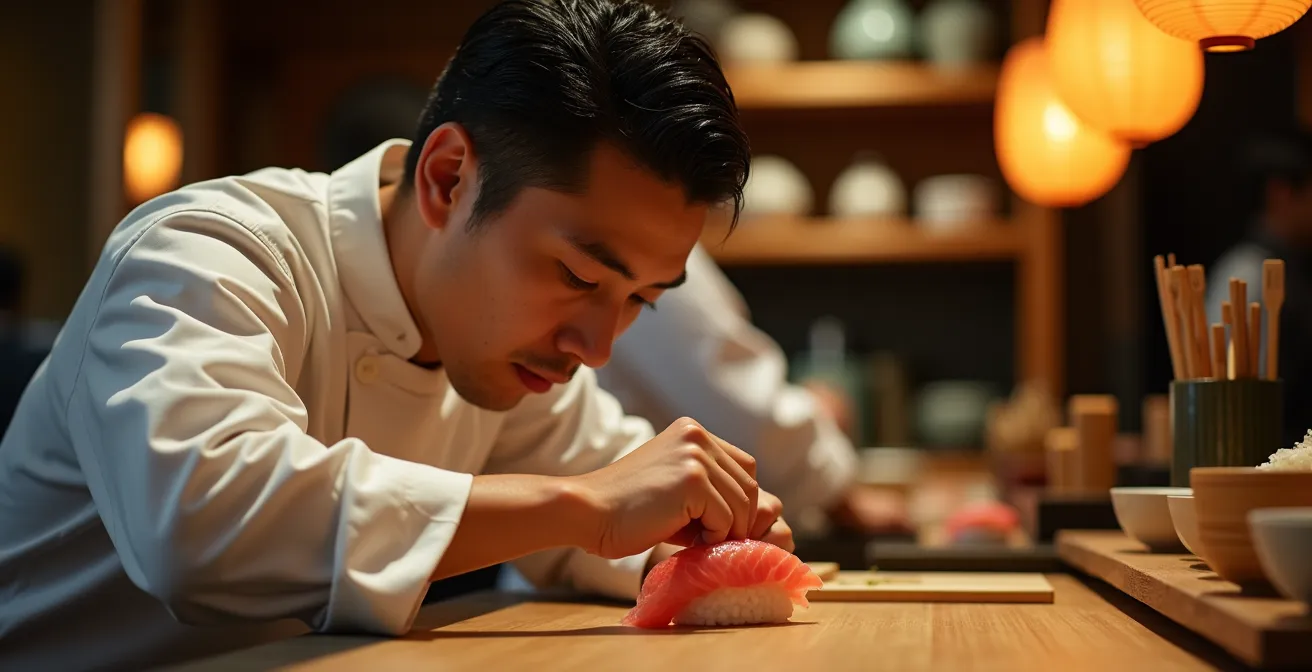
Omakase is a high-return but high-risk investment for your palate; its value depends entirely on your willingness to trade control for curation.
- The price reflects a 35-40% cost for premium ingredients and a 30% investment in the chef’s years of expertise.
- Success for beginners hinges on clear communication about dietary needs, which chefs at top-tier establishments view as a creative challenge, not a burden.
Recommendation: For a first-time, lower-risk investment, consider a lunch omakase, which is often 30-50% cheaper while still offering a high-quality introduction to the chef’s style.
The term ‘omakase’ whispers of luxury, exclusivity, and a bill that can make your eyes water. For a first-time high-end diner, the central question is a practical one: is it truly worth it? The internet is filled with simple advice to “trust the chef” and “enjoy the experience.” But this advice sidesteps the core anxiety of any significant purchase: am I making a smart investment, or am I overpaying for a trend? This isn’t just about food; it’s a transaction where you surrender all control in exchange for a promise of brilliance.
This guide approaches the question from a different perspective. Think of this not as a restaurant review, but as a consultation with a financial advisor for foodies. We will analyze omakase as an investment. We’ll break down the ‘Return on Indulgence’ (ROI), assess the risks—from picky eating to surprise costs—and equip you with the strategies to decide if this specific asset class belongs in your personal ‘palate portfolio.’ We won’t just tell you what omakase is; we will dissect its value proposition piece by piece.
This article will guide you through the financial and experiential components of the omakase model. By exploring what you’re really paying for, how to manage potential risks, and understanding the structure of the meal, you’ll be able to make an informed decision that aligns with your budget and your appetite for adventure.
Summary: An Investor’s Guide to the Omakase Experience
- What Does ‘Omakase’ Literally Mean and What Are You Agreeing To?
- How to Calculate If You Are Getting Your Money’s Worth in an Omakase?
- Ordering A La Carte or Chef’s Choice: Which Is Better for Picky Eaters?
- The ‘Market Price’ Trap: How to Avoid Surprise Bills at the End?
- How Long Should a 20-Course Omakase Dinner Actually Take?
- How Much of Your Bill Pays for the Manhattan Real Estate?
- Kaiseki or Omakase: Which Fine Dining Style Offers More Variety?
- How to Navigate a Chef’s Choice Menu Without Dietary Anxiety?
What Does ‘Omakase’ Literally Mean and What Are You Agreeing To?
At its core, “omakase” translates to “I leave it up to you.” But in the context of a high-end restaurant, this is more than a polite suggestion; it’s a binding verbal contract. You are agreeing to cede all decision-making power to the chef. This isn’t just about what you’ll eat; it’s about the sequence, the pace, and the narrative of the entire meal. You are investing in the chef’s expertise, their access to seasonal ingredients, and their artistic vision. Essentially, you’re not just buying dinner; you’re commissioning a personalized work of culinary art.
In the United States, this concept has evolved. As the celebrated food writer Jeffrey Steingarten noted in Vogue Magazine, it typically refers to a unique and intimate dining format. This is the heart of the “Trust Contract.”
In the U.S., omakase usually refers to an extended sushi dinner, ideally eaten at the sushi counter, where the chef prepares one piece of fish at a time, announces its name and origin, answers your questions, and guesses what else you might enjoy.
– Jeffrey Steingarten, Vogue Magazine
This direct interaction is a key component of the value. The experience is both a meal and an education. You are paying for a story, told one piece at a time, over a duration that respects the process. A typical omakase is a commitment, often lasting between two and two and a half hours, allowing the chef to guide you through a carefully constructed flavor journey without rush.
How to Calculate If You Are Getting Your Money’s Worth in an Omakase?
To determine if omakase is a sound investment, you must first understand what your money is actually buying. It’s not a simple calculation of ingredient cost versus menu price. The premium price tag is a blend of tangible and intangible assets. A significant portion of the bill is allocated to the raw materials, but an equal, if not greater, portion is dedicated to the skill and experience that transform those ingredients into something extraordinary. This is where the concept of “Return on Indulgence” comes into play.
A financial breakdown of a typical omakase experience reveals that you’re paying for much more than just fish. The value is distributed across several key areas, as shown in a recent analysis of omakase cost components.
| Cost Component | Percentage | What You’re Paying For |
|---|---|---|
| Premium Ingredients | 35-40% | Rare, seasonal fish often air-flown from Japan |
| Chef’s Expertise | 30% | Years of training, personalized menu curation |
| Exclusive Experience | 20-25% | Intimate setting, direct chef interaction |
| Overhead & Service | 10-15% | Premium location, specialized equipment |
For beginners looking to dip their toes into these waters without a full financial commitment, there is a savvy strategy. As one case study on dining trends points out, lunch omakase courses are often a fantastic entry point. Typically priced 30-50% less than their dinner counterparts, they offer a condensed but still high-quality experience. This approach allows you to assess a chef’s style and build trust with a smaller initial investment, minimizing your financial risk while maximizing your introduction to this dining art form.
Ordering A La Carte or Chef’s Choice: Which Is Better for Picky Eaters?
The greatest perceived risk for a beginner is the fear of the unknown, especially for those with a selective palate. What if you’re served something you genuinely dislike? This is where you must manage your “palate portfolio.” An à la carte menu is like a low-risk mutual fund: you stick to what you know is profitable (or, in this case, palatable). Omakase is the high-growth tech stock: the potential for a massive return (discovering a new favorite) is high, but so is the risk of a loss.
For a picky eater, the idea of surrendering control can be daunting. The key is to see it not as a single, all-or-nothing choice, but as a journey of building trust. You don’t have to jump straight to the 20-course blind tasting. You can start by ordering a few trusted à la carte pieces and then ask the chef to choose the next one for you, gradually expanding your comfort zone. This progression builds a ladder of trust from the familiar to the adventurous.
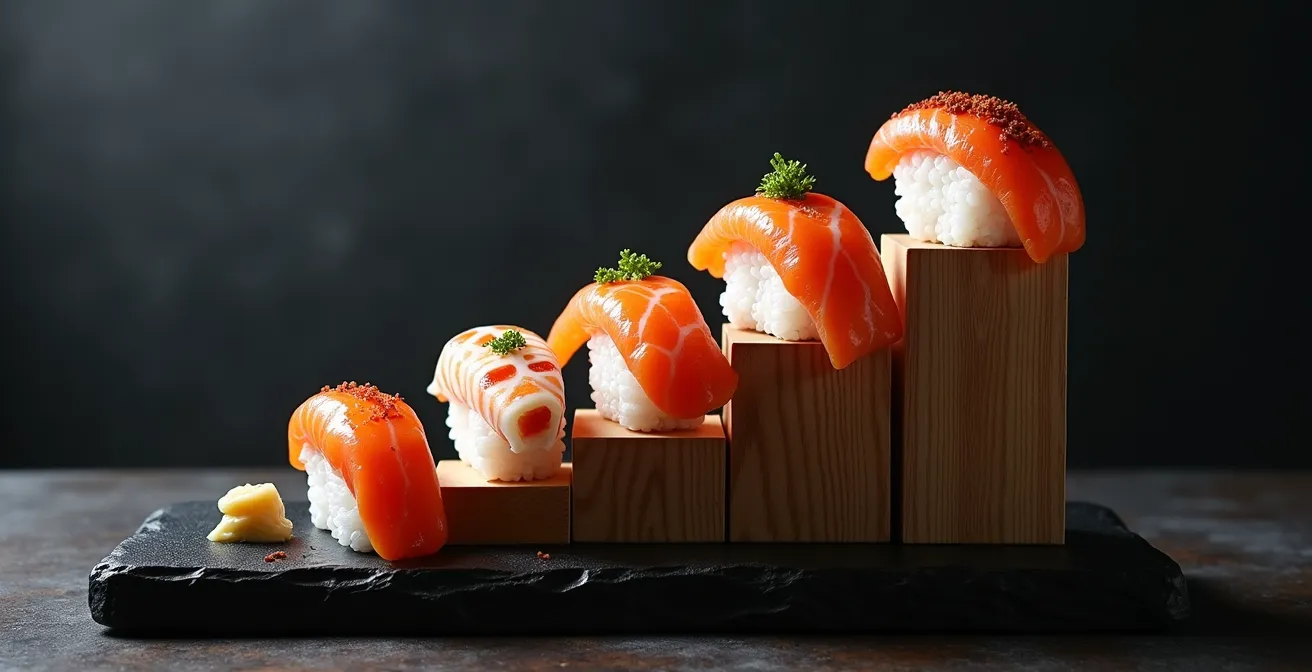
As this visual metaphor suggests, each step up the ladder represents an increase in confidence. However, even within a full omakase, you are not entirely without a voice. The art lies in communicating your preferences diplomatically, distinguishing between a severe allergy and a simple dislike. Framing your limitations positively allows the chef to see them as a creative challenge rather than a nuisance. Honesty about your preferences is an essential part of the “Trust Contract.”
Your Action Plan: Diplomatic Disclosure for Preferences
- Lead with enthusiasm: Start by saying, “I’m very excited to try your recommendations and explore the menu.”
- State preferences clearly and concisely: “Just so you are aware, I have a textural challenge with items like squid or octopus.”
- Express gratitude and openness: Follow up with, “I would be grateful if we could explore the other wonderful items you have instead.”
- Frame your needs appropriately: Use the “Allergy vs. Aversion” spectrum to clarify the severity. Is it a deadly allergy or a strong dislike?
- Ask the confidence question when booking: Inquire, “With my specific limitations, will the chef be able to create a full and exciting experience?”
The ‘Market Price’ Trap: How to Avoid Surprise Bills at the End?
While many omakase menus are fixed-price, the experience often includes the option for additional, à la carte pieces at the end. This is where the term “market price” can introduce a significant financial variable, potentially leading to a surprise on your final bill. These items are often the most luxurious and seasonal offerings, like premium cuts of tuna (toro) or special varieties of sea urchin (uni), whose costs are not stable.
The term “market price” is not a gimmick; it reflects a volatile supply chain where the cost of a single ingredient can shift dramatically. For instance, reports show that market prices for premium ingredients like uni can fluctuate by 20-50% daily depending on the catch, quality, and auction results in Japan. The restaurant passes this fluctuating cost directly to the consumer. This isn’t meant to be deceptive, but it does require the diner to be a proactive financial participant.
So, how do you enjoy these delicacies without risking budget blow-out? The answer is simple: ask. In the world of high-end dining, it is perfectly acceptable and even wise to inquire about costs. You can state your budget upfront when making a reservation, or politely ask for the approximate price of a specific item before ordering. A simple, “That sounds amazing. To help me decide, could you give me an idea of the price for the special uni today?” is a graceful way to gather information. This transparency protects both you and the restaurant from any end-of-meal awkwardness. Think of it as checking the stock price before executing a trade in your palate portfolio.
How Long Should a 20-Course Omakase Dinner Actually Take?
The time you spend at the sushi counter—often two hours or more for a lengthy menu—is not dead time; it’s a crucial component of the value you’re paying for. A 20-course omakase is not a race. It’s a deliberately paced performance, and rushing it would be like fast-forwarding through a movie. The extended duration serves several critical functions that directly contribute to the quality and enjoyment of the meal, justifying the investment of both time and money.
First, there’s the science of taste. Each piece of nigiri is a delicate construction. According to some sushi experts, the sushi rice maintains its ideal temperature and texture for only about 30 seconds after being served. The slow, one-piece-at-a-time pacing ensures you experience each creation at its absolute peak. Second, the pacing is a narrative tool. As a case study from the Michelin Guide describes, a multi-course omakase is often structured like a theatrical performance in three acts. It begins with lighter appetizers and white fish (Act I), builds to a crescendo with richer, fattier, and more intensely flavored pieces (Act II), and concludes with a gentle denouement of tamago (egg omelet) and soup (Act III). This arc creates a complete and satisfying story, turning the meal into a “memorable feast.”
This structure prevents palate fatigue and allows you to appreciate the subtle differences between each piece. The time between courses is a deliberate “rest” that cleanses the palate and builds anticipation. Rushing this process would be like hearing all the notes of a symphony played at once—you’d get the information but lose the music entirely. The duration is not a bug; it’s a feature, and a significant part of the “Experience Equity” you are purchasing.
How Much of Your Bill Pays for the Manhattan Real Estate?
A considerable, often overlooked, portion of your omakase bill is allocated to “Experience Equity”—the value derived from the environment itself. This is especially true in prime metropolitan locations like Manhattan, where real estate costs are astronomical. You are not just paying for a seat; you are paying for the exclusivity that the high cost of that seat creates. The limited number of seats at an 8- or 10-person counter is a direct result of the high rent per square foot. This scarcity is a key ingredient in the luxury recipe.
This is a deliberate business and marketing strategy. The small, intimate setting fosters a direct, personal connection with the chef, which is a cornerstone of the omakase value proposition. It ensures that the chef’s attention is not divided and that every diner receives a bespoke experience. The premium rent is a filter, ensuring an environment of quiet reverence and focus on the food. As one industry analysis bluntly puts it, the cost of the location is part of the product itself.
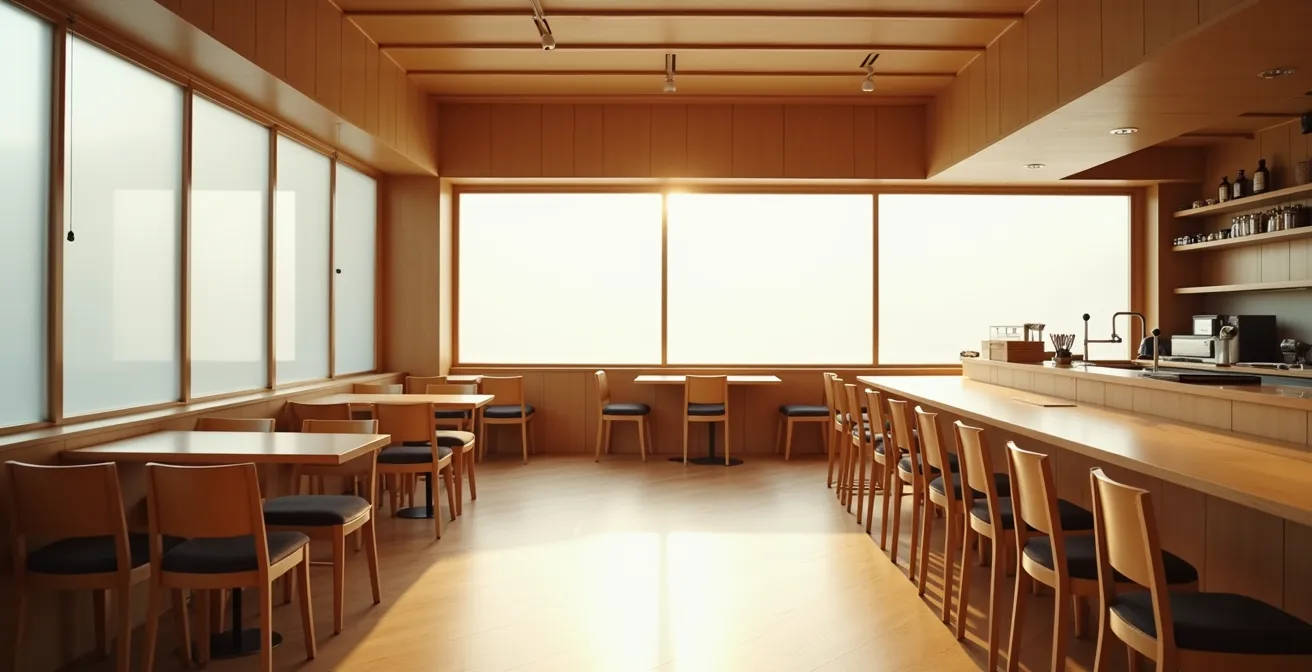
The high rent is not just a cost; it’s a tool to engineer the luxury experience itself.
– Industry Analysis, Restaurant Economics Study
When you sit at that counter, you are occupying a highly valuable piece of real estate for two or more hours. Part of your bill is, quite literally, rent. This cost ensures that the environment is controlled, serene, and free from the hustle of a larger, more “economical” restaurant. Recognizing this helps you understand that you are investing not only in food and skill but also in a carefully engineered bubble of tranquility and exclusivity. For many, this guaranteed atmosphere is a significant part of the return on their investment.
Kaiseki or Omakase: Which Fine Dining Style Offers More Variety?
For a beginner exploring Japanese fine dining, it’s easy to see “omakase” as the only option. However, understanding its counterpart, kaiseki, is crucial for making an informed investment in your dining experience. Think of it as choosing between different asset classes. Omakase is like investing deeply in a single, high-performing stock (the art of sushi), while kaiseki is like investing in a diversified mutual fund that covers the entire market (a broad range of Japanese cooking techniques).
The primary difference lies in the type of variety offered. Omakase provides a deep dive into one specific art form, usually sushi, showcasing nuanced variations in fish, cuts, and aging techniques. It’s a masterclass in a single subject. Kaiseki, on the other hand, is a highly structured, multi-course meal that presents a broad spectrum of culinary methods: grilling (yakimono), steaming (mushimono), frying (agemono), and more. It is a celebration of seasonality and balance across different cooking styles.
The choice between them depends entirely on your investment goals. Are you looking to become a connoisseur of sushi, or do you want a grand tour of Japanese cuisine? A comparative look at the two styles highlights their distinct approaches to variety and the dining experience.
| Aspect | Kaiseki | Omakase |
|---|---|---|
| Structure | Highly ritualized, fixed sequence | Flexible, chef decides mid-course |
| Variety Type | Broad culinary techniques (grilling, steaming, frying) | Deep dive into one art form (usually sushi) |
| Seasonality | Strictly seasonal menu changes | Daily variations based on market |
| Interaction | Formal, distant service | Intimate chef engagement |
For a beginner, a kaiseki meal can sometimes feel less intimidating because the variety is broader, increasing the odds you’ll find many things you enjoy. However, an omakase offers a more personal and educational interaction. Neither is inherently “better,” but they offer different types of “returns” on your investment. Knowing the difference allows you to allocate your dining budget to the experience that best suits your curiosity.
Key Takeaways
- Omakase is a “Trust Contract”: You are paying for the chef’s expertise and vision, not just a list of dishes.
- Value is multifaceted: The price covers premium ingredients, years of chef training, and the exclusive, intimate experience.
- Risk can be managed: Start with a less expensive lunch omakase and learn to communicate preferences diplomatically.
How to Navigate a Chef’s Choice Menu Without Dietary Anxiety?
The final, and perhaps most critical, component of ensuring a high “Return on Indulgence” is effective communication. For those with dietary restrictions or strong preferences, the idea of a blind menu can cause significant anxiety. However, in the world of true omakase, these limitations should not be a barrier. In fact, how a chef responds to your needs is a powerful indicator of the restaurant’s quality.
A world-class chef sees a dietary restriction not as an annoyance, but as a creative challenge. A case study of high-end establishments reveals that top chefs pride themselves on their ability to pivot and craft an equally stunning experience around a guest’s limitations. A dismissive or frustrated reaction to a politely stated allergy is a major red flag, signaling a poor service philosophy and a rigid, uninspired kitchen. Your investment is safer with a chef who embraces the challenge.
To facilitate this, it’s helpful to be equipped with the right language. Clear, concise communication is essential. You must inform the restaurant of any severe allergies at the time of booking. For preferences or less severe restrictions, a polite reminder upon being seated is appropriate. Using a few simple Japanese phrases can also show respect and facilitate understanding.
- To state allergies: “Arerugi ga arimasu” (I have allergies).
- To express a preference politely: Always use “onegaishimasu” (please) when making a request.
- To ask what something is: “Kore wa nan no sakana desu ka?” (What fish is this?).
- To show appreciation for an accommodation: A simple “Oishii” (delicious) is a powerful acknowledgment.
Ultimately, a successful omakase experience for someone with restrictions is a partnership. Your role is to provide clear, polite, and timely information. The chef’s role is to apply their creativity to deliver a memorable meal within those parameters. By managing this interaction effectively, you transform a potential risk into an opportunity for a truly personalized and rewarding culinary investment.
By viewing omakase through this financial lens, you can move beyond the simple question of “is it worth it?” and answer the more important question: “Is it the right investment for me?” Equipped with an understanding of the costs, risks, and potential returns, you are now prepared to make a decision that satisfies both your curiosity and your wallet.
Frequently Asked Questions about Omakase
Should I ask about prices upfront?
Yes, it’s completely acceptable to state your budget when making reservations or ask about price ranges for market-priced items. Top-tier restaurants appreciate clarity and want you to be comfortable with your spending.
What’s the difference between fixed-price and market-price omakase?
A fixed-price omakase has one set cost for the entire pre-determined meal. Market-price items are typically extra, optional pieces you can order after the main course is finished, with prices that fluctuate based on daily availability.
How do I politely inquire about specific item prices?
A simple and polite way is to frame it as a decision-making tool. You can say: “To help me choose, could you let me know the approximate price for the special Uni today?” This shows you are engaged and mindful, not just cheap.