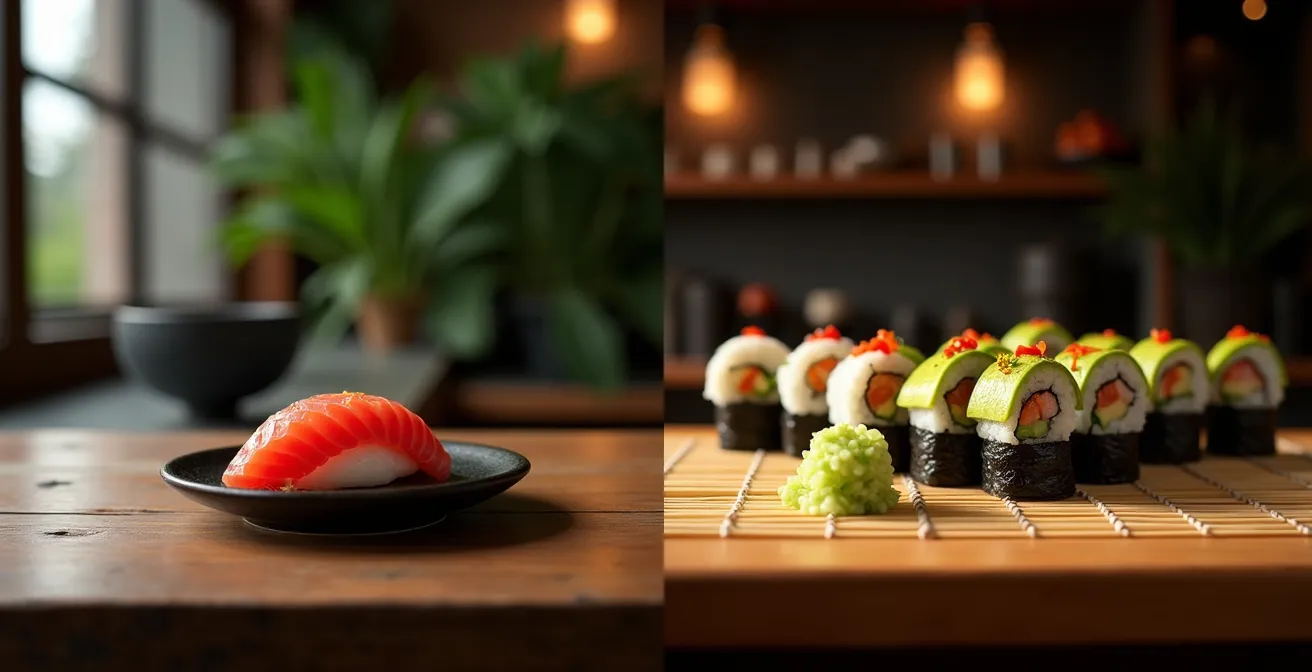
The debate over the California Roll’s authenticity is not about a simple “yes or no,” but about understanding a global story of culinary adaptation.
- Western ingredients like cream cheese and mayonnaise are “culinary translations,” replacing traditional fats to suit a familiar palate.
- Even “traditional” ingredients like salmon are modern additions to sushi, driven entirely by global logistics, not ancient custom.
Recommendation: To truly understand sushi, one must look beyond fixed recipes and examine its fluid history, from an ancient preservation method to a global phenomenon.
The California roll sits at a fascinating cultural crossroads. For millions, it is the friendly, accessible entry point into the world of sushi—a familiar combination of crab, avocado, and cucumber with the seaweed discreetly tucked inside. For purists, however, it represents a fundamental distortion of Japanese culinary heritage, or washoku. The debate is often framed as a simple binary: authentic versus fake. This line of questioning, however, may obscure a more interesting reality.
The standard origin story, placing its invention in either Los Angeles or Vancouver in the 1970s to appeal to Western tastes, is only the beginning of the narrative. To truly understand the California roll and its kin, we must move beyond a rigid definition of authenticity. Instead, we can view these adaptations through the lens of a culinary sociologist, analyzing them as artifacts of globalization. Each “inauthentic” ingredient tells a story of economic pressure, logistical prowess, and the complex process of translating a dish from one culture to another.
This article deconstructs the key adaptations that define Westernized sushi. By examining the “why” behind ingredients like mayonnaise and cream cheese, and even questioning the traditional status of mainstays like salmon, we uncover the hidden forces that shape what we call sushi today. The journey will take us from the Mekong Delta to the fjords of Norway, revealing that the evolution of sushi is a story far older and more dynamic than the controversy over a single roll.
To navigate this complex culinary history, this article breaks down the evolution and adaptation of sushi into distinct components. The following summary outlines the key areas of discussion, from the introduction of Western condiments to the surprising origins of the dish itself.
Summary: The Global Evolution of a Japanese Tradition
- How Did Mayonnaise Become a Staple in Western Sushi Adaptation?
- Mango and Strawberry: Where Do Japanese Chefs Draw the Line?
- Why Did Cream Cheese Become the Primary fat Source in American Sushi?
- How Global Logistics Changed Japanese Menus?
- Naruto Style: Is Sushi Without Rice Still Sushi?
- Why Were Nigiri Pieces 3 Times Larger in the 1800s Than Today?
- How Fermented Fish Techniques Traveled From the Mekong to Japan?
- How to Eat Sushi Responsibly Without Supporting Overfishing?
How Did Mayonnaise Become a Staple in Western Sushi Adaptation?
The appearance of spicy mayonnaise drizzled over a maki roll is often cited as a prime example of sushi’s Westernization. From a purist perspective, the rich, egg-based condiment has no place in traditional Japanese cuisine. However, its widespread adoption is not random; it serves a distinct functional purpose in the process of culinary translation. Traditional sushi derives much of its richness and coveted umami flavor from high-quality, fatty fish like toro (fatty tuna). These premium cuts are expensive and possess a flavor profile that can be challenging for uninitiated palates.
Mayonnaise, particularly when mixed with sriracha or other chili sauces, offers a familiar and cost-effective substitute for this richness. It delivers a creamy texture and a fat content that satisfies the Western palate’s expectations, acting as a bridge to the more subtle flavors of raw fish. This strategy proved to be a commercial success. As one market analysis notes, the incorporation of local ingredients, including spicy mayo rolls, has directly contributed to sushi’s broad appeal and market growth. The condiment effectively lowered the barrier to entry, making sushi seem less foreign and more inviting.
Case Study: The Spicy Tuna Roll as Gateway Sushi
The spicy tuna roll is a quintessential example of this phenomenon. By mixing minced, lower-grade tuna with spicy mayonnaise, sushi chefs created a dish that was both flavorful and texturally familiar to American diners. This innovation became a template for countless ‘spicy’ variations, from salmon to yellowtail. It successfully catered to a demand for novel dining experiences while grounding them in the comforting, creamy textures common in Western food, demonstrating a successful adaptation that balances foreign and familiar elements.
Therefore, the role of mayonnaise in sushi is less a corruption and more a pragmatic adaptation. It solved a specific problem: how to replicate the satisfying mouthfeel of traditional, high-fat sushi for a new market that was both price-sensitive and hesitant about unfamiliar textures. It became a key tool in the acclimatization of the Western palate to the world of sushi.
Mango and Strawberry: Where Do Japanese Chefs Draw the Line?
If mayonnaise and avocado represent the first wave of sushi’s globalization, the introduction of sweet fruits like mango, strawberry, and kiwi marks a more debated frontier. For many, including some innovative Western chefs, this is where the line between creative fusion and conceptual breakdown begins to blur. The fundamental grammar of traditional sushi is built on a balance of savory (fish, soy sauce), sour (vinegared rice), and subtle sweetness, but the overt, sugary notes of tropical fruit challenge this foundation. The question then becomes: at what point does a dish cease to be an evolution of sushi and become something else entirely?
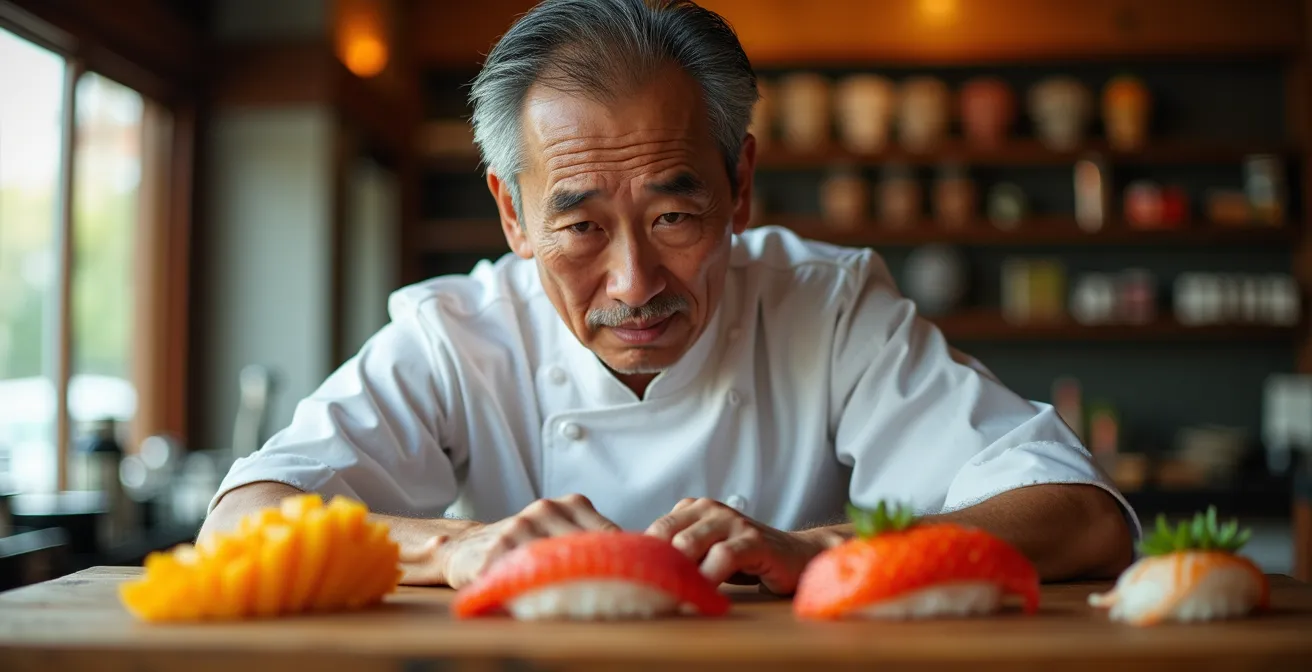
The perspective of a traditional itamae (sushi chef) is often rooted in the principle of enhancing, not masking, the core ingredient. The goal is to present the fish in its best possible state, and every other element—from the rice to the wasabi—is there to support it. From this viewpoint, a powerful flavor like mango does not complement delicate fish; it dominates it. However, the global palate is not bound by the same rules. In many culinary traditions, the combination of sweet and savory is commonplace, making fruit-filled rolls a logical and appealing step for consumers.
Plant-based sushi has become one of the most significant shifts in the sushi industry… Chefs are experimenting with jackfruit, roasted bell peppers, avocado, and marinated mushrooms.
– Toast POS, Top 15 Sushi Scene Trends 2025
This push towards new ingredients isn’t limited to fruit. The rise of plant-based cuisine is introducing a host of new elements to the sushi counter. This trend suggests that the “line” is not a fixed boundary but a constantly shifting cultural consensus. While a master chef in Tokyo might draw a hard line at fruit, an innovative chef in Miami or São Paulo sees it as just another color in their culinary palette.
Why Did Cream Cheese Become the Primary fat Source in American Sushi?
Alongside mayonnaise, cream cheese is perhaps the most quintessentially American addition to the sushi canon. Its inclusion, most famously in the Philadelphia roll, is a direct and almost literal example of culinary translation. The ingredient’s journey into the maki roll was not an arbitrary choice but a deliberate effort to map a familiar American flavor profile onto a foreign food structure. This move was instrumental in demystifying sushi for a generation of diners.
The logic becomes clear when one considers the classic American bagel with lox and cream cheese. This beloved combination of smoked salmon, tangy and rich cream cheese, and a starchy base was a pre-existing, trusted flavor profile. By reassembling these components within a seaweed-and-rice wrapper, chefs created a dish that was novel in form but deeply familiar in taste. The cream cheese provided the fatty, creamy element that the American palate was accustomed to, much like mayonnaise did in other rolls. It offered a textural and flavor experience that was safe and predictable, reducing the perceived risk of trying “raw fish.”
Case Study: The Philadelphia Roll’s Cultural Translation
The Philadelphia roll is more than just a menu item; it’s a sociological artifact. It represents a direct cultural translation of the lox and cream cheese bagel into sushi form. According to a report on the history of American sushi, this familiar flavor combination was a critical factor in easing American diners into sushi consumption. By presenting known tastes in a new format, it built a bridge of trust and paved the way for more adventurous eating, proving the power of translating, rather than simply importing, a foreign cuisine.
Ultimately, cream cheese became a primary fat source in American sushi because it was not seen as a foreign ingredient. It was a domestic flavor anchor in an otherwise unfamiliar sea. Its success demonstrates that the most effective culinary adaptations often work by finding a point of commonality between two distinct food cultures, creating a hybrid that is embraced by the new audience as their own.
How Global Logistics Changed Japanese Menus?
While purists often criticize Western additions to sushi, many are unaware that one of Japan’s most popular sushi toppings today—salmon—is itself a modern, foreign import. The story of how Norwegian salmon entered the highly traditionalist Japanese market is a powerful lesson in logistical determinism, where supply chains and marketing can redefine what is considered “traditional.” Until the 1980s, the Japanese did not eat raw salmon. Pacific salmon was known to have parasites, and the idea of consuming it uncooked was unthinkable.
This changed due to a concerted effort by Norway. Faced with a surplus of its high-quality, parasite-free farmed Atlantic salmon, the Norwegian government and seafood industry launched “Project Japan” in the mid-1980s. Their goal was to convince the skeptical Japanese market that their salmon was safe and delicious when eaten raw. It was a decade-long struggle against deep-seated culinary traditions. The success of this campaign was staggering. As official Norwegian data shows, Project Japan’s remarkable success shows that what began as a 2-tonne export in 1980 grew to over 45,000 tonnes two decades later.

Today, salmon is ubiquitous in sushi restaurants across Japan and worldwide. This “tradition” is less than 40 years old and was born not from ancient Japanese practice, but from modern aquaculture, refrigerated transport, and a brilliant international marketing strategy. As the CEO of the Norwegian Seafood Council, Christian Chramer, states, “Around 30% of Norwegian salmon ends up as sushi and is consumed raw.” This fact fundamentally challenges the purist argument. If salmon, a Norwegian import, can be accepted as a core part of modern sushi, on what grounds can avocado or cream cheese be definitively rejected?
Naruto Style: Is Sushi Without Rice Still Sushi?
The debate over authenticity takes a fascinating turn with the emergence of “Naruto style” rolls, where fish and vegetables are wrapped in a thin sheet of cucumber instead of rice and seaweed. This adaptation, driven by low-carb and gluten-free dietary trends, strikes at the very heart of the question: what is sushi? For many, the answer lies in the etymology of the word itself. If a roll has no rice, can it still be called sushi?
This is not just a philosophical question but a linguistic one. The argument hinges on the historical meaning of the food’s name. It is a common misconception that “sushi” means “raw fish.” In reality, the term refers to the rice and its preparation.
The Etymological Argument
As linguistic and culinary historians point out, the word “sushi” (寿司) is a combination of two words: ‘su’, meaning vinegar, and ‘meshi’, the word for rice. Thus, as noted in a detailed analysis on Wikipedia, sushi literally means “vinegared rice.” This etymological foundation suggests that a riceless roll is a fundamental contradiction in terms. Calling it sushi would be akin to calling something a “breadless sandwich.” From this strictly literal perspective, Naruto-style rolls are not a form of sushi, but an entirely different dish that merely borrows the format and ingredients of a maki roll.
However, language and cuisine are both living, evolving systems. While the etymological fallacy—the belief that a word’s original meaning is its only true meaning—is a powerful purist argument, it ignores centuries of evolution. Words change their meaning based on common usage, and “sushi” in the popular global imagination has become synonymous with a broader category of Japanese-style rolls, whether they contain rice or not. This tension between historical definition and modern usage is central to the entire authenticity debate.
Why Were Nigiri Pieces 3 Times Larger in the 1800s Than Today?
The argument for a fixed, unchanging “authentic sushi” often overlooks the fact that sushi has been continuously evolving within Japan for centuries. A striking example of this is the size of nigiri-zushi. Today, a piece of nigiri is a delicate, often two-bite morsel, a format associated with refined dining. However, in the Edo period (1603-1868), when nigiri was first popularized in Tokyo (then called Edo), it was a very different food. Pieces were often two to three times larger than they are today.
This larger size was a direct reflection of its function. Edo-mae (Edo-style) sushi was not high cuisine; it was fast food. It was sold from street-side stalls to laborers and townspeople looking for a quick, substantial, and inexpensive meal. The large, hand-pressed block of rice topped with a slice of cured or cooked fish was designed to be filling and easy to eat on the go. It was the 19th-century equivalent of a hot dog or a slice of pizza, a meal in a single handful.
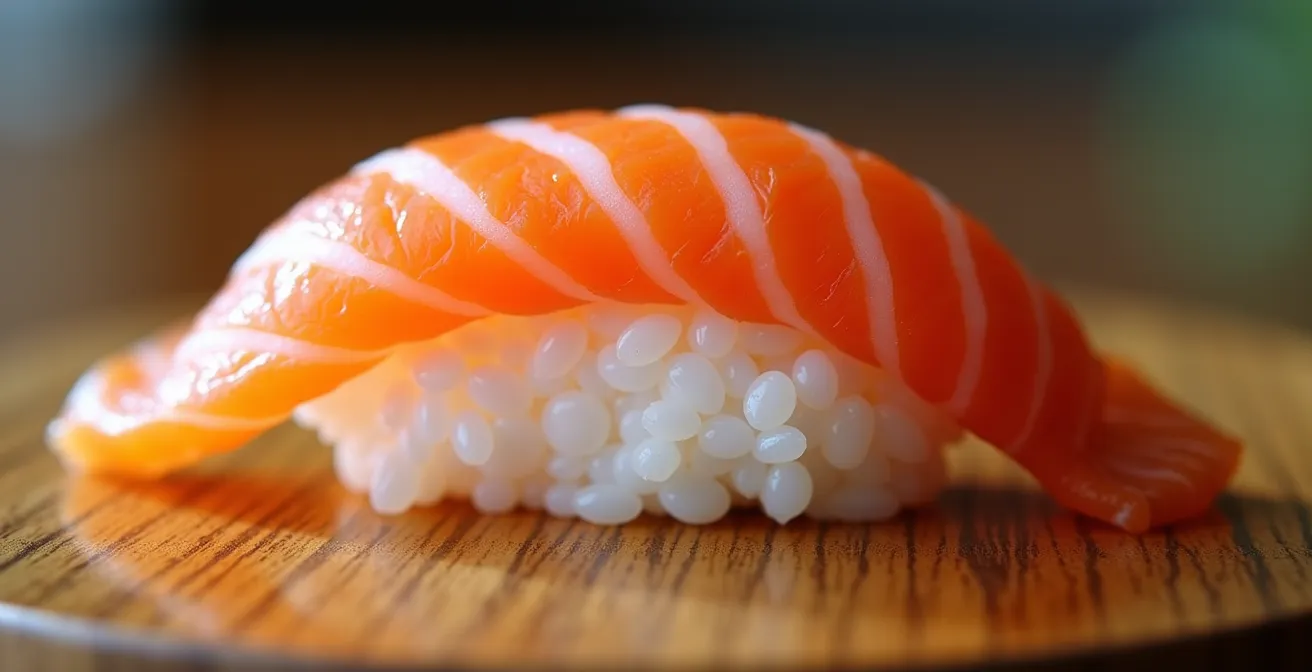
The transformation of nigiri into the smaller, more elegant form we know today occurred over the 20th century. Several factors contributed to this “shrinkage.” The advent of refrigeration allowed for the use of fresh, high-quality raw fish, turning sushi into a more premium product. As it moved from street stalls into formal restaurants, the emphasis shifted from sustenance to artistry. The smaller size allowed the itamae to focus on perfect balance, texture, and presentation. It also allowed diners to sample a wider variety of fish in a single meal, a hallmark of the modern omakase experience.
This history shows that evolution is not a uniquely Western phenomenon. Sushi’s form has always been shaped by the social, economic, and technological context of its time, even within Japan. The idea of a single, timelessly “authentic” size is a modern fiction.
How Fermented Fish Techniques Traveled From the Mekong to Japan?
Perhaps the most profound challenge to modern notions of sushi authenticity lies in its ancient origins. The pristine slice of raw fish on perfectly vinegared rice is a relatively recent invention. The earliest form of sushi, known as narezushi, had a completely different purpose and form. It was not a dish to be eaten fresh but a method of fish preservation that originated in Southeast Asia, likely around the Mekong River basin, as far back as the 2nd century.
The technique involved packing gutted fish in salted, cooked rice. The rice would then undergo a natural lactic acid fermentation over several months. This fermentation process preserved the fish while breaking it down and imparting a powerful, sour, and intensely savory flavor. Crucially, in this original method, the rice was not meant to be eaten. Its sole purpose was to act as the fermentation medium. Once the fish was sufficiently preserved, the rice, which had turned into a smelly, glue-like paste, was scraped off and discarded. The fish was all that was consumed.
Narezushi: The Missing Link in Sushi’s Evolution
This preservation technique spread from Southeast Asia through China and arrived in Japan around the Nara period (8th century). In Japan, this evolved into regional specialties like funa-zushi, made with crucian carp from Lake Biwa, which is still prepared today. This early narezushi is the “missing link” in sushi’s history. It establishes that the original function of rice in sushi was not for consumption but for preservation. The idea of eating the fish and the rice together came much, much later, as fermentation times shortened and the rice remained palatable.
This historical fact radically reframes the entire authenticity debate. Arguments over the “correct” type of fish or the inclusion of avocado seem minor when compared to the reality that the earliest form of sushi involved eating fermented fish and throwing the rice away. It demonstrates that the core identity of sushi has never been static; it has transformed from a preservation method into a form of fast food, and finally, into a global culinary art form.
Key takeaways
- Western adaptations are often “culinary translations” of flavor profiles, substituting ingredients like mayonnaise for the fat of premium fish.
- What is considered “traditional” is often a modern invention of logistics, as seen with Norwegian salmon’s introduction to Japan in the 1980s.
- Sushi’s true origin lies in fish preservation, where rice was used for fermentation and then discarded, challenging the entire modern concept of the dish.
How to Eat Sushi Responsibly Without Supporting Overfishing?
The globalization of sushi, from the California roll to salmon nigiri, has created a worldwide demand that places immense pressure on marine ecosystems. The popularity of certain species, particularly bluefin tuna, has led to severe overfishing and pushed populations to the brink of collapse. As consumers, engaging with sushi in the 21st century carries a responsibility to make choices that support sustainability. Moving beyond the debate of authenticity, the more pressing question now is how to enjoy sushi ethically.
A key strategy is diversification. The heavy focus on a few “popular” fish like tuna, salmon, and yellowtail concentrates fishing pressure. By being open to trying less common but more sustainable species, consumers can help alleviate this strain. This often means engaging with the chef and asking questions—not just “what’s fresh?” but also “what’s sustainable?” Many chefs are passionate about this topic and are eager to guide diners toward responsible choices, such as farmed fish from reputable sources or wild-caught fish from well-managed fisheries. Norway, for instance, has built a massive industry by managing its resources, now accounting for approximately 53% of the global salmon market.
The most significant shift, however, may be embracing the next wave of culinary innovation: plant-based sushi. With an estimated 65% of people globally trying to eat less meat, chefs are responding with incredible creativity. They are using ingredients like marinated tomatoes to mimic the texture of tuna, or thinly sliced, roasted bell peppers to stand in for fish. This is not merely a vegan alternative; it is a new frontier for sushi, one that offers complex flavors without the ecological footprint.
Your Action Plan for Responsible Sushi Consumption
- Diversify Your Choices: Explore the menu beyond tuna and salmon. Ask for chef’s recommendations on less common but more sustainable fish like mackerel or arctic char.
- Ask About Sourcing: Inquire where the fish comes from. Is it wild-caught or farmed? Reputable restaurants should be transparent about their supply chain.
- Embrace Plant-Based Options: Try innovative vegetable or fruit-based rolls. These dishes reduce pressure on fish stocks and showcase a different kind of culinary creativity.
- Understand Certifications: Look for certifications like the Marine Stewardship Council (MSC) for wild fish or the Aquaculture Stewardship Council (ASC) for farmed fish, which indicate sustainable practices.
- Re-evaluate “Bluefin”: Given the critically endangered status of bluefin tuna, consider it a rare luxury to be avoided, or ensure it comes from a verifiably sustainable source.
Ultimately, eating sushi responsibly means becoming an informed and conscious consumer. It involves shifting our focus from a rigid idea of “authenticity” to a more dynamic appreciation for a cuisine that continues to evolve, while ensuring that this evolution does not come at the expense of the oceans.
By engaging with sushi’s complex history and its modern ecological challenges, your next meal can be more than just a culinary experience; it can be a conscious choice that participates in the next chapter of sushi’s ongoing story.