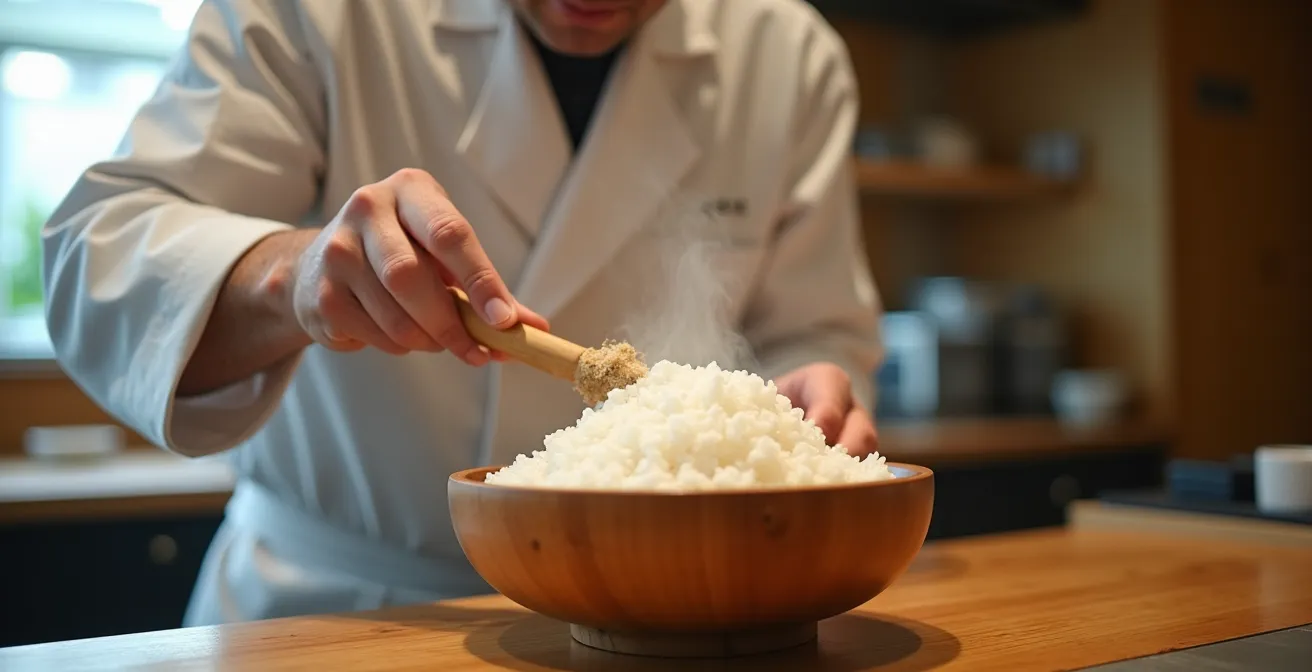
Achieving perfect *shari* is not about following a recipe; it is a rapid, precise control of starch chemistry at a molecular level.
- The moment vinegar hits hot rice is a race against time; slow mixing causes starch to break down, resulting in a mushy texture.
- Storing *shari* below body temperature—especially in a refrigerator—triggers irreversible starch retrogradation, creating a hard, grainy texture.
Recommendation: Ditch volume measurements. Use a digital scale to weigh your rice, water, and *sushi-zu* components for absolute consistency, and always mix the vinegar in with fast, cutting motions while the rice is above 65°C.
The sublime experience of high-quality sushi hinges not on the fish, but on the rice. Yet for many detail-oriented cooks, achieving that perfect *shari*—each grain distinct, glossy, and imbued with a delicate balance of acidity and umami—remains an exercise in frustration. One batch is a sticky, mushy paste; the next is bland and hard. The common advice to simply “rinse the rice well” or “fold in the vinegar” barely scratches the surface. These instructions miss the fundamental point: creating *shari* is less an act of cooking and more an act of applied chemistry.
The transformation from steamed rice to perfect *shari* is a series of time-sensitive, temperature-dependent chemical reactions. The secret lies not in a mystical technique but in a deep understanding of starch gelatinization, acid-based protein denaturing, and the crystalline process of starch retrogradation. To master *shari* is to master the manipulation of these forces. It requires an obsessive focus on details that most recipes omit, from the specific angle of your rice paddle to the ambient humidity of your kitchen.
This guide deconstructs the process from a Gohan-Sommelier’s perspective. We will move beyond vague instructions to explore the scientific ‘why’ behind each critical step. We will analyze the molecular differences between vinegar types, calculate ratios with gram-level precision, and understand the physics of proper storage. By focusing on the chemistry, you will learn to control the outcome every single time, transforming your sushi rice from a source of anxiety into a pillar of culinary perfection.
To navigate this deep dive into the science of *shari*, this guide is structured to answer the most critical questions an aspiring rice master faces. The following summary outlines the key chemical and technical challenges we will solve.
Summary: The Science and Technique of Perfect Shari
- Why Your Rice Becomes Mushy When Mixed With Vinegar Too Slowly?
- Red Akazu vs. White Rice Vinegar: Which Pairs Best With Fatty Tuna?
- The Storage Mistake That Makes Sushi Rice Hard Within an Hour
- How to Calculate the Ideal Vinegar Ratio for 3 Cups of Uncooked Rice?
- Can You Revive Leftover Shari Without Losing Its Unique Texture?
- Why Does Cold Rice Feel Hard and Grainy on the Tongue?
- Does Sugar Content Affect the Shine of the Rice Grains?
- How Many Times Must You Rinse Rice to Achieve Perfect Separation?
Why Your Rice Becomes Mushy When Mixed With Vinegar Too Slowly?
The transformation from steamed rice to *shari* is a race against temperature. The mushy texture that plagues many attempts is a direct result of failing to cool the rice fast enough while incorporating the vinegar. When rice is cooked, its starch granules undergo gelatinization, swelling with water and becoming soft and vulnerable. This process peaks when the rice is hottest. If you mix the vinegar solution too slowly, you are essentially crushing these delicate, over-saturated starch structures before the vinegar’s acid and the fanning’s evaporative cooling can firm them up.
Furthermore, the process is chemically time-sensitive. The ideal texture is achieved when the vinegar is absorbed while the rice is still hot enough to be porous but not so hot that its starches degrade. As research confirms that rice grains above 65°C (150°F) are in this peak fragile, gelatinized state, the goal is to coat every grain and begin cooling it below this threshold as quickly as possible. The acid in the vinegar helps to tighten the proteins on the grain’s exterior, creating a protective barrier. Slow mixing means prolonged heat exposure and physical damage, leading to starch leakage and a sticky, mashed consistency.
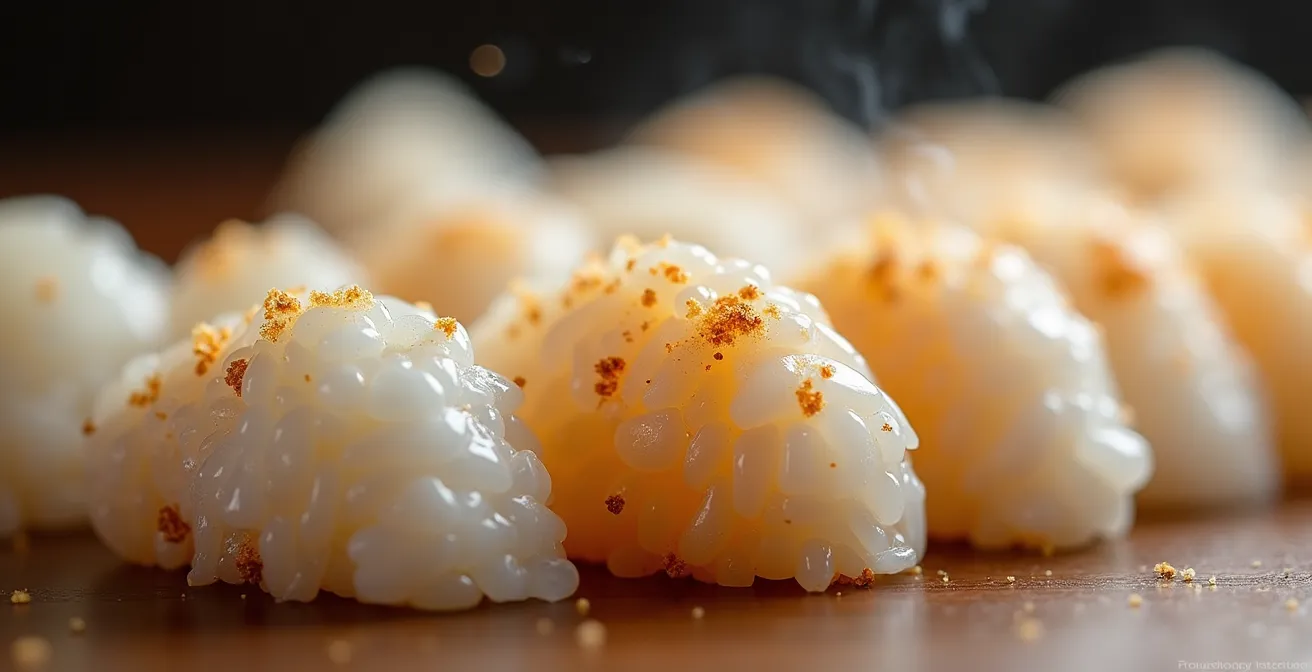
The solution is not just speed, but technique. An *itamae* uses a precise, slicing motion known as *kiru-yōni* (切るように), meaning “to cut.” This method, combined with simultaneous fanning, separates the grains to create air channels, maximizing surface area for rapid evaporative cooling and preventing the paddle from crushing the rice. It is a controlled, aggressive cooling process that locks in the vinegar’s flavor while setting the starches for that perfect al dente texture.
Red Akazu vs. White Rice Vinegar: Which Pairs Best With Fatty Tuna?
The choice of vinegar is not merely a matter of flavor, but of chemical synergy, especially when dealing with rich, fatty fish like *ōtoro* (fatty tuna). While standard white rice vinegar provides a sharp, clean acidity that “cuts through” fat, traditional Edomae-style sushi masters prefer red vinegar, or *akazu*. The reason lies in its unique chemical composition, which is a byproduct of its production from aged sake lees rather than fermented rice.
This aging process gives *akazu* a significantly higher concentration of amino acids, the building blocks of umami. When this umami-rich vinegar is paired with the natural glutamates present in fatty fish and a touch of soy sauce, it creates a powerful umami synergy. Instead of just contrasting the fat, it amplifies the fish’s inherent savory depth, resulting in a more complex and lingering flavor profile. White rice vinegar, with its low amino acid content, simply cannot achieve this level of flavor complexity.
As Chef Yoshio Sakuta of the Michelin-starred Sushi Sakuta demonstrates, the application can be even more nuanced. He uses a blend of five vinegars and adjusts the temperature of his *akazu*-seasoned *shari* based on the topping. For exceptionally fatty fish like *nodoguro* and *kinmedai*, he presses them onto hotter rice, using the heat to gently render the fat and further enhance the umami synergy with the warm, malty notes of the *akazu*. This is a masterful control of both chemistry and temperature. The following table breaks down the fundamental differences. As noted in the Michelin Guide, the choice between these vinegars is a foundational decision in defining a sushi restaurant’s character.
| Characteristic | Red Akazu | White Rice Vinegar |
|---|---|---|
| Production Method | Aged sake lees fermentation | Rice fermentation |
| Amino Acid Content | High (umami-rich) | Low |
| Flavor Profile | Malty, complex, savory | Sharp, clean, acidic |
| Effect on Fatty Fish | Enhances umami synergy | Cuts through fat |
| Historical Use | Original Edomae tradition | Modern adaptation |
| Rice Color | Reddish-brown tint | White/translucent |
The Storage Mistake That Makes Sushi Rice Hard Within an Hour
The single most destructive mistake in handling *shari* is refrigeration. The desire to “keep it fresh” leads many to place their carefully prepared rice in the fridge, only to find it unpleasantly hard, dry, and grainy within an hour. This is not spoilage; it is a chemical process called starch retrogradation. Once cooked rice cools below a certain temperature, its branched starch molecules (amylopectin) begin to realign themselves into a tightly packed, crystalline structure. This process squeezes out the water molecules that were trapped during cooking, resulting in a firm, dry texture that the tongue perceives as “hard.”
The refrigerator is the perfect environment to accelerate this process. In fact, as scientific studies confirm that storing cooked rice at 4°C (39°F) rapidly accelerates this crystallization. Once retrogradation is fully established, it is largely irreversible, even with reheating. This is why leftover *shari* never tastes as good as it did when fresh. Professional sushi restaurants never refrigerate their rice during service. Instead, they employ a strict protocol to maintain the *shari* at or near human body temperature (around 30-35°C or 86-95°F), the optimal range to halt retrogradation and preserve the ideal texture.
This is achieved by using insulated containers, often traditional wooden *hangiri* or *ohitsu* bowls, which naturally regulate moisture. The rice is covered with a damp cloth to prevent the surface from drying out, and the entire container is often placed inside a larger insulated box (like a Cambro or styrofoam cooler) to maintain a stable temperature for hours. This meticulous temperature control is the only way to ensure every piece of nigiri served has the same perfect, tender bite.
Action Plan: Auditing Your Shari Storage Protocol
- Temperature Check: Measure the temperature of your “room temperature” storage spot. Is it consistently between 30-35°C, or does it fluctuate wildly?
- Container Material: Are you using a plastic or metal bowl that traps condensation, or a wooden *hangiri* that breathes and wicks away excess moisture?
- Moisture Management: Inventory your covering method. Are you using a dripping wet cloth that makes rice soggy, or a perfectly damp cloth that matches the rice’s surface humidity?
- Insulation Effectiveness: Assess your insulation. Is your container left on an open counter, or is it protected within a secondary insulated box to buffer against temperature drops?
- Service Duration Plan: How long do you need the rice to last? Plan to make smaller, fresher batches rather than one large batch you struggle to keep warm.
How to Calculate the Ideal Vinegar Ratio for 3 Cups of Uncooked Rice?
The pursuit of perfection in *shari* demands a departure from imprecise volume measurements like “cups” and “tablespoons.” The density of rice grains, sugar crystals, and salt varies, meaning a “cup” is never truly consistent. Professional kitchens operate on a foundation of weight-based ratios for unwavering consistency. A typical starting point for *sushi-zu* (the vinegar mixture) is a 4:2:1 ratio by weight of vinegar, sugar, and salt, applied to a specific weight of uncooked rice.
For instance, instead of starting with a vague “3 cups of rice,” a professional starts with a precise 500g of uncooked rice. The corresponding *sushi-zu* would then be calculated with precision: 80ml of vinegar (as its density is close to 1g/ml), 24g of sugar, and 10g of salt. This eliminates the ±20% variance that can occur with volume-based recipes, ensuring the flavor profile is identical from batch to batch. The table below illustrates the stark difference in precision between the two methods. According to commercial sushi equipment manufacturer Suzumo, this shift to weight is the first step any aspiring professional should take.
| Rice Amount | Volume Method | Professional Weight Method | Variance Risk |
|---|---|---|---|
| Base Recipe | 3 cups rice | 500g rice | ±20% accuracy |
| Vinegar Ratio | 0.5 cup | 80ml (4:2:1 ratio) | Consistent results |
| Sugar | 2 tablespoons | 24g | Precise sweetness |
| Salt | 2 teaspoons | 10g | Balanced flavor |
However, true mastery requires adapting this base ratio to environmental conditions. As taught at institutions like the Tokyo Sushi Academy, ambient humidity plays a crucial role. In a humid climate (over 70% humidity), the cooked rice will have already absorbed significant atmospheric moisture. In this case, the amount of *sushi-zu* should be reduced by up to 10% to avoid a wet, soggy finish. Conversely, in a very dry environment (under 30% humidity), the rice will be thirstier, and the *sushi-zu* quantity should be increased by 5-10%. The final visual check is paramount: the grains must have a brilliant sheen without looking wet, and they must separate easily when gently pressed.
Can You Revive Leftover Shari Without Losing Its Unique Texture?
While freshly made *shari* is always superior, it is possible to gently revive leftover rice that has been properly stored (i.e., not refrigerated). The goal is to reintroduce moisture and warmth without turning the rice to mush. The most effective professional technique is a gentle steam revival. This method avoids the direct, harsh heat of a microwave, which tends to create hot spots and uneven texture. Instead, it uses indirect, moist heat to softly warm the grains and relax the slightly stiffened starches.
To do this, the cold *shari* is placed in a steamer basket or a heatproof sieve. A small splash of sake, not water, is often added and gently fluffed through the rice. Sake is preferred as its alcohol content helps it evaporate cleanly without making the rice waterlogged, and it adds a subtle layer of complexity. The basket is then placed over a pot of simmering water, ensuring the rice itself does not touch the liquid. Covered and steamed for just 5 to 7 minutes, the rice will warm through, regaining much of its tender texture. It’s a delicate process that can save a batch for a casual meal like a *chirashizushi* bowl.
For an added layer of perfection, a trade secret can enhance the rice’s appearance both initially and after revival. As renowned Japanese cooking expert Makiko Itoh explains:
One trick of the trade that I learned from my mother, who used to run a very busy sushi restaurant: add a tiny bit of flavorless vegetable oil (about 1/8 teaspoon per rice-cooker cup) to create extra shine.
– Makiko Itoh, JustHungry Japanese Cooking 101
This micro-dose of oil helps coat each grain, creating a more durable gloss and a slight barrier against moisture loss, making the revival process even more effective. However, if the rice is too firm or has been refrigerated, it’s best to repurpose it for dishes where firmness is a virtue, such as pan-fried *yaki onigiri*.
Why Does Cold Rice Feel Hard and Grainy on the Tongue?
The unpleasant hardness of cold sushi rice is a direct result of its specific starch composition, a characteristic that also makes it perfect for *shari* when warm. Rice starch is composed of two molecules: long, straight chains of amylose and highly branched, tree-like structures of amylopectin. The textural magic of Japanese short-grain rice (Japonica varieties like Koshihikari) comes from its uniquely high amylopectin content.
Japanese rice typically contains 80-85% amylopectin, compared to 70-75% in long-grain Indica varieties. During cooking, these branched amylopectin molecules trap large amounts of water, creating the soft, slightly sticky, and tender texture prized in sushi. However, this high amylopectin content is also responsible for rapid retrogradation. As the rice cools below body temperature, these intricate branches begin to collapse and recrystallize into a more compact, orderly state. This process effectively squeezes the water molecules out from between the branches.
Your tongue is an incredibly sensitive instrument. It doesn’t just taste the hardness; it feels the physical result of this recrystallization. The “grainy” sensation is the detection of these newly formed, dense crystalline starch clusters, and the “dry” or “hard” feeling is the result of the expelled water. The higher the amylopectin content, the more pronounced this effect becomes upon cooling. Therefore, the very quality that makes Japanese rice ideally soft and moist when warm is the same quality that makes it unpleasantly hard and grainy when cold. This is a fundamental, unavoidable chemical property of high-grade sushi rice.
Does Sugar Content Affect the Shine of the Rice Grains?
Yes, but not just the content—the *type* of sugar is paramount in creating the brilliant, long-lasting shine (*tsuya*) of high-end *shari*. While granulated sugar (sucrose) will add sweetness and a basic gloss, it is chemically inferior to the sugars found in *mirin* (sweet rice wine) for creating a durable, crystalline glaze. Top-tier sushi restaurants often substitute some or all of the granulated sugar in their *sushi-zu* with high-quality *hon-mirin* for this very reason.
The scientific difference lies in the molecular structure. Granulated sugar is pure sucrose. Mirin, on the other hand, is a complex liquid containing multiple types of sugars, most notably glucose and maltose, formed during its fermentation process. Glucose molecules are simpler than sucrose and are more effective at forming a stable, even, crystalline coating on the surface of the rice grains. This glucose-based glaze is more resilient and less prone to breaking down over time.
This creates a shine that is not only more brilliant but also significantly more durable. While a sucrose-based glaze might look good initially, it can become dull or weep after an hour or two of service. The complex sugars from mirin form a more stable matrix that maintains its luster for hours, ensuring that the last piece of sushi served looks as impeccable as the first. This is another example of how an obsessive focus on chemical details elevates *shari* from merely “seasoned” to truly “perfected.” The choice to use mirin is a choice for superior, more stable surface chemistry.
Key takeaways
- The mixing of vinegar and rice is a chemical race; it must be done with a fast, cutting motion above 65°C to prevent starches from collapsing into mush.
- Rice storage is a game of temperature control. Keeping *shari* near 35°C in a wooden container is essential to halt starch retrogradation, the irreversible hardening process that occurs in a refrigerator.
- Ultimate consistency comes from precision. Use a digital scale to weigh all components and consider adjusting your vinegar ratio based on ambient humidity for true mastery.
How Many Times Must You Rinse Rice to Achieve Perfect Separation?
One of the most pervasive myths in rice preparation is the instruction to “rinse until the water runs crystal clear.” This is a fundamental misunderstanding of rice chemistry. The goal of rinsing is not to remove all surface starch, but to wash away excess starch dust and broken particles while retaining just enough to give the cooked grains a subtle, cohesive stickiness. Rinsing until the water is perfectly clear strips the grains bare, resulting in rice that is too loose and fails to hold its shape for nigiri.
The professional technique is a more nuanced process of observation. The water’s clarity should transition through three distinct stages: from completely opaque (like milk), to cloudy, and finally to a slightly translucent state. This is the stopping point. Typically, this is achieved in about three gentle rinses. It is crucial to use cold or even iced water, which firms up the grains and prevents them from absorbing cloudy water or breaking during the wash. The motion should be a gentle, circular “clawing” with your fingertips, not a vigorous scrubbing that can damage the grains.
The final test is the water itself. After the last rinse and drain, the residual water should still be slightly cloudy, indicating that a thin, essential layer of binding starch remains on the surface of each grain. This fine-tuned balance is the secret to *shari* that is perfectly separated yet holds together with just the right amount of gentle pressure. Over-rinsing is a common amateur mistake that sacrifices the essential texture required for authentic sushi. Mastering the rinse is about knowing when to stop, not about achieving an arbitrary level of clarity.
With this molecular-level understanding of the forces at play, you can move beyond simply following a recipe. You are now equipped to diagnose issues, adapt to your environment, and consistently control the texture and flavor of your *shari*. The next step is to apply this obsessive precision in your own kitchen, starting with the most fundamental tool of consistency: the digital scale.