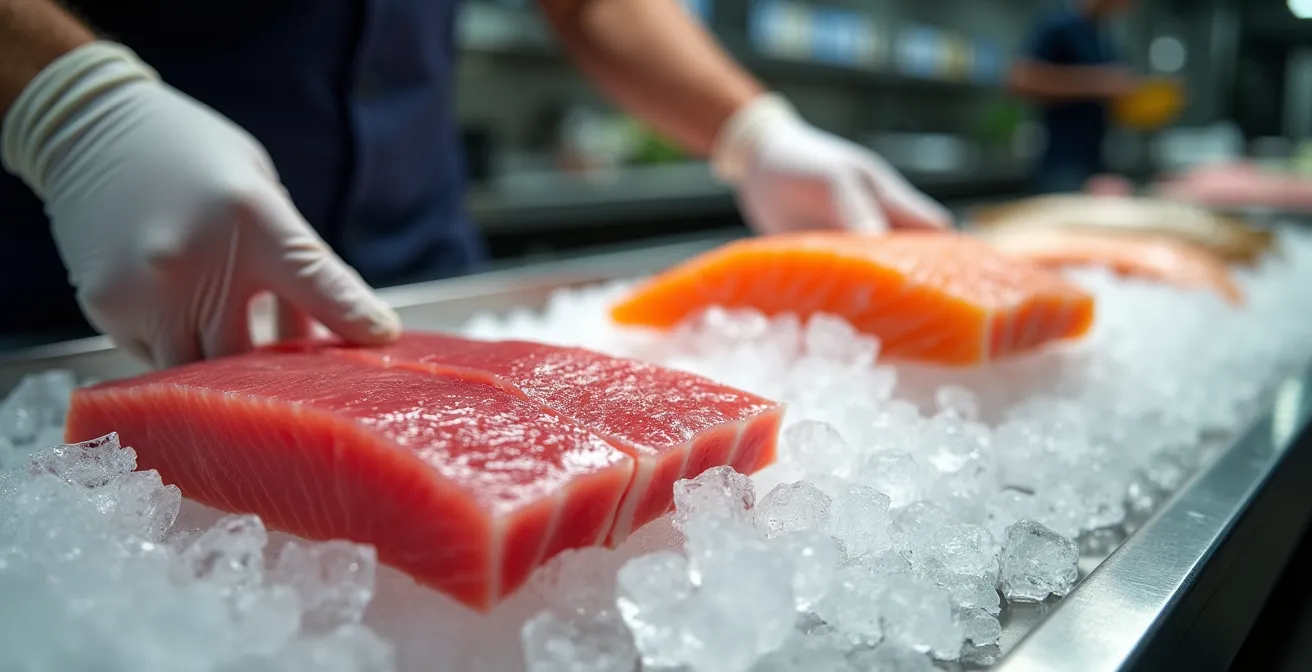
The term ‘sashimi-grade’ is a marketing invention, not a legal regulation. True safety for raw fish comes from a verified parasite destruction process.
- Most “fresh” fish is not safe to eat raw; it must undergo a specific deep-freeze cycle to kill parasites.
- Visual cues like color and texture help spot decay, but they don’t guarantee the absence of invisible parasites.
Recommendation: Instead of looking for a label, ask your fishmonger for documentation of the fish’s freezing process (time and temperature).
You’re standing at the fish counter, staring at a beautiful, glistening slab of tuna. The little sign next to it proudly declares “Sashimi-Grade.” It looks perfect, but a nagging voice in your head asks, “Is this actually safe?” You’ve heard the common advice: it should smell like the ocean, not “fishy,” and the flesh should be firm. These are good starting points for spotting fish that’s going bad, but they tell you absolutely nothing about the single biggest risk in eating raw fish: parasites.
The truth is, the entire concept of “sashimi-grade” or “sushi-grade” is a house of cards. It’s a marketing term, not a regulated standard. In most Western countries, there is no official body that inspects and certifies a fish as “sashimi-grade.” The label is something the seller decides to put on their product, and its meaning can vary wildly from a shop that follows meticulous safety protocols to one that simply wants to charge you a premium. So, if the label is meaningless, how do you protect yourself?
The key isn’t a label; it’s a process. Specifically, a documented parasite destruction process. This article cuts through the marketing fluff. I’m not here to sell you on fancy labels. I’m here to give you the blunt, honest truth about what makes fish safe to eat raw, based on the science of cold chain integrity and parasite control. We’ll cover the one question that matters more than any other, why frozen fish is often your safest bet, and which species you should never, ever consider eating raw. This is the information the industry uses to protect itself; it’s time you had it too.
This guide will walk you through the non-negotiable checks and essential knowledge for sourcing fish that is genuinely safe for raw consumption. Explore the sections below to become a smarter, safer seafood consumer.
Summary: Your Guide to Truly Safe Raw Fish
- What Does ‘Sashimi-Grade’ Actually Mean Legally in Your Country?
- Clear Eyes and Red Gills: Which Signs Matter for Cut Fillets?
- Why Frozen Fish Is Often Safer for Raw Consumption Than Fresh Catch?
- The Parasite Mistake: Which Species Must Never Be Eaten Raw?
- How to Transport Raw Fish in Summer Without Breaking the Cold Chain?
- MSC or ASC: Which Seafood Labels Can You Actually Trust?
- Thermos or Wood: Which Vessel Keeps Shari at Body Temperature Longer?
- Is Eating Raw Seafood Safe for Everyone During the Summer Months?
What Does ‘Sashimi-Grade’ Actually Mean Legally in Your Country?
Let’s get this out of the way first: in most places, including the U.S. and Europe, the term “sashimi-grade” has no legal definition. It is not a government-regulated standard. It is a marketing term, plain and simple. A fishmonger can slap that label on any fish they choose, and they aren’t breaking any laws. This is the most critical fact you need to understand. Your safety does not come from a sticker; it comes from a verifiable process.
So what is that process? The only thing that truly matters for raw fish safety is parasite destruction. Wild fish are a natural host for parasites like Anisakis. The only way to make them safe for raw consumption is to kill those parasites. The FDA has clear guidelines for this, and they have nothing to do with how “fresh” a fish is. It’s all about freezing. The fish must be frozen and stored at a specific, extremely low temperature for a set amount of time.
According to official guidance for parasite destruction, fish intended for raw consumption must be frozen at -31°F (-35°C) for 15 hours, or at -4°F (-20°C) for 7 days. This is far colder than your home freezer can achieve. This means that a “fresh, never-frozen” wild fish is one of the most dangerous things you can eat raw. A trustworthy supplier doesn’t just say their fish is “sashimi-grade”; they provide documentation of their parasite destruction freezing process. You have the right to ask for this. Forget the label and start asking the questions that actually matter.
Action Plan: Questions to Ask Your Fishmonger
- Ask: ‘Can you tell me about the parasite destruction process this fish underwent? Was it frozen to spec?’
- Inquire: ‘Was this fish flash-frozen at sea or commercially frozen after landing? Can you provide traceability?’
- Verify: ‘Where was this fish caught and when did it arrive? Can I see its supply chain record?’
- Check: ‘Do you use a separate, sanitized preparation area for fish intended to be eaten raw?’
- Assess: ‘Would you personally eat this fish raw today?’ Their confidence and reasoning are telling.
Clear Eyes and Red Gills: Which Signs Matter for Cut Fillets?
The old wisdom about “bright eyes and red gills” is great if you’re buying a whole fish. But most of us are buying pre-cut fillets or loins. For these, you need a different set of visual and sensory checks. These signs won’t tell you if a fish has parasites—only proper freezing can guarantee that—but they are your frontline defense against fish that is simply old, mishandled, or starting to decay. When you’re at the counter, your eyes and nose are your best tools for spotting red flags.
First, look at the flesh itself. It should have a certain translucence and vibrancy. For tuna, look for a deep, rich color without any brown spots. The muscle fibers should be tight and intact, often with a natural, subtle iridescent sheen. This iridescence is a sign of freshness; a dull, matte appearance is not. Crucially, there should be no milky or slimy liquid pooling on the fish or in its tray. This “slime” is a clear indicator of bacterial growth and is an absolute deal-breaker. The edges of the fillet should be clean-cut and moist, not dry, dark, or curling, which are signs of oxidation and age.
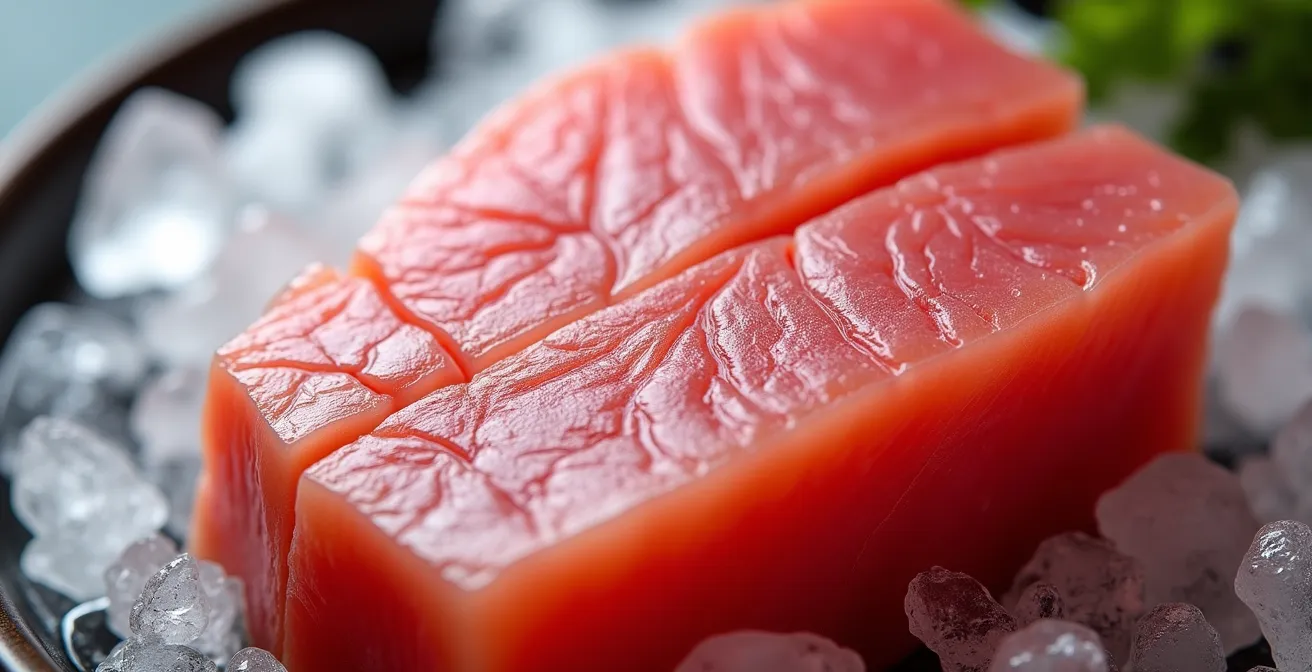
As the image above shows, high-quality fish has a tight, well-defined texture. Finally, trust your nose. The fish should smell clean and briny, like a fresh sea breeze. Any hint of ammonia, a sour odor, or a strong “fishy” smell means you should walk away. Your sense of smell is an incredibly effective tool for detecting the byproducts of bacterial decay. If your nose tells you something is off, listen to it, no matter how good the fish looks. Don’t be shy about asking to smell the fish before you buy it. A good fishmonger with a quality product will have nothing to hide.
Why Frozen Fish Is Often Safer for Raw Consumption Than Fresh Catch?
There’s a deep-seated bias that “fresh is always best.” When it comes to cooked fish, that can be true. But for raw fish, this belief is not only wrong, it’s dangerous. The safest fish for sashimi is almost always fish that has been commercially flash-frozen. This isn’t an opinion; it’s a matter of food science. The reason comes down to one thing: killing parasites effectively.
Wild fish, especially species like salmon, mackerel, and herring, are natural hosts for worms like the Anisakis parasite. If ingested live by a human, they can cause anisakiasis, a painful and sometimes severe gastrointestinal infection. Cooking kills these parasites instantly. But for raw preparations, the only reliable method is a deep freeze. This is where the distinction between a home freezer and a commercial freezer becomes critical. Your freezer at home typically runs around 0°F (-18°C). This is not cold enough to reliably kill parasites. Commercial flash-freezing, especially “frozen-at-sea” (FAS) operations, use temperatures of -35°C (-31°F) or even colder, which freezes the fish solid in minutes.
Case Study: The Anisakis Parasite Lifecycle Interruption
Anisakis parasites, commonly found in wild salmon and herring, are effectively killed through commercial deep-freezing processes. These parasites normally complete their lifecycle moving between marine mammals and fish, but flash-freezing at -31°F breaks this cycle completely, making the fish safe for raw consumption. Home freezers, which cannot achieve these parasite-killing temperatures, are not a safe alternative for treating fresh-caught fish you intend to eat raw. This interruption of the parasite’s lifecycle is the entire basis for safe, raw, wild-caught fish.
This process does more than just kill parasites. Because it’s so fast, it forms very small ice crystals that don’t damage the fish’s cell walls, preserving its texture and flavor far better than a slow freeze in a home freezer would. So, the “fresh” wild salmon at the counter that was flown in on ice might be teeming with live parasites, while the vacuum-packed, flash-frozen fillet next to it is the safest product you can buy. It’s a counter-intuitive but essential truth for any sashimi lover.
The Parasite Mistake: Which Species Must Never Be Eaten Raw?
Not all fish are created equal when it comes to parasite risk. While proper freezing can make many species safe, some carry such a high or specific parasite load that they should never be consumed raw, no matter how they are handled. Knowing which fish to avoid is just as important as knowing which ones are safe.
The number one rule is simple: never eat any freshwater fish raw. This includes species like trout, perch, and pike. These fish can carry tapeworms, such as Diphyllobothrium latum, which can grow to astounding lengths inside the human intestine and are not reliably killed by the same freezing methods used for saltwater parasites. The risk is simply too high. Similarly, many common saltwater whitefish are a poor choice for raw consumption. As one expert guide points out:
Nematodes are frequently present in white fish species, such as cod, haddock, and hake. This is why you’ll rarely see white fish species on sushi menus.
– Nordic Catch, Sushi-Grade Seafood Guide
These fish are delicious when cooked, as the heat destroys any parasites, but their flesh is often riddled with worms that make them unsuitable for raw dishes. To make this easier, it’s helpful to think of fish in risk tiers. Some species are naturally low-risk, some require mandatory freezing, and some should be avoided entirely for raw applications.
| Risk Tier | Species | Key Considerations |
|---|---|---|
| Tier 1 (Lowest Risk) | Farmed salmon, yellowfin tuna, bluefin tuna | Naturally resistant to parasites or controlled diet in farms |
| Tier 2 (Requires Deep-Freezing) | Wild salmon, mackerel, snapper, herring | Must undergo FDA-approved freezing protocols |
| Tier 3 (Never Raw) | All freshwater fish, cod, haddock, hake | High parasite loads, especially tapeworms in freshwater species |
How to Transport Raw Fish in Summer Without Breaking the Cold Chain?
You’ve done your homework. You’ve asked the right questions, verified the freezing process, and selected a beautiful, safe piece of fish. Now comes a step that many people overlook: getting it home safely. The journey from the fish market to your refrigerator is a critical link in the cold chain integrity. Breaking this chain, even for a short time, especially during hot summer months, can allow harmful bacteria to multiply rapidly, turning a perfectly safe piece of fish into a food safety hazard.
Your goal is to keep the fish at or below 40°F (4°C) at all times. On a hot day, the inside of your car can reach well over 100°F, and a standard plastic bag offers zero protection. The fish market should be your last stop before heading straight home. Do not leave the fish in a hot car while you run other errands. For the transport itself, a small cooler with ice packs or bags of crushed ice is not just a good idea—it’s essential. Ask the fishmonger to pack your fish with a small bag of ice if possible.
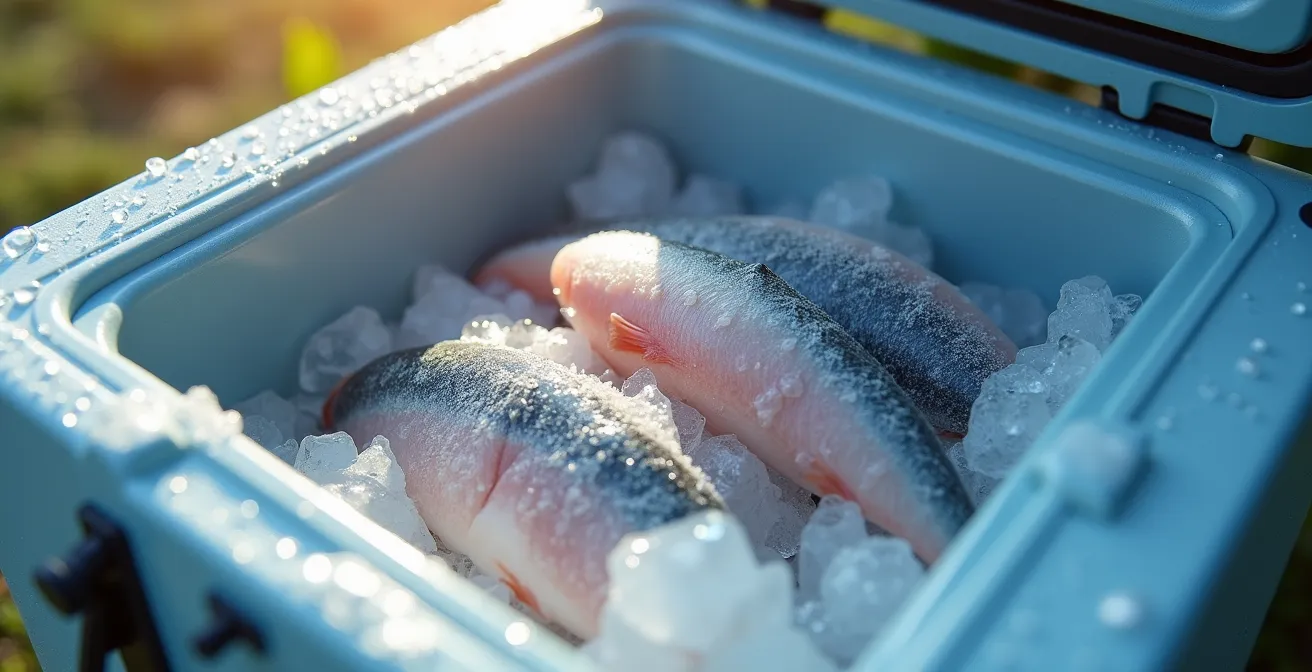
As illustrated, the fish should be in a sealed package to prevent it from getting water-logged, and then surrounded by ice. This creates a cold micro-environment that protects it from the ambient heat. The moment you get home, the fish should go directly into the coldest part of your refrigerator, which is usually the back of the bottom shelf. Plan to use the fish that same day. Raw fish is not something to be stored for long periods. Maintaining the cold chain is a simple but non-negotiable step to ensure the fish you so carefully selected remains safe to eat.
MSC or ASC: Which Seafood Labels Can You Actually Trust?
Walking down the seafood aisle, you’ll see other labels besides “sashimi-grade.” Two of the most common are the MSC (Marine Stewardship Council) for wild-caught fish and the ASC (Aquaculture Stewardship Council) for farmed fish. It’s important to understand what these labels actually mean, because they are often mistaken for a seal of safety or quality, which is not their primary purpose. These are sustainability certifications.
An MSC logo tells you that the wild fish was caught in a way that minimizes environmental impact and ensures the long-term health of the fish stock. An ASC logo indicates that the farmed fish was raised with responsible practices, managing its environmental and social footprint. Neither label is a guarantee that the fish is safe to eat raw. A wild-caught MSC-certified fish still needs to undergo the proper parasite destruction freeze cycle. However, these labels can indirectly point you toward a higher-quality product.
Case Study: The ASC-Certified Farmed Salmon Advantage
A major advantage of some high-quality farmed salmon, often carrying an ASC certification, is the control over their diet. These salmon are raised on a controlled pellet feed in clean, well-managed environments. This process effectively eliminates the “wild-caught gamble” by preventing the fish from ingesting the intermediate hosts that carry parasites. Paradoxically, this can make a responsibly farmed salmon consistently safer for raw consumption than its wild counterpart, which requires the additional freezing step to be made safe.
Essentially, you can’t use these labels as a shortcut to determine raw-eating safety. However, a supplier who invests in certified sustainable seafood is often more conscientious about their overall supply chain, including handling and traceability. Think of these labels as a positive indicator of a supplier’s professionalism, but not a replacement for doing your own due diligence and asking about the parasite destruction process. The two concepts—sustainability and raw safety—are separate, though they can sometimes overlap in beneficial ways.
Thermos or Wood: Which Vessel Keeps Shari at Body Temperature Longer?
While the focus is often on the fish, a perfect piece of sashimi or sushi is a duet between the fish and the rice (shari). The temperature and texture of the rice are just as crucial as the quality of the seafood. The ideal shari is served at or near human body temperature (around 98°F/37°C), which enhances its flavor and texture. A common mistake home cooks make is storing their prepared sushi rice in a sealed container or thermos to keep it warm. This is precisely the wrong approach.
The problem with a sealed, insulated container is that it traps steam and moisture. This trapped moisture turns the rice gummy and ruins its delicate texture. This is why professional sushi chefs use a traditional wooden bowl called a hangiri or a wooden container called an ohitsu. The secret of these wooden vessels isn’t insulation; it’s moisture management. The uncoated wood naturally absorbs the excess moisture steaming off the hot rice, while also allowing some steam to escape. This prevents the rice from getting soggy and ensures each grain remains distinct and perfectly seasoned.
The Science Behind Traditional Wooden Hangiri Bowls
Traditional wooden hangiri or ohitsu bowls are superior to thermos containers not for insulation but for moisture management. The uncoated wood naturally absorbs excess moisture from cooling rice, preventing the gummy texture that develops when steam is trapped in sealed containers like a thermos. This moisture regulation is why professional sushi chefs worldwide still prefer wooden vessels despite modern alternatives, as it is the key to achieving the correct texture for shari.
You don’t need to own a professional hangiri to achieve good results at home. You can replicate the effect by spreading your freshly cooked and seasoned sushi rice in the widest glass or ceramic bowl you have (avoid metal, as it can react with the vinegar). Instead of sealing it with a lid or plastic wrap, cover the bowl with a clean, slightly damp kitchen towel. This allows the excess steam to escape while preventing the surface of the rice from drying out and forming a crust. Let it cool gradually, and you’ll have shari that is much closer to what you’d find in a high-end sushi restaurant.
Key Takeaways
- The term ‘sashimi-grade’ is an unregulated marketing tool. Do not rely on it for safety.
- True safety for wild-caught raw fish comes from a documented deep-freeze process that kills parasites.
- Never eat freshwater fish raw, and be aware of high-risk groups (like the immunocompromised) who should avoid raw seafood entirely.
Is Eating Raw Seafood Safe for Everyone During the Summer Months?
Summer brings warm weather, and with it, a heightened risk that goes beyond parasites. This risk comes from naturally occurring bacteria, specifically those from the Vibrio genus. These bacteria thrive in warm coastal waters, the very places where much of our seafood is harvested. While they can be present year-round, their numbers explode during the summer months, increasing the risk of contamination.
Vibrio parahaemolyticus is a common culprit, causing gastroenteritis, while its more dangerous cousin, Vibrio vulnificus, can cause severe wound infections and life-threatening sepsis, particularly in certain individuals. The danger is real; a European Food Safety Authority (EFSA) assessment found that during warm water conditions, Vibrio parahaemolyticus was present in approximately 20% of tested seafood samples. Even more concerning is the bacteria’s ability to survive in cold water by entering a “viable but non-culturable” (VBNC) state, only to become active again when temperatures rise.
This risk is not distributed equally. For a healthy person, a Vibrio infection might mean an unpleasant but short-lived illness. For people in high-risk groups, it can be deadly. These groups have physiological vulnerabilities that make them far more susceptible to severe infection. This is not a matter of being “careful”; it’s a matter of biological reality. If you or someone you are serving falls into one of these categories, avoiding raw seafood, especially during summer, is the only truly safe course of action.
| Risk Group | Physiological Vulnerability | Specific Danger |
|---|---|---|
| Immunocompromised | Weakened immune response | Severe Vibrio vulnificus infections, potential sepsis |
| Liver disease patients | Reduced toxin processing | Higher susceptibility to Vibrio, increased mortality risk |
| Low stomach acid | Reduced bacterial killing | More bacteria survive to cause infection |
| Elderly (65+) | Declining immune function | Prolonged illness, higher hospitalization rates |
| Young children | Developing immune system | More severe symptoms, dehydration risk |
Frequently Asked Questions About Sashimi Quality and Labels
How do sustainable fishing methods affect sashimi quality?
Line-caught fish, which are often MSC-certified, typically experience less stress and physical bruising compared to fish caught in large trawl nets. This results in better flesh texture and a cleaner flavor, making them superior for raw consumption, provided they still undergo the necessary parasite destruction process.
Should I trust ASC labels for farmed fish used in sashimi?
ASC certification guarantees responsible farming practices, which often translates to a healthier, higher-quality fish. For species like salmon, ASC-certified farms that use controlled pellet diets can produce fish that is more consistently parasite-free than wild alternatives, making them a very reliable and safe choice for sashimi.
Ultimately, your safety is in your hands. Stop looking for a reassuring sticker and start acting like an informed consumer. Arm yourself with this knowledge, look for the signs, and most importantly, ask the right questions. Your health depends on it.