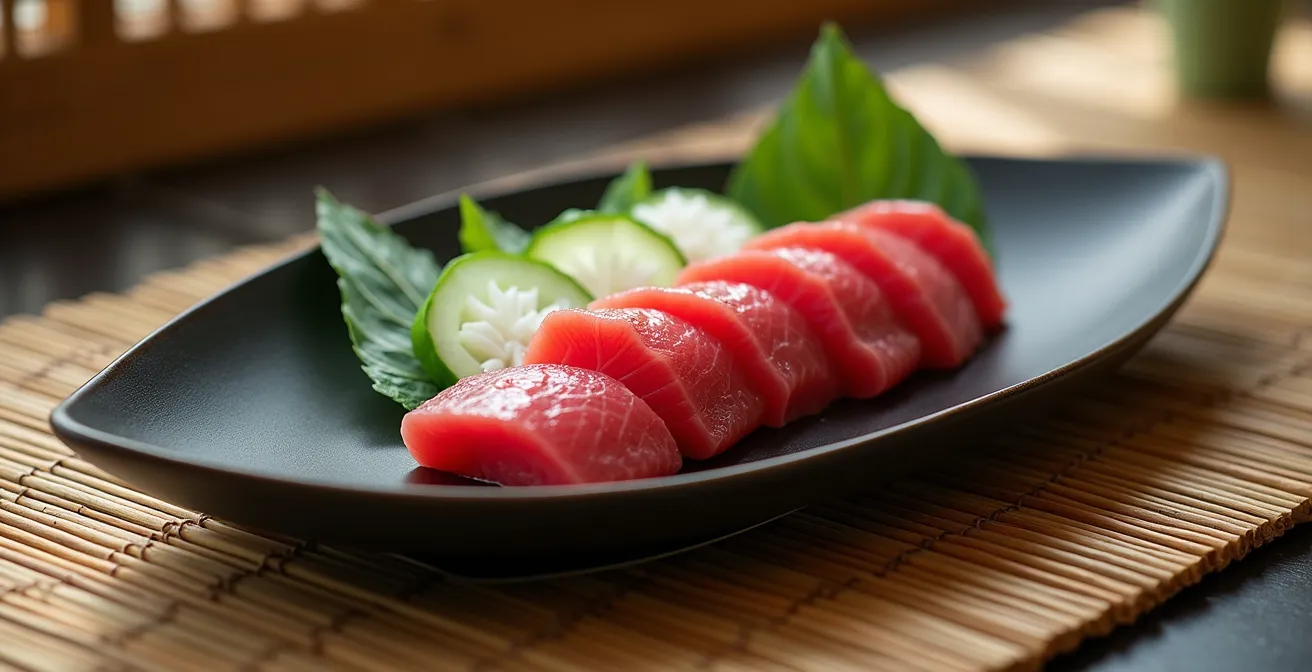
The common belief that sashimi arrangement is purely for visual appeal is a misconception; its primary, traditional purpose is to function as a system of sensory engineering that actively protects the flavor integrity of each fish.
- The placement of fish, from light to rich, creates a deliberate tasting path that prevents stronger flavors from overpowering delicate ones.
- Garnishes like cucumber and daikon are not decoration but functional barriers, designed to stop oils and moisture from migrating between different types of fish.
Recommendation: Stop thinking about your platter as a static picture and start designing it as an interactive tasting map, where every element has a protective and guiding role.
Crafting a sashimi platter is an act of curation that engages all the senses. For the host, the ultimate goal is to present a vibrant tableau of the ocean’s finest offerings. Yet, a common frustration quietly undermines this effort: the bold, oily essence of a mackerel slice migrating to taint the subtle, sweet purity of a neighboring scallop. Many guides focus on the aesthetics, the simple beauty of the arrangement. They might touch on related arts like nigiri or the distinction from sushi, where rice is a key component. But they often miss the fundamental principle that governs the art of sashimi presentation.
The solution isn’t found in more elaborate garnishes or a more colorful plate. The real mastery lies in understanding that traditional Japanese plating is not decorative but deeply functional. It is a form of sensory engineering designed with a single, crucial purpose: to prevent the very flavor cross-contamination you seek to avoid. This perspective shifts the entire process. You are no longer just an artist arranging colors; you are a curator, a guardian of flavor, building a system of defenses to protect the unique integrity of every single slice.
This guide will deconstruct the traditional rules of sashimi arrangement, revealing the functional science behind the art. We will explore how placement, dividers, temperature, and even the order of consumption work in concert to create a flawless tasting experience. By the end, you will be equipped to assemble a platter not just of beautiful, fresh fish, but of distinct, protected, and perfectly preserved flavors, ensuring each bite is exactly as the chef—and nature—intended.
This article provides a structured path to mastering the art of sashimi presentation. Below, the table of contents outlines each critical stage, from the philosophical underpinnings of the arrangement to the practical steps of consumption, guiding you toward creating a truly exceptional sensory experience.
Summary: A Curator’s Guide to Preventing Sashimi Flavor Contamination
- Why Do Japanese Chefs Always Serve Sashimi Slices in Odd Numbers?
- Red, White, Silver: In What Visual Order Should You Place Fish?
- How to Use Cucumber Dividers to Stop Oils From Mixing on the Plate?
- The Oxidation Mistake: How Long Can Sashimi Sit Before Losing Color?
- Tamari or Ponzu: Which Dipping Sauce Should Accompany a Varied Platter?
- How to Plan a Sushi Platter That Balances Colors and Textures?
- In What Order Should You Eat Nigiri to Maximize Flavor Perception?
- How to Appreciate Sashimi Purity Without Overusing Soy Sauce?
Why Do Japanese Chefs Always Serve Sashimi Slices in Odd Numbers?
The practice of serving sashimi in odd numbers—typically three, five, or seven slices—is often superficially explained as a tradition for good luck. While not incorrect, this explanation misses the deeper aesthetic and psychological purpose. This principle, known as *kisuu* (奇数), is a cornerstone of Japanese aesthetics rooted in the concept of *fukinsei*, or asymmetry. Symmetrical, even-numbered arrangements are seen as static and complete, offering no room for the imagination. Odd numbers, by contrast, create a natural sense of movement and visual tension.
This asymmetry is not random; it’s a deliberate act of sensory engineering. An arrangement of five pieces of tuna in the background and three slices of sea bream in the foreground forces the eye to travel across the plate, creating a dynamic visual journey that mirrors the forthcoming tasting journey. According to Japanese culinary tradition, this is often executed with 3 or 5 varieties of fish, with 1 or 3 slices per type, to achieve this balanced asymmetry. The arrangement is intentionally incomplete, inviting the diner to engage with and complete the experience.
Breaking this rule is also a conscious act. A celebratory platter for a special occasion might feature a more lavish, bountiful display where the strictness of *kisuu* is relaxed. Similarly, a platter for a couple might intentionally use even numbers as a symbol of their union. For the curator, understanding this philosophy is the first step: the number of slices is not a superstition but a tool to control the visual rhythm of the plate and set the stage for a more mindful tasting experience. It signals that every element on the plate is intentional.
Red, White, Silver: In What Visual Order Should You Place Fish?
The visual flow of a sashimi platter is, in fact, a flavor map. The arrangement of fish by color—from light, white-fleshed fish to rich, red, and silver-skinned varieties—is the most critical strategy in preventing flavor contamination on the palate. The rule is to plate from the back to the front and from left to right, starting with the strongest flavors and darkest colors and moving toward the most delicate. This creates a clear path for both the eyes and the palate.
This is not merely an aesthetic choice. Placing bolder flavors like deep red tuna (akami) or oily mackerel (saba) at the back or left-most starting point establishes a visual and gustatory anchor. As the diner’s eyes—and later, chopsticks—move forward and to the right, they encounter progressively lighter flavors, such as pinkish salmon or hamachi, culminating in the clean, subtle notes of white fish like sea bream (tai) or flounder (hirame) at the front.
Case Study: Professional Sashimi Color Arrangement
This principle is expertly demonstrated by Japanese plating instructors like Mieko-san. In her teachings, she consistently shows that one should always plate darker colors first (tuna), starting from the left back side of the plate. Then, white fish like sea bream is added in front. This technique masterfully creates visual depth while simultaneously guiding the diner’s palate from stronger to more delicate flavors, ensuring the subtler fish are not tasted first and then overwhelmed by the memory of a richer one.
This color gradient serves as a built-in guide for the correct order of eating, preventing the diner from accidentally starting with a powerful flavor that would numb their palate to the nuances of more delicate pieces. The visual order is the first line of defense in protecting the flavor integrity of each slice.
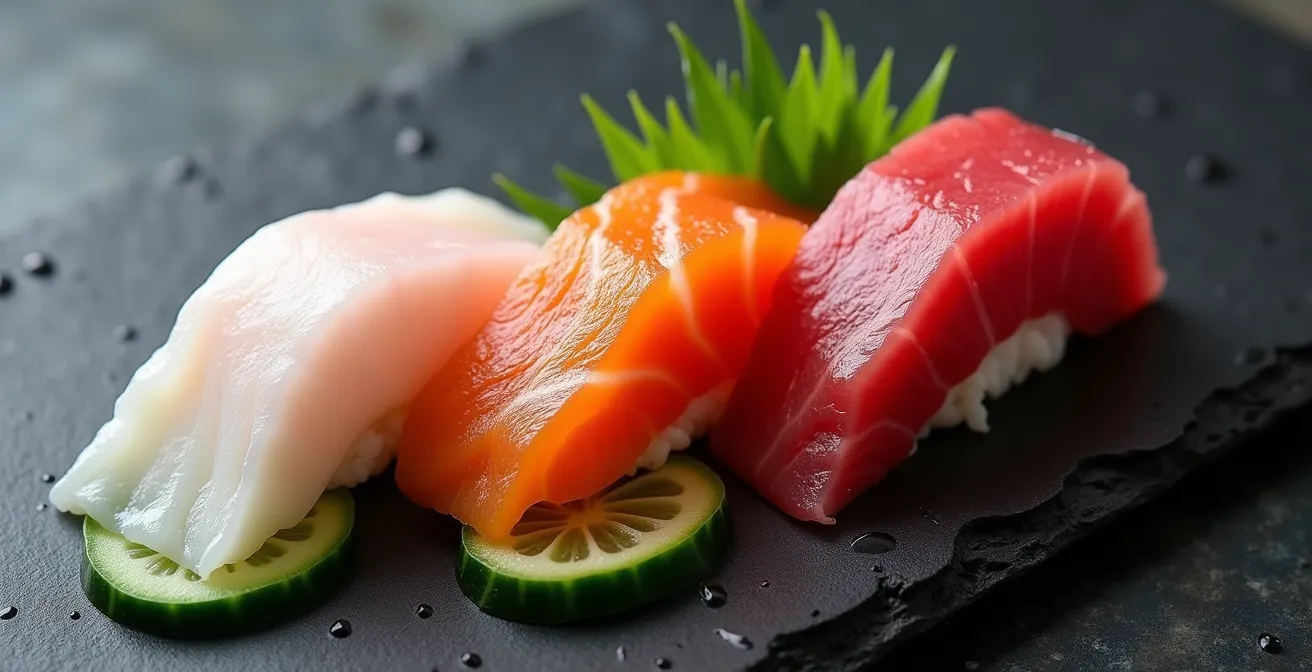
As you can see, the arrangement creates a natural flow. The deep red of the tuna at the back draws the eye first, signaling a richer starting point, while the pristine white of the hirame in the foreground promises a clean, delicate finish. This visual hierarchy is the silent language of the sashimi master.
How to Use Cucumber Dividers to Stop Oils From Mixing on the Plate?
While visual order guides the palate, physical barriers provide the most direct defense against flavor cross-contamination on the plate itself. Garnishes, known as *tsuma*, are not mere decoration; they are functional tools chosen for their specific properties. The humble cucumber slice, in particular, is a master of flavor containment.
The key lies in its waxy skin. When sliced thinly on a diagonal, a cucumber acts as a natural, impermeable wall. It is strategically placed between an oily fish, like mackerel or rich salmon, and a leaner fish, like flounder or squid. The waxy surface prevents the fish oils—the primary culprits of flavor migration—from seeping across the plate and tainting the adjacent piece. Slicing them to a precise thickness is also part of the technique; Japanese chefs recommend cutting dividers to about 2-3mm thickness to ensure they are sturdy enough to stand yet delicate enough not to overwhelm the plate.
However, the cucumber is just one tool in the arsenal of “defensive plating.” Different dividers serve different purposes, and choosing the right one for the right fish is a mark of expertise. A mound of julienned daikon radish (*tsuma*) is not an oil barrier but a moisture absorber, perfect for placing under lean white fish to keep them from becoming waterlogged. A vibrant green shiso leaf is not a barrier at all but an aromatic enhancer, its faint minty-anise flavor designed to complement the richness of fatty tuna. Understanding these roles allows you to build a truly functional and protected platter.
| Divider Type | Function | Best Paired With | Preparation Method |
|---|---|---|---|
| Cucumber | Oil barrier (waxy skin) | Oily fish (mackerel) | Thin diagonal slices |
| Daikon Tsuma | Moisture absorber | Lean fish (sea bream) | Julienned, soaked in cold water |
| Shiso Leaf | Aromatic enhancer | Fatty tuna | Whole leaf placement |
| Carrot | Color contrast | White fish | Decorative cutting |
This table illustrates that every element of *tsuma* has a calculated purpose. Your role as a curator is to select and deploy these elements not for how they look, but for the specific protective function they provide to the fish they accompany.
The Oxidation Mistake: How Long Can Sashimi Sit Before Losing Color?
The most pristine arrangement is meaningless if the fish itself has degraded. The greatest enemy of fresh sashimi, besides flavor contamination, is time and temperature. From the moment a fish is sliced, it begins to oxidize. This process dulls its vibrant color, alters its delicate texture, and mutes its flavor. The common advice to “serve fresh” is an understatement; it is an absolute imperative.
A slice of brilliant red tuna can begin to turn a dull brownish-maroon at the edges within minutes of exposure to room temperature air. A translucent piece of flounder can lose its sheen and firm texture, becoming soft and unappealing. This is why professional sushi chefs recommend serving sashimi immediately or keeping it refrigerated right up until the moment of service. There is no “safe” window for sashimi to sit out; every second is a compromise on quality.
Therefore, temperature management is a non-negotiable part of sensory engineering. This extends beyond simple refrigeration. The tools and surfaces you use play a crucial role. A cold plate acts as a heat sink, drawing warmth away from the fish and extending its peak freshness. A traditional bed of crushed ice, separated by a bamboo leaf to prevent waterlogging, serves the same purpose for a longer service. Even the knife matters. A single, clean stroke from a razor-sharp *yanagiba* minimizes cell damage, slowing the oxidation process from the very start. Protecting flavor integrity is a battle fought against the clock and the thermometer.
Your Action Plan for Perfect Temperature Control
- Plate Chilling: Pre-chill all ceramic or stone serving plates in the refrigerator for at least 30 minutes before plating.
- Ice Bed Preparation: If service will be extended, create a bed of crushed ice on the platter, using a bamboo leaf or plastic wrap as a barrier to prevent direct contact and waterlogging.
- Surface Selection: Consider using a naturally cold surface like a stone slate for serving, which retains cold temperature longer.
- Staged Preparation: Keep all prepared sashimi covered and refrigerated between the time it is sliced and the moment it is arranged for final service.
- Cutting Technique: Ensure you use an extremely sharp, single-bevel knife (like a yanagiba) to slice the fish in one clean, single stroke, which minimizes cell damage and slows oxidation.
By implementing these steps, you are actively fighting the degradation of the fish, ensuring that when it reaches the diner, it is in its most perfect state—vibrant in color, firm in texture, and pure in flavor.
Tamari or Ponzu: Which Dipping Sauce Should Accompany a Varied Platter?
After meticulously protecting the flavor of each slice on the plate, the choice of dipping sauce presents a final opportunity to either elevate or obliterate that effort. The modern Western approach often involves a single dish of soy sauce, sometimes premixed with wasabi. This one-size-fits-all method is the antithesis of curated tasting. A single, overpowering sauce cannot possibly complement the diverse range of flavors on a varied platter.
The professional strategy, often seen in high-end Japanese restaurants, is to offer options, allowing the sauce to serve the fish, not the other way around. The goal is to provide a condiment that enhances, rather than masks, the fish’s natural character. This means thinking in pairs. A classic, high-quality soy sauce (or its gluten-free counterpart, tamari) provides a salty, umami-rich depth that stands up well to richer, oilier fish like tuna or salmon.
In contrast, a lighter, more acidic ponzu sauce—a blend of soy sauce, citrus juice (often yuzu or sudachi), and dashi—provides a refreshing, zesty tang. This acidity is perfect for cutting through the richness of some fish, but its true purpose is to brighten and complement the subtle flavors of lean white fish like sea bream or flounder, which would be overwhelmed by straight soy sauce. Offering both, in separate small dishes, empowers the diner to make an informed choice for each piece of fish, respecting the integrity you have worked so hard to preserve.
Ultimately, the best high-end establishments present their sauces on the side, trusting the diner to apply them with restraint. The unspoken rule is that for the most premium cuts, like fatty *otoro* or sweet, creamy *uni* (sea urchin), the best “sauce” is often no sauce at all. Their flavors are so complex and complete that any addition would be a subtraction.
How to Plan a Sushi Platter That Balances Colors and Textures?
A truly magnificent sashimi platter appeals not only to the palate but also to the eye, following the traditional Japanese culinary principle of *goshiki*, or “five colors.” This framework is another layer of sensory engineering, ensuring a platter is balanced, nutritionally complete, and visually irresistible. It dictates that a well-composed meal should incorporate black, white, red, yellow, and green elements.
This is not a restrictive rule but a creative guide to building complexity and harmony. When planning your platter, thinking in terms of *goshiki* naturally leads you to a more diverse and interesting selection that balances flavors, colors, and textures. You are prompted to move beyond a simple duo of tuna and salmon and explore the full spectrum of what the sea has to offer.
- Red (Aka): The most straightforward color, represented by the vibrant warmth of tuna (maguro) or salmon (sake). This provides a rich, powerful focal point.
- White (Shiro): This brings brightness and a clean aesthetic. It can be fulfilled by the flesh of lean white fish like sea bream (tai) or squid (ika), or by a garnish of finely shredded daikon.
- Yellow (Ki): A splash of yellow adds a touch of sunshine and often a unique texture. This is perfectly embodied by the prized, creamy *uni* (sea urchin roe) or the delicate petals of a yellow chrysanthemum garnish.
- Green (Midori): Green introduces freshness and a vegetal note. This can be the vibrant color of wasabi, the herbaceous quality of a shiso leaf, or the crispness of a cucumber, used either as a divider or a decorative rose.
- Black/Purple (Kuro): This color provides depth, contrast, and an earthy anchor. While less common in the fish itself, it can be introduced through slivers of toasted nori (seaweed), slices of simmered shiitake mushrooms, or a sprinkle of black sesame seeds.
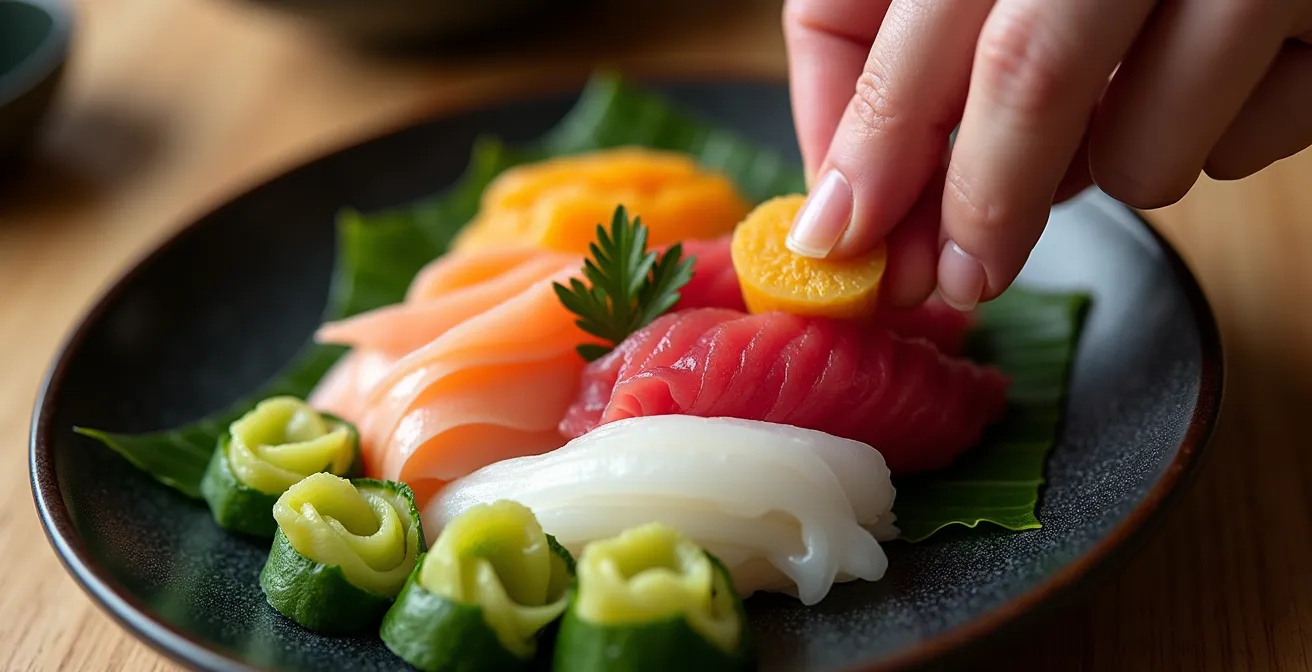
By intentionally seeking out these five colors, you create a platter that is not only visually stunning but also texturally and gastronomically diverse. The creamy yellow of uni contrasts with the firm bite of white squid; the rich red of tuna is balanced by the fresh green of cucumber. Following the *goshiki* principle is a holistic approach to building a complete and satisfying sensory experience.
In What Order Should You Eat Nigiri to Maximize Flavor Perception?
The carefully engineered platter has been presented. Now, the responsibility for preserving flavor integrity shifts to the diner. The order of consumption is the final, crucial act in the sensory journey. Whether eating sashimi or its close cousin, nigiri (fish over rice), the guiding principle remains the same: progress from light to rich. Starting with a powerful, fatty flavor like *otoro* would be like listening to the finale of a symphony first; it would overwhelm the senses and render them unable to appreciate the subtle notes of the opening movements.
The proper sequence is a mirror of the platter’s visual arrangement. One should begin with the lean, white-fleshed fish (shiromi) like flounder or sea bream. These have clean, delicate flavors that awaken the palate without fatiguing it. The texture of these fish is also important; they are often firmer, and the thickness of the slice contributes to the experience. For instance, Japanese culinary experts recommend cutting sashimi to a 7-10mm thickness for soft fish like tuna to optimize the textural sensation, while firmer white fish may be sliced thinner.
The Traditional Palate Journey
In traditional Japanese dining, the progression is an established ritual. One starts with light-flavored white fish (hirame, tai), then moves to medium-fatty fish like salmon or yellowtail (hamachi). The journey culminates with the richest, most flavorful cuts, such as fatty tuna (chutoro or otoro) or oily mackerel. Crucially, the palate is cleansed between different types of fish not by drowning the next piece in sauce, but by eating a small piece of pickled ginger (gari). This resets the taste buds, preparing them to receive the next flavor in its purest form.
Eating in the correct order is an act of respect for the fish and the chef. It ensures that the subtle complexity of a delicate piece of flounder is appreciated on its own terms, rather than being lost in the lingering memory of a more powerful flavor. It is the final, active step in preventing flavor contamination.
Key Takeaways
- Arrange with Purpose: Structure your platter from back-left to front-right, placing dark, rich fish first and light, delicate fish last to create a visual and gustatory map.
- Use Defensive Garnishes: Employ cucumber slices as oil barriers, daikon as moisture absorbers, and shiso as aromatic enhancers, not just as decoration.
- Master Temperature: The fight against flavor degradation is a fight against warmth. Use pre-chilled plates and serve immediately to preserve the fish’s color, texture, and taste.
How to Appreciate Sashimi Purity Without Overusing Soy Sauce?
The ultimate goal of this entire process—the careful sourcing, the precise slicing, the defensive plating—is to deliver a piece of fish to the palate in its most perfect, unadulterated state. The overuse of soy sauce and wasabi is perhaps the most common way this entire effort is undone at the last second. Appreciating sashimi purity requires a shift in mindset: the condiments are there to accentuate, not to conceal.
The first step is to taste the fish for what it is. For each new type of fish on your platter, the first piece should be eaten completely plain. This is an act of calibration. Pay attention to its initial temperature on the tongue, its texture as you bite, the way its subtle flavors develop, and the nature of its finish. Is it clean and crisp, or rich and lingering? Only after you understand its essential character can you decide what, if anything, it needs.
Never mix wasabi with soy sauce – put wasabi directly on the fish, especially oily ones, before dipping
– Traditional Japanese dining etiquette, How to eat sashimi the correct way
For the second piece, if you desire the pungent heat of wasabi, apply a tiny amount directly onto the fish itself. This allows the wasabi’s volatile compounds to interact with the fish’s oils directly, creating a brighter, more focused flavor enhancement. Finally, for the third piece, if you still feel it needs a touch of umami, dip only one corner of the fish—never the entire slice—into the soy sauce. This light touch ensures the soy sauce complements the flavor profile without drowning it. This mindful protocol transforms eating from a simple act of consumption into an active, appreciative tasting.
You have now moved beyond simply arranging fish on a plate. By understanding the functional purpose behind each tradition, you have learned to engineer a sensory experience, protecting the integrity of each flavor and guiding the diner on a deliberate journey. To apply these principles effectively, start by focusing on the core strategy of flavor mapping. Evaluate your fish selection and begin building your platter with this new, protective mindset.