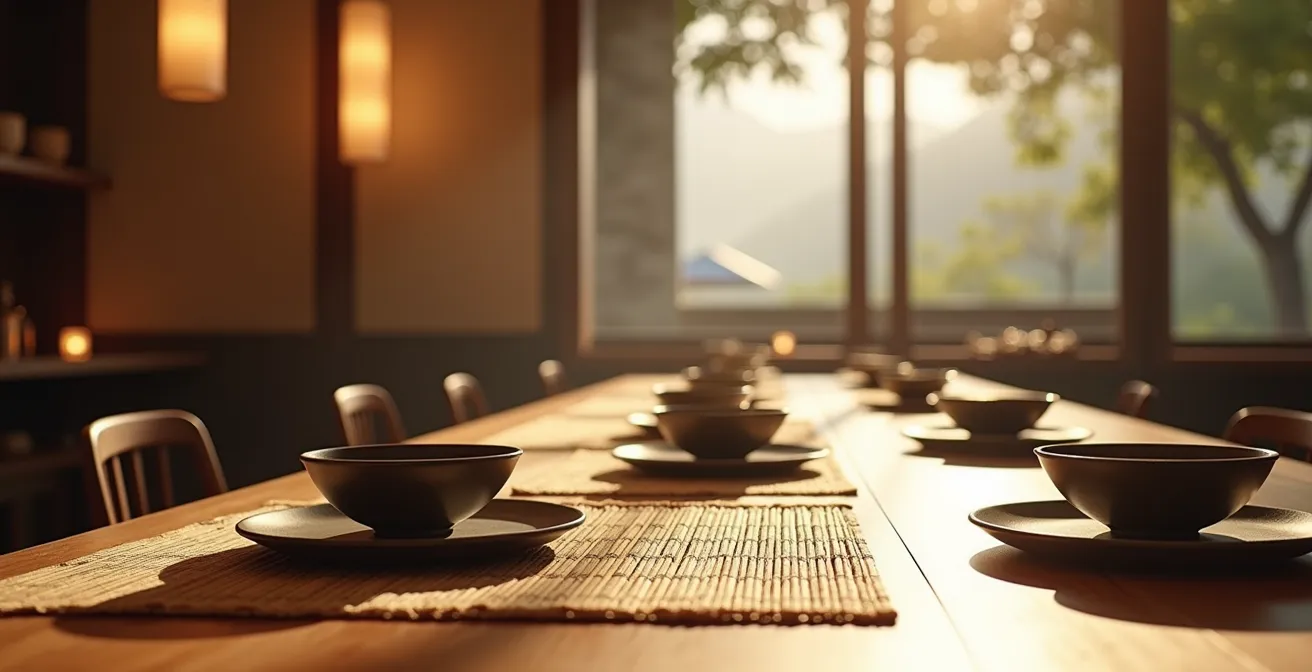
Many travelers mistake Japanese hospitality, or omotenashi, for a superior version of Western service. The truth is, it’s a fundamentally different communication system. Where Western service is often verbal and transactional, authentic omotenashi operates on silent observation and mutual respect. This guide decodes this silent language, revealing why the absence of frequent check-ins, tipping, and customization is not a lack of service, but the very sign of its excellence.
A traveler sits at a high-end sushi bar in Tokyo. The food is sublime, each piece a work of art. Yet, a subtle unease creeps in. The waiter hasn’t asked “Is everything okay?” even once. When the meal ends, an attempt to leave a generous tip is met with a polite but firm refusal. This scenario, common for many Western visitors, stems from a fundamental misunderstanding. We judge Japanese service by our own cultural standards, expecting a familiar script of verbal reassurances and financial rewards. We look for attentive service, but we misinterpret what “attentive” truly means in this context.
The common advice is to simply “not tip” and “be polite,” but this barely scratches the surface. This approach treats omotenashi as a set of rules to follow rather than a philosophy to understand. The real gap isn’t in etiquette; it’s in communication. Western service is largely explicit and transactional—a performance often motivated by a potential reward. You ask for what you want, and good service is a friendly, responsive fulfillment of that request. But what if the highest form of care wasn’t about responding to requests, but about anticipating needs so perfectly that requests become unnecessary?
This is the core of omotenashi. It is not a transaction; it is a form of deep, respectful, and often silent communication. It’s a system built on the art of “reading the air” (kuuki wo yomu) and the artisan’s pride (shokunin). This article moves beyond the superficial rules to explore the ‘why’ behind the actions. We will deconstruct the silent cues, the motivations, and the philosophies that separate Japanese hospitality from Western service standards, transforming your next dining experience from one of confusion to one of profound appreciation.
To navigate this cultural landscape, this article breaks down the key differences you’ll encounter, from the silence at your table to the philosophy behind the chef’s craft. Explore the nuances that define this unique approach to hospitality.
Summary: Understanding the Core Differences in Hospitality
- Why Doesn’t the Waiter Ask ‘Is Everything Okay’ Every 5 Minutes in Japan?
- How Do Best Chefs Clean Your Plate Without You Noticing?
- Why Tipping at a Sushi Bar in Japan Can Be Considered Rude?
- The Customization Mistake That Breaks the Flow of Omotenashi
- How to Become a Regular (Joren) at an Exclusive Sushi Shop?
- How to Apply the Shokunin Spirit to Your Daily Cooking Routine?
- How Does the Tipping Culture in the US Change the Service Model?
- What Dining Etiquette Mistakes Offend Traditional Sushi Chefs?
Why Doesn’t the Waiter Ask ‘Is Everything Okay’ Every 5 Minutes in Japan?
In a Western restaurant, a waiter’s frequent verbal check-ins are a sign of attentiveness. In Japan, the opposite is true. Constant interruptions are seen as a disruption to the diner’s experience—a failure of the staff to be truly observant. This philosophy is rooted in the concept of kuuki wo yomu, or “reading the air.” It is the art of anticipating a guest’s needs through silent, continuous observation rather than direct questioning. The goal is to provide service so seamless that the guest is never forced to break their conversation or interrupt their meal to ask for something.
Instead of asking, staff are trained to watch for non-verbal cues. Is a guest looking around the room? They may need service. Have they leaned back in their chair? This could be a natural pause, an ideal moment to clear a plate. This silent attentiveness is a core tenet of omotenashi. The best service is invisible, making the guest feel cared for without ever feeling monitored. It’s a shift from a reactive model (waiting for a customer’s request) to a proactive, almost psychic one.
Case Study: Sushi Shikon’s Silent Service Excellence
The three-Michelin-starred Sushi Shikon perfectly embodies the principle of “reading the air.” Chef Kakinuma trains his staff to meticulously observe non-verbal signals. They watch the guests’ eating pace, take note of when conversations pause, and clear plates only during these natural breaks in the flow of the meal. This intense focus on observation means service happens without a word. As a result, diner reviews frequently praise the overall serene and immersive experience, demonstrating how the absence of verbal interruptions directly enhances guest satisfaction and elevates the meal beyond just the food itself.
This approach requires immense skill and concentration from the staff. They must maintain peripheral awareness of the entire dining room while appearing completely uninvolved, ensuring the focus remains on the food and the company. For a Westerner, the silence can feel like neglect, but it is in fact the highest form of respect for the diner’s personal space and experience.
How Do Best Chefs Clean Your Plate Without You Noticing?
The art of “reading the air” extends to the physical act of service, which is best described as an invisible choreography. In a top-tier Japanese establishment, the clearing of a plate or the refilling of a glass is executed with such subtlety and timing that it often goes completely unnoticed by the guest. This is not an accident; it is a highly practiced skill known as kikubari, or anticipatory care. It’s about performing a necessary action at the precise moment it will cause the least possible intrusion.
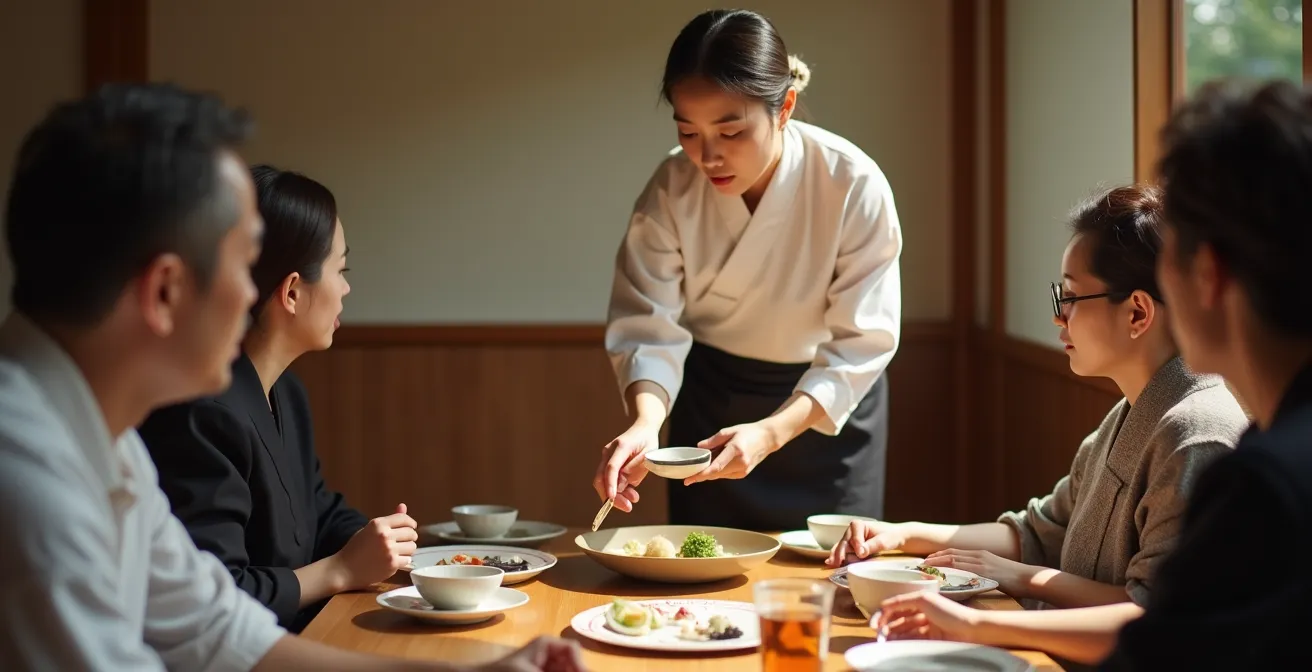
As the illustration above suggests, a server will wait for a natural pause in the guest’s attention—perhaps as they turn to a companion or reach for their tea. The server’s movements are fluid and deliberate, their body angled to minimize their presence. This contrasts sharply with the often-brisk efficiency of Western service, where a plate might be whisked away the second the last bite is taken, sometimes with a perfunctory “Are you finished with that?” This philosophy of transparent, non-intrusive action is central to the dining experience. As Chef Kakinuma of Sushi Shikon notes in a Michelin Guide feature on Japanese Hospitality:
Like tea ceremony, sushi is prepared in front of the customer. The openness in showing how the sushi is made and who is making it publicly is one of our ways to present omotenashi.
– Chef Kakinuma, Michelin Guide Feature on Japanese Hospitality
This openness in preparation is balanced by an invisibility in maintenance. The stage is open for the performance of cooking, but the “stagehands” who maintain the environment are trained to be ghosts. The result is an uninterrupted flow, where the focus remains purely on the artistry of the chef and the enjoyment of the meal.
Why Tipping at a Sushi Bar in Japan Can Be Considered Rude?
For many Western travelers, tipping is an ingrained habit—a way to show appreciation for good service. In Japan, however, attempting to leave a tip can cause confusion and even be perceived as rude. This is because omotenashi and Western service operate on fundamentally different economic and philosophical models. In Japan, excellent service is not an optional extra; it is an integral, expected part of the dining experience, and its cost is already built into the price of the meal.
Offering a tip can imply two things, both of which are culturally dissonant. First, it suggests that the service was transactional, performed with the expectation of a financial reward. This undermines the spirit of omotenashi, which is rooted in a sincere, heartfelt desire to provide an excellent experience for its own sake. Second, it can subtly imply that you believe the establishment does not pay its staff a fair wage, necessitating a subsidy from the customer. Since the Japanese service industry’s economics are based on salaries, recent industry data reveals that 68.4% of Japanese restaurant operators in 2023 struggled with price increases, indicating that pricing, not tipping, is the mechanism for financial adjustment.
The core difference in philosophy is stark when laid out side-by-side.
| Aspect | Omotenashi (Japan) | Western Service |
|---|---|---|
| Motivation | Sincere desire to provide excellent experience | Financial incentive through tips |
| Payment Structure | Service included in price | Base wage + gratuity expected |
| Host-Guest Relationship | Mutual respect, balanced exchange | Transactional, customer superiority |
| Service Philosophy | Anticipate needs without expectation | Respond to requests for reward |
| Cultural Implication of Tipping | Suggests service was transactional, not sincere | Shows appreciation for good service |
Ultimately, tipping frames the relationship as one between a superior (the paying customer) and a subordinate (the server). Omotenashi strives for a relationship of equals: a host and a respected guest engaged in an exchange of mutual respect.
The Customization Mistake That Breaks the Flow of Omotenashi
In the West, the mantra is often “the customer is always right.” Customization is king. “No onions,” “sauce on the side,” or “can I substitute the fries for a salad?” are common and expected requests. Applying this mindset in a traditional Japanese setting, especially at a high-end sushi bar offering an omakase (chef’s choice) menu, is a significant cultural misstep. Here, the guiding principle is not customer command, but trust in the chef’s expertise.
An omakase experience is a curated journey designed by the chef, who is considered a shokunin—a master artisan who has dedicated their life to perfecting their craft. Each piece of sushi is prepared with a specific balance of flavor, texture, and temperature. Requesting alterations—like extra wasabi, dousing a delicate piece in soy sauce, or asking for a different fish—is akin to telling a concert pianist which notes to play. It breaks the intended flow and implies a lack of respect for the chef’s accumulated knowledge and artistic vision.
This is why finishing every piece served is so critical. The Gurunavi Japanese Dining Guide is unequivocal on this point:
When dining omakase, finishing everything that’s put in front of you is essential for good sushi etiquette; it’s considered extremely rude, not to mention wasteful, to leave any of the pieces uneaten.
– Gurunavi Japanese Dining Guide, How to Eat Sushi like a Native: 8 Sushi Etiquette Tips
This isn’t about forcing you to eat something you dislike (allergies, of course, should be mentioned upfront). It’s about participating in the experience as it was designed. Instead of asking for a fork because you’re uncomfortable with chopsticks, the omotenashi mindset encourages embracing the challenge. The experience is not about bending the environment to your comfort zone, but about respectfully entering the one the host has created for you. It is a relational, not a customizable, encounter.
How to Become a Regular (Joren) at an Exclusive Sushi Shop?
In the transactional world of Western dining, being a “regular” might mean getting a table faster or a free drink. In Japan, becoming a joren (regular patron) at an exclusive establishment is a much deeper, more meaningful relationship. It signifies a transition from a mere customer to a respected member of the restaurant’s community. This status isn’t bought; it is earned over time through consistent, respectful behavior that demonstrates a genuine appreciation for the establishment’s craft and philosophy.
Earning joren status is the ultimate outcome of understanding omotenashi. It is a two-way street of recognition and respect. The guest shows trust in the chef, and in return, the chef may begin to offer special, off-menu items tailored to the guest’s known preferences. This is not customization on demand; it is a gift born from a developed relationship. It’s a journey of mutual understanding, as highlighted in the experience of a service attendant at a top-tier restaurant.
Case Study: The Journey to Understanding at Sushi Shikon
Cookie Chung, a senior service attendant at three-Michelin-starred Sushi Shikon, recounted her difficult journey to understanding omotenashi. Coming from Hong Kong, she initially clashed with Chef Kakinuma’s criticisms of her service style. However, after three and a half years of observation and practice, she absorbed the philosophy. She now finds deep satisfaction when guests, who have come to know and respect her service, specifically request her. This illustrates how the joren relationship develops not from a single perfect visit, but through a long-term investment in mutual understanding and respect.
Becoming a joren is about the quality of your presence, not just the frequency of your visits. It requires you to be an active, appreciative participant in the dining experience. The following plan can help you audit your behavior and consciously work toward this respected status.
Action Plan: Auditing Your Path to ‘Joren’ Status
- Touchpoint Audit: List all key interaction moments during a visit (arrival greeting, ordering, receiving a dish, leaving). Honestly assess your current actions at each point. Do you return the “Irasshaimase!” with a respectful nod? Do you offer a sincere “Gochisousama deshita” upon departure?
- Trust Inventory: Review your last few orders at a favorite spot. Are you consistently choosing omakase to demonstrate trust in the chef’s expertise, or are you defaulting to specific, safe requests? Inventory your “trust level” in the chef’s vision.
- Coherence Check: Confront your dining habits with the principles of respect. Time yourself: are you eating nigiri within the recommended 30 seconds? Are you avoiding disruptive phone use and keeping your conversation at an appropriate volume? Check your actions against the house’s flow.
- Memorability Audit: Are your interactions memorable for the right reasons? Do you show genuine, non-intrusive curiosity about the ingredients, or are your interactions purely transactional? Your goal is to be remembered as an appreciative guest, not just another customer.
- Integration Plan: Based on this audit, identify one or two specific behaviors to consciously integrate into your next visit. This could be focusing on your eating pace, asking one thoughtful question about a less common ingredient, or simply being more present and observant.
How to Apply the Shokunin Spirit to Your Daily Cooking Routine?
The philosophy of omotenashi is not confined to restaurants; it is an extension of a deeper cultural concept: the shokunin spirit. A shokunin is an artisan who not only masters their craft but also embodies a social and spiritual obligation to work to their highest potential for the benefit of the community. A sushi chef is a shokunin, but so is a carpenter, a potter, or a sword-smith. This mindset—a relentless pursuit of perfection in one’s work—can be applied even to the most mundane of tasks, including your own daily cooking routine.
Applying the shokunin spirit to home cooking is not about buying expensive ingredients or attempting complex recipes. It is about changing your mindset. It’s about treating your tools, your ingredients, and the process itself with profound respect. It means transforming cooking from a chore into a practice of mindfulness. This begins with the care of your tools, the foundation of any craft.
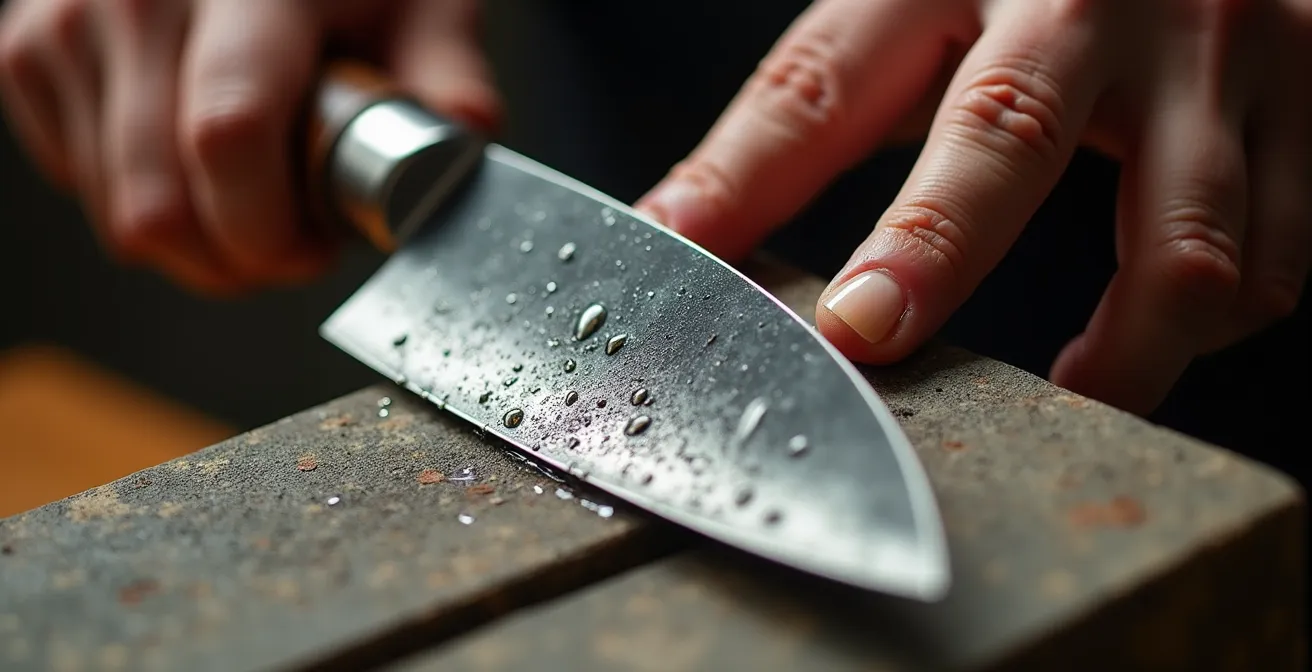
The act of sharpening a knife, cleaning your workspace before you begin, or mindfully arranging ingredients (your mise en place) are not just preparatory steps. They are rituals that cultivate focus and respect for the task at hand. This is the practice of “daily kata”—small, repeated forms or routines that build mastery over time. By focusing on perfecting a single, simple action, like a specific cutting technique, you elevate the entire process.
To bring this spirit into your kitchen, consider adopting a set of daily practices:
- Morning Preparation Ritual: Before cooking, clean and inspect your knives and workspace. Start with a clean slate.
- Practice One Cut Perfection: Dedicate five minutes each day to perfecting a single technique, like the julienne or the brunoise.
- Mindful Mise en Place: Arrange your ingredients with the same care and intention as a tea master setting up for a ceremony.
- Single-Task Focus: Complete each step fully and mindfully before moving to the next. Avoid chaotic multitasking.
- Tool Respect: Hand-wash, dry, and properly store each tool immediately after use. This honors their role in your craft.
- Evening Reset: The final step of your cooking process should be cleaning the entire workspace, leaving it ready for the next day.
This approach transforms cooking from a means to an end (a meal) into a meditative practice that honors the ingredients, the tools, and your own potential for improvement.
How Does the Tipping Culture in the US Change the Service Model?
The Japanese model of omotenashi stands in stark contrast to the service model prevalent in the United States, which is fundamentally shaped by tipping culture. While both aim to provide a pleasant experience, their motivations, methods, and outcomes are vastly different. The US model is explicitly transactional, where the quality and style of service are often directly tied to the server’s pursuit of a gratuity. This creates a completely different dynamic between staff and guest.
This transactional nature is becoming more apparent as diners worldwide gain more exposure to different service styles. The growing appreciation for authentic Japanese dining culture is evident; a recent report from TableCheck showed a 229.4% increase in international visitor reservations at Japanese restaurants compared to pre-pandemic levels in 2019. As more people experience omotenashi, the performative aspects of the US tipping model become clearer. Frequent interruptions, scripted enthusiasm, and upselling are all techniques designed to maximize the final tip.
The burden on the customer is also different. In the US, the guest is tasked with judging the server’s performance and calculating an appropriate percentage, effectively making them responsible for a portion of the employee’s wage. In the Japanese model, the guest’s only responsibility is to enjoy the experience. The employer is solely responsible for fair compensation, ensuring a consistent standard of excellence for every customer, regardless of their perceived “tip potential.”
This table breaks down the fundamental differences driven by the underlying economic model:
| Service Element | US Tipping Model | Japanese Omotenashi Model |
|---|---|---|
| Server Interruptions | Frequent check-ins to maximize tips | Observation without interruption |
| Customization Approach | Accommodate all requests for better tips | Trust chef’s expertise and vision |
| Performance Style | Scripted friendliness and enthusiasm | Sincere, understated attentiveness |
| Customer Burden | Calculate appropriate tip percentage | Simply enjoy the experience |
| Quality Consistency | Varies based on expected tip potential | Uniform excellence regardless of customer |
| Wage Responsibility | Transferred from employer to customer | Employer ensures fair compensation |
Ultimately, the US tipping model encourages a performance of friendliness, while the Japanese omotenashi model cultivates a practice of sincere, understated care.
Key Takeaways
- Japanese hospitality (Omotenashi) is a non-verbal communication system based on anticipating needs, not a better version of Western service.
- The absence of tipping is philosophical; it ensures service is sincere and relational, not transactional.
- Respect for the chef’s expertise (Shokunin spirit) is paramount, making excessive customization a sign of distrust.
What Dining Etiquette Mistakes Offend Traditional Sushi Chefs?
While understanding the deep philosophy of omotenashi is key, avoiding a few critical etiquette mistakes can make a significant difference in how you are perceived at a traditional sushi-ya. These are not arbitrary rules but practices that show respect for the shokunin’s craft and the integrity of the food. The most significant errors often revolve around temperature, timing, and the deconstruction of the chef’s carefully balanced creation.
A master sushi chef considers the temperature of the rice (shari) and the fish (neta) to be crucial. Each piece of nigiri is served at its optimal moment, meant to be consumed immediately. Delaying even for a minute to take a photo can ruin this delicate balance. As one executive chef emphasized in a Michelin Guide feature on Omakase tips, “The nigiri/sushi is made at the perfect temperature, so it is important that it is eaten quickly.” This principle of immediacy is paramount.
Furthermore, adding excessive condiments or altering the piece demonstrates a lack of trust. Mixing wasabi into soy sauce is a common faux pas, as the chef has already applied the perfect amount of wasabi for that specific fish. Drowning the piece in soy sauce (especially rice-down) overpowers the subtle flavors. The rice itself is considered the soul of the sushi; leaving any behind is seen as extremely wasteful and disrespectful.
To ensure a smooth and respectful experience, be mindful of these cardinal sins of sushi dining:
- CRITICAL: Never leave rice (shari) behind. It’s the heart of the sushi.
- CRITICAL: Eat nigiri within 30 seconds of it being served to respect the temperature balance.
- MAJOR: Do not drown your sushi in soy sauce. Dip the fish-side only, and do so lightly.
- MAJOR: Never place pickled ginger (gari) on top of your sushi. It is a palate cleanser to be eaten between different types of fish.
- MAJOR: Do not disrupt the chef’s pacing with loud conversations or phone calls.
- MODERATE: Avoid rubbing your chopsticks together. This implies you think the utensils are of poor quality.
- MODERATE: Do not bite a piece of nigiri in half. It is designed to be enjoyed in a single, perfect bite.
By avoiding these mistakes, you signal to the chef that you are not just a customer, but an appreciative guest who understands and respects their art form.
Ultimately, navigating Japanese hospitality is less about memorizing rules and more about shifting your perspective. It’s about recognizing that you are a guest in a space curated with immense care, where the highest form of appreciation is not a verbal compliment or a monetary tip, but your own quiet, mindful enjoyment of the experience. Embrace the silence, trust the artisan, and you will discover a form of hospitality that is profoundly rewarding.