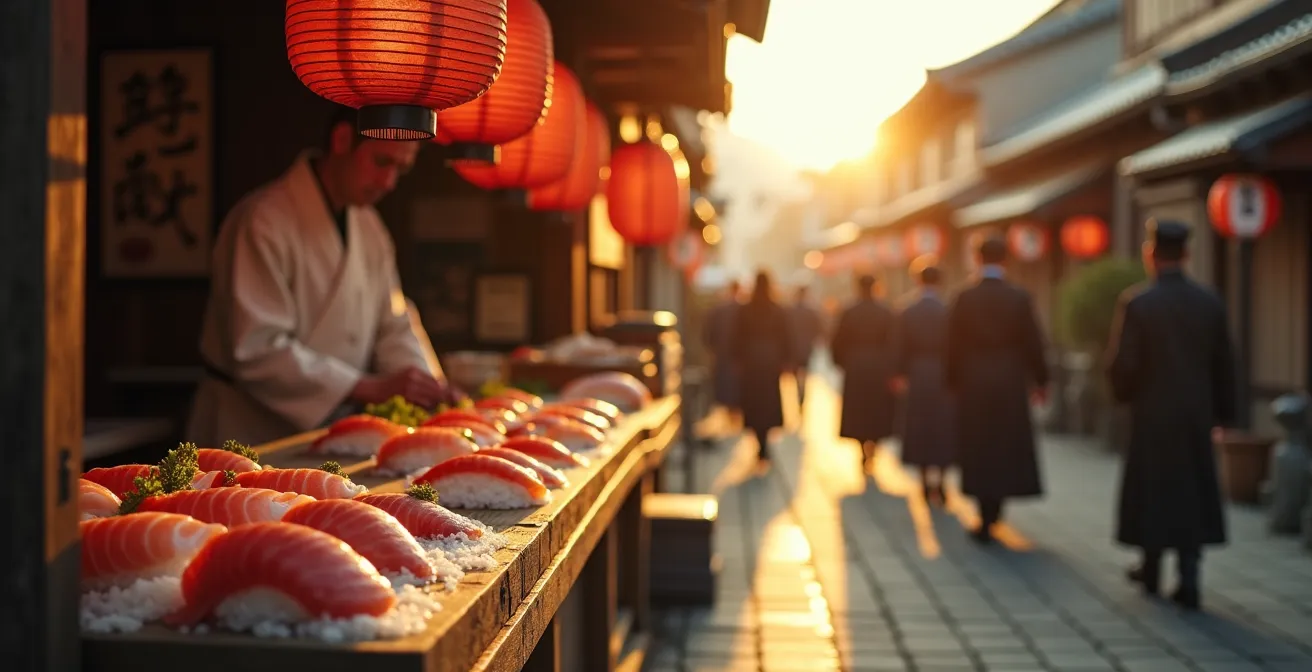
The belief that the best sushi is the ‘freshest’ sushi is a modern myth; the soul of authentic sushi lies in the Edo-era art of ‘work’—curing, marinating, and aging fish to perfection.
- Cheap, mass-produced red vinegar (akazu) and the rise of mobile food stalls (yatai) turned sushi from a preserved dish into the world’s first true fast food.
- Techniques like salting (shime) and marinating (zuke) were not just for preservation but were sophisticated methods to enhance umami and texture, a necessity in a time without refrigeration.
Recommendation: Next time you eat sushi, notice the subtle tint of the rice or the texture of the fish—you’re tasting the legacy of Edo’s resourceful chefs.
Step into the bustling streets of 19th-century Edo—modern-day Tokyo. The air is thick with the scent of woodsmoke, simmering broth, and the sharp tang of vinegar. This is not a serene tea garden; this is one of the largest cities on Earth, a vibrant metropolis teeming with artisans, merchants, and samurai. Many people believe the story of sushi is a simple tale of fresh fish and rice. They picture tranquil masters crafting perfect, delicate morsels. The reality, however, was forged in the noise and necessity of this sprawling urban landscape.
The common wisdom about sushi centers on its freshness, a relatively modern obsession enabled by refrigeration and global supply chains. But to truly understand sushi, you must look past the modern sushi bar and into its past. The key is not just the ingredients, but the ingenious techniques developed to make them delicious and, crucially, safe to eat in a world without ice. The story of sushi is a story of scientific innovation born from urban pressure, where chefs were part chemists, part entrepreneurs.
But what if the most important innovations in sushi had nothing to do with finding the freshest fish, and everything to do with mastering the art of transforming it? This is the core of the Edomae style. It’s an approach that questions our modern assumptions, revealing that the complex flavors we cherish in high-end sushi are not new inventions, but a direct inheritance from the resourceful chefs of old Edo.
This journey will take us back in time to uncover the specific breakthroughs that shaped the sushi we know and love. We will explore how economic necessity created a new kind of vinegar, how a new hand-pressed form revolutionized street food, and why the “work” applied to the fish is still the true hallmark of a master sushi chef.
This article explores the foundational pillars of Edomae sushi that emerged from the unique circumstances of the Edo period. Follow along to understand the history and technique behind every bite.
Summary: The Edo Period’s Lasting Fingerprint on Sushi
- How the Mass Production of Vinegar in Edo Created Fast Food Sushi?
- Why Did Chefs Switch From Box Sushi to Hand-Pressed Shapes in the 1820s?
- Yatai Stalls: Were They the True Ancestors of Modern Food Trucks?
- How Did Edo Chefs Prevent Food Poisoning Without Any Refrigeration?
- When Did Soy Sauce Become the Standard Dipping Sauce for Sushi?
- Aged Akazu vs. Supermarket Vinegar: When Can You Taste the Difference?
- How Does the Smell of Cypress Wood Affect the Tasting Experience?
- Edo-mae Style Fish: Why Cured Toppings Taste Better Than Fresh Catch?
How the Mass Production of Vinegar in Edo Created Fast Food Sushi?
The birth of sushi as a quick, accessible meal is inextricably linked to one crucial ingredient: vinegar. Before the Edo period, sushi was primarily a method of preserving fish in fermented rice, a process that took months. The rice was discarded, and only the soured fish was eaten. The transformation into a fast food required a radical shortcut. This was only possible because of an economic and industrial breakthrough in the production of rice vinegar.
As Edo’s population swelled, with historical records suggesting it had over 1 million residents, the demand for quick, cheap food skyrocketed. This urban pressure created a market for innovation. The turning point came with the development of akazu, or red vinegar. A man named Nakano Matazaemon discovered that sake lees, the yeast mash left over from brewing sake, could be fermented and aged to create a flavorful, high-quality vinegar. This was a stroke of genius; it turned a cheap industrial byproduct into a valuable commodity.
This new, affordable red vinegar, made from fermented sake lees, meant that chefs no longer had to wait months for rice to naturally sour. They could simply cook fresh rice and season it with akazu, giving it the characteristic acidic taste and preservative qualities instantly. This allowed them to pair the rice with lightly cured fish from the nearby Tokyo Bay, creating a dish that could be made and sold in minutes. Without the mass production of this “red vinegar,” the concept of fast-food sushi would have been economically impossible.
Why Did Chefs Switch From Box Sushi to Hand-Pressed Shapes in the 1820s?
Before the iconic, hand-formed nigiri, sushi was often made using wooden molds. This form, known as *oshizushi* (pressed sushi) or *hakozushi* (box sushi), involved layering vinegared rice and cured fish in a box and pressing it into a compact cake, which was then sliced. While effective, this process was relatively slow and better suited to a take-home product. For the fast-paced environment of an Edo street stall, a more dynamic method was needed.
This is where a chef named Hanaya Yohei enters the story. As PBS Food notes in “The History of Sushi,” Yohei is often considered the creator of modern nigiri sushi, or at the very least its first great marketer. Working from his mobile stall, he needed to serve customers quickly. He abandoned the cumbersome box mold in favor of a technique that was both performance and preparation: pressing a slice of seasoned fish onto a small, warm ball of vinegared rice by hand. This was *nigiri-zushi*, which literally means “hand-pressed sushi.”
This innovation was a game-changer. It allowed a single chef to prepare sushi to order in a matter of seconds. The warmth of the chef’s hands would slightly warm the rice, creating a delightful contrast with the cool fish topping. This direct, intimate method of preparation also became a form of theater, a display of skill and speed that captivated customers.
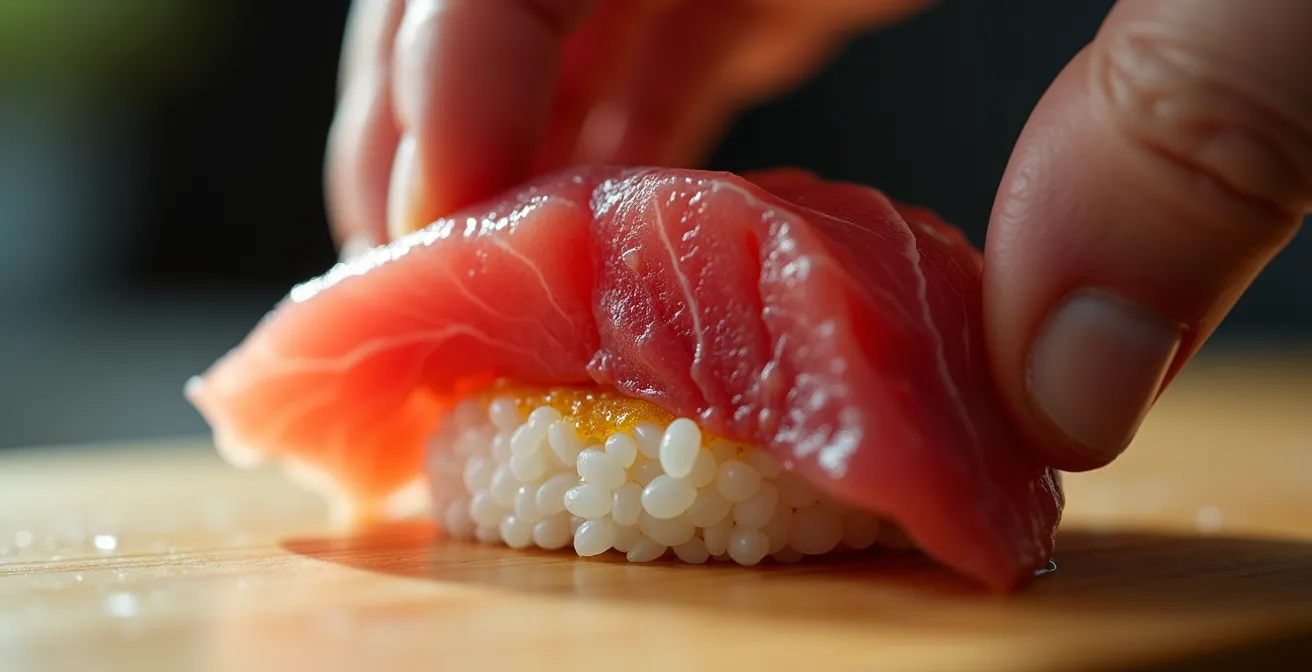
The switch to hand-pressed shapes was not merely an aesthetic choice; it was an adaptation driven by the demands of a new business model. It maximized efficiency, enhanced the eating experience, and established the dynamic between chef and customer that still defines the modern sushi counter. The nigiri shape is a direct result of the entrepreneurial grit required to succeed on the competitive streets of Edo.
Yatai Stalls: Were They the True Ancestors of Modern Food Trucks?
Long before food trucks lined city streets, the avenues of Edo were crowded with *yatai*—portable food stalls. These simple wooden carts, often equipped with a small stove and a prep area, were the engine of the city’s vibrant street food culture. By the 19th century, Edo had become one of the world’s largest cities, filled with a large population of working-class men, samurai, and merchants who often lived in small quarters without kitchens and needed quick, hearty meals.
The yatai were the perfect solution. As noted by Google Arts & Culture, these stalls catered to this influx of single men, and new eating styles like standing while eating became popular. Yatai offered a variety of what were then considered novel fast foods: tempura, soba noodles, grilled eel, and, most importantly, nigiri-zushi. This was food made by common people, for common people—a far cry from the exclusive, high-end image sushi would later acquire.
These stalls were the epitome of lean business models. With low overhead and the ability to move to where the crowds were, yatai vendors were agile entrepreneurs. They served their sushi on a piece of bamboo leaf, and customers would eat it with their hands, a quick and satisfying snack. This model of serving high-quality, specialized food from a mobile unit is the direct ancestor of the modern food truck phenomenon. The core principles are identical: go to the customer, serve a specialty product quickly, and maintain low operational costs.
How Did Edo Chefs Prevent Food Poisoning Without Any Refrigeration?
In an era without a single refrigerator, serving raw fish in a hot, humid city seems like a recipe for disaster. Yet, Edo’s sushi chefs thrived. Their secret was not magic, but a remarkable understanding of food science—a series of techniques collectively known as *Edomae shigoto*, or the “work of Edo.” These methods were not just for preservation; they were designed to enhance flavor, improve texture, and, most critically, ensure safety.
Each piece of fish was subjected to a specific process based on its fat content, texture, and origin. This was scientific precision applied with an artisan’s touch. For example, oily fish like mackerel or gizzard shad (*kohada*) were cured with salt and vinegar (*shime*). This process denatured the proteins, firmed the flesh, and drastically altered the pH, making it inhospitable to bacteria. Tuna (*maguro*), a prized catch, was often marinated in a special blend of soy sauce (*zuke*), which used osmotic pressure to draw out water and imbue the fish with umami.
The chefs’ arsenal extended beyond the fish itself. A dab of wasabi placed between the fish and rice wasn’t just for a spicy kick; wasabi has natural antimicrobial properties. The pickled ginger served alongside, known as *gari*, was not just a palate cleanser but also possessed antibacterial qualities. Every single element on the plate had a purpose, contributing to a system of food safety that was incredibly effective.
The Edo Chef’s Preservation Playbook: Key Techniques
- Marinating in Soy Sauce (Zuke): Use the principle of osmotic pressure to dehydrate the fish and infuse it with the preservative qualities of soy sauce.
- Salt/Vinegar Curing (Shime): Drastically change the pH level of the fish with a salt and vinegar cure to inhibit bacterial growth and firm the flesh.
- Kelp Curing (Kobujime): Wrap fish in kombu kelp, allowing enzymes and glutamic acid to create a natural preservative barrier while adding deep umami flavor.
- Leveraging Wasabi’s Power: Apply a small amount of wasabi directly to the fish, utilizing its natural antimicrobial properties as a final safety measure.
- Serving with Pickled Ginger (Gari): Include slices of gari with the meal, valued for its proven antibacterial effects and its ability to cleanse the palate.
When Did Soy Sauce Become the Standard Dipping Sauce for Sushi?
Today, the small dish of soy sauce, or *shoyu*, is a ubiquitous part of the sushi experience. However, this was not always the case. The rise of soy sauce as sushi’s primary condiment is deeply tied to the political and economic ascent of Edo itself. When the Tokugawa shogunate moved the capital to Edo in 1606, the entire Kanto region, where Edo was located, experienced an economic boom. This spurred the growth of local industries, including the large-scale production of soy sauce.
The nearby towns of Noda and Choshi (in modern-day Chiba Prefecture) became epicenters of shoyu production, perfecting a dark, flavorful brew that complemented the rich, fatty fish from Tokyo Bay, like tuna and bonito. This Kanto-style soy sauce was different from the lighter varieties found in the Kansai region (around Osaka and Kyoto) and it quickly became the taste of Edo.
However, the practice in authentic Edomae sushi stalls was quite different from the modern “do-it-yourself” dipping. The chef retained complete control over the seasoning. They would use what is known as nikiri shoyu—a customized glaze made by boiling soy sauce with sake, mirin, and kombu dashi. The chef would then brush the perfect amount of this nikiri directly onto the fish topping just before serving it. This ensured a perfect balance of flavor and prevented the rice from becoming soggy or oversaturated. The practice, as described in Japanese culinary tradition, was for the chef to brush a “customized, often boiled and seasoned soy sauce onto the sushi.” This act was part of the chef’s *shigoto* (work), a final touch to present the ingredient at its peak.
Aged Akazu vs. Supermarket Vinegar: When Can You Taste the Difference?
Not all sushi vinegars are created equal. While most modern sushi is made with a clear or pale white rice vinegar, traditional Edomae sushi was defined by the use of akazu, a distinctive red vinegar. Made from sake lees that have been aged for several years, akazu has a flavor profile that is worlds apart from its modern, mass-produced counterparts. It is milder in acidity, exceptionally rich, and packed with a deep, malty umami flavor.
This difference in production is stark. As a historical analysis reveals, supermarket vinegar is an industrial product, made quickly for sharpness and consistency. Akazu, by contrast, is an artisanal creation. The long aging process of the sake lees allows for complex flavors to develop. Mizkan, the company founded by the inventor of akazu, still produces a premium version called Mitsuban Yamabuki, named for its brilliant golden-yellow hue. This commitment to a centuries-old process highlights its cherished status.
So, when can you actually taste the difference? The robust, umami-rich character of akazu pairs magnificently with richer, oilier fish like tuna (especially fatty cuts like *toro*), bonito, and eel. It complements their strong flavors without overpowering them, adding a layer of complexity. Standard white vinegar, with its sharp, one-dimensional acidity, is often better suited for delicate white fish, where it can provide a clean contrast without coloring the flavor. The most obvious visual cue is the rice itself; akazu gives the sushi rice, or *shari*, a distinct amber or brownish tint, a hallmark of traditional Edomae preparation.
The following table breaks down the essential distinctions between these two foundational ingredients of sushi.
| Characteristic | Aged Akazu | Supermarket Vinegar |
|---|---|---|
| Production Time | Years of aging sake lees | Quick industrial process |
| Flavor Profile | Malty, deep umami, rounder | One-dimensional acidity |
| Color Impact | Amber tint to rice | No color change |
| Best Pairing | Fatty fish like tuna | Light white fish |
| Traditional Use | Edo period standard | Modern convenience option |
How Does the Smell of Cypress Wood Affect the Tasting Experience?
In the world of Edomae sushi, some of the most important ingredients are completely invisible. One such element is the wood used in the chef’s tools. Traditional sushi chefs exclusively use implements made from hinoki, or Japanese cypress. This isn’t a choice based on aesthetics alone; hinoki wood possesses unique properties that actively contribute to the quality of the final product, acting as an ‘invisible ingredient’.
Firstly, hinoki has remarkable functional characteristics. The large, shallow wooden tub used for mixing and cooling sushi rice, known as a *hangiri*, is made of uncoated hinoki. The wood naturally absorbs excess moisture from the freshly cooked rice, ensuring each grain is perfectly plump and distinct, not mushy. At the same time, it helps the rice cool to the ideal temperature for nigiri. The wooden boxes used to store fish toppings, or *neta-bako*, also regulate humidity, keeping the fish at its optimal texture.
Secondly, and perhaps more importantly, hinoki has powerful aromatic and antibacterial properties. The wood contains the natural antibacterial agent hinokitiol, which helps maintain a hygienic environment—a critical feature in the pre-refrigeration era. Beyond its scientific benefits, hinoki imparts a subtle, clean, and slightly citrusy-pine aroma to the rice as it’s being mixed. This delicate fragrance doesn’t overpower the fish but enhances its clean flavor, elevating the entire sensory experience. It’s a scent that purifies the palate and signals quality and tradition.
Key Takeaways
- Sushi’s origin as a fast food was driven by Edo’s urban boom and the invention of affordable red vinegar (akazu).
- The hand-pressed nigiri form was an entrepreneurial innovation for street stalls (yatai), prioritizing speed and a direct chef-customer interaction.
- Edo-era preservation (zuke, shime, kobujime) was a sophisticated science designed to enhance umami and texture, not just prevent spoilage.
Edo-mae Style Fish: Why Cured Toppings Taste Better Than Fresh Catch?
The modern obsession with “freshness” in sushi is, ironically, at odds with the very soul of traditional Edomae style. The term Edomae itself means “in front of Edo,” referring to the fish and shellfish caught in the rich waters of Tokyo Bay. But the genius of the style was not in serving this catch immediately. Instead, it was in the application of *shigoto*—the “work” or craft applied to each ingredient to elevate it to its peak flavor potential. In many cases, this meant that a cured, aged, or simmered topping was considered far superior to its fresh counterpart.
As historian Eric C. Rath explains in “Oishi: The History of Sushi”:
Edomae sushi is about applying the correct ‘work’ to each ingredient to elevate it to its peak flavor potential, whether through salting, marinating, or simmering.
– Eric C. Rath, Oishi: The History of Sushi
This philosophy is perfectly embodied in the preparation of *kohada* (gizzard shad). Fresh out of the water, this small, silvery fish is bony and has an unpleasantly strong flavor. It is essentially inedible. Through the precise work of filleting, salting, and curing in vinegar, the chef transforms it. The bones soften, the fishy taste mellows into a complex savory note, and the texture becomes firm yet yielding. The “work” has unlocked its potential, creating a delicacy from something that was previously worthless. Similarly, simmering eel (*anago*) until it is meltingly tender or aging tuna to develop deeper umami are other examples of this transformative craft.
This approach reveals the fundamental truth of Edomae sushi: the chef’s skill is paramount. It is a culinary philosophy where human ingenuity and a deep understanding of ingredients are used to create flavors that nature alone cannot provide. It is a celebration of transformation, not just freshness.
Now that you have a historian’s perspective on the innovations of the Edo period, you can approach your next sushi meal not just as a consumer, but as a connoisseur of history, able to recognize the centuries of craft and ingenuity in every single bite.