The difference between perfectly aged fish and spoiled product is not art, but a quantifiable biochemical race.
- Umami (inosinic acid) peaks around day 7, but spoilage accelerates exponentially above 2°C, making temperature the most critical control.
- White-fleshed fish are biochemically ideal for aging; high-fat red fish carry significant histamine risks that can be dangerous.
Recommendation: Control your aging environment with scientific precision (1-2°C) and use metrics like K-value to win the race against microbial decay.
For any chef dedicated to the craft of Jukusei, the fear is palpable. You hang a beautiful, prime-quality fish, dreaming of the complex, nutty, and profound umami that aging can unlock. Yet, in the back of your mind, a clock is ticking. Is this enzymatic magic, or is it the beginning of decay? The line between a transcendent culinary experience and a dangerous, spoiled product is terrifyingly thin. Many speak of tradition and instinct, advising you to simply trust the process, but this offers little comfort when a high-value product and your guests’ safety are at stake.
The truth is, this process is not mystical. It is a predictable and controllable biochemical race. On one side, enzymes within the fish’s muscle begin a cascade that transforms tasteless compounds into the highly desirable inosinic acid (IMP), a core component of umami. On the other side, microbial agents—bacteria and yeast—are poised to multiply, leading to off-flavors, dangerous toxins, and outright rot. The conventional wisdom to “be careful” is insufficient. To master aging, you must move beyond artistry and into the realm of science.
This guide abandons vague advice in favor of quantifiable data and precise controls. We will not be discussing feelings or intuition. Instead, we will dissect the enzymatic pathways, define the critical temperature and time thresholds, and explore the variables that dictate success or failure. By understanding the underlying science, you can stop guessing and start engineering a predictable outcome: maximum umami, perfect texture, and absolute safety. We will explore the fundamental transformation of ATP, the critical trade-offs over time, and the specific protocols required to keep the forces of decay firmly in check.
This article provides a scientific framework for mastering the art of aging fish. The following sections break down each critical element, from the initial biochemical reactions to the final tasting protocol, giving you the knowledge to control the process with precision.
Summary: At What Point Does Aging Fish Stop Increasing Umami and Start Rotting?
- How Does ATP Convert into Inosinic Acid During the Aging Process?
- Soft Texture or High Umami: Which One Do You Prioritize in Aging?
- White Fish vs. Red Fish: Which Species Gains Most Umami from Aging?
- Why Does Curing Fish in Kombu Multiply Umami by 7 Times?
- Why Must Aging Fridges Be Kept Between 1°C and 2°C Strictly?
- Why Freshly Caught Fish Is Often Too Tough for Sushi?
- How Fast Do Omega-3 Fatty Acids Oxidize at Room Temperature?
- How to Appreciate Sashimi Purity Without Overusing Soy Sauce?
How Does ATP Convert into Inosinic Acid During the Aging Process?
The development of umami in aged fish is not a matter of opinion; it is a direct result of a well-understood enzymatic cascade. Immediately after a fish dies, its cellular energy source, adenosine triphosphate (ATP), begins to break down. This process is not decay but a sequential transformation. ATP first degrades into adenosine diphosphate (ADP), then into adenosine monophosphate (AMP). The crucial step for flavor development occurs when the fish’s own enzymes convert AMP into inosinic acid (IMP), a potent umami compound. This is the source of the deep, savory flavor that fresh fish lacks.
However, this umami peak is temporary. The same enzymatic process continues, and IMP is further degraded into inosine and, finally, into hypoxanthine. Hypoxanthine contributes a noticeable bitterness and is a key indicator that the fish is moving past its prime and toward spoilage. The concentration of these compounds can be scientifically measured using the K-value. A K-value below 20% indicates sashimi-grade freshness, where ATP is still abundant. As the fish ages, the K-value rises. The sweet spot for umami is in the intermediate range, but once the K-value exceeds 60%, it signals advanced spoilage dominated by hypoxanthine and bacterial byproducts.
Therefore, a chef’s goal is to hold the fish in the state of maximum IMP concentration for as long as possible. This is achieved by controlling the rate of the enzymatic cascade, primarily through temperature. By slowing down the enzymes, you extend the window where IMP is dominant before it degrades into bitter hypoxanthine. This is the scientific core of the “biochemical race” you must manage.
Soft Texture or High Umami: Which One Do You Prioritize in Aging?
The aging process forces a critical choice upon the chef: do you prioritize the firm, bouncy texture of a relatively fresh fish, or the deep, complex umami that only develops with time? These two qualities are often inversely correlated. As the enzymatic breakdown creates umami compounds, other enzymes, known as proteases, are simultaneously at work. These proteases break down the collagen and connective tissues that give the fish its structure, resulting in a much softer, more tender texture.
This creates a clear timeline of trade-offs. In the first 2-3 days, texture is at its peak. The fish has passed through rigor mortis, but its flesh remains firm and resilient. Umami levels are rising but have not yet peaked. From days 4 to 7, the fish enters the umami-dominant phase. Research shows that inosinic acid production peaks around day 7 of aging, after which it begins its inevitable decline into bitter hypoxanthine. During this period, the texture becomes noticeably softer, sometimes described as “melty” or “buttery.”
The illustration below visually represents this crucial balance between texture and umami over time.
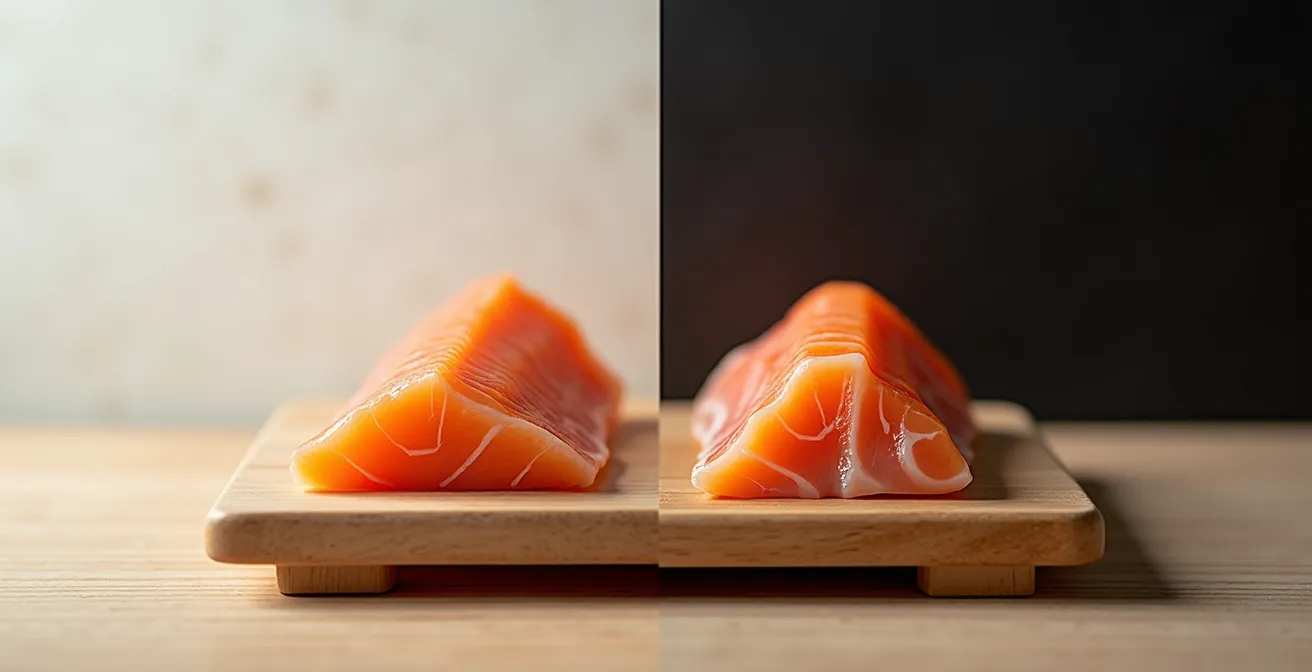
As you can see, the ideal aging window depends entirely on the desired outcome. For a dish where texture is paramount, a shorter aging period is preferable. For a preparation designed to showcase the most profound umami flavor, you must push the aging closer to that 7-day mark, accepting the resulting softer flesh. A master chef knows how to select the right aging time for the right species and the right dish, understanding that there is no single “perfect” day, only a perfect balance for a specific purpose.
White Fish vs. Red Fish: Which Species Gains Most Umami from Aging?
Not all fish are created equal when it comes to aging. The biological makeup of a species dictates its potential for umami development and, more importantly, its safety profile. Generally, white-fleshed fish (shiromi) like sea bream (madai), flounder (hirame), and sea bass (suzuki) are considered superior candidates for aging. Their lean muscle structure contains high initial concentrations of ATP, providing ample raw material for the enzymatic conversion to inosinic acid (IMP). Studies confirm this, showing that white-fleshed fish show 1.93 μmol/g IMP content after 21 days of aging under controlled conditions, a significant increase that translates directly to enhanced umami.
In contrast, red-fleshed and blue-backed fish (akami), such as mackerel (saba), sardines (iwashi), and even tuna (maguro), present a much higher risk. While they can develop umami, their high fat content is prone to rapid oxidation, leading to rancid flavors. More critically, they contain high levels of the amino acid histidine. During aging, certain bacteria can convert histidine into histamine, which can cause a severe allergic-like reaction known as scombroid poisoning. This risk is not to be underestimated.
As experts from the Master of Japanese Cuisine Academy warn, the danger is real and specific to certain species:
Blue-backed fish, such as horse mackerel and sardine, are not suited for the aging method because they can create high levels of histamine that can cause a serious physical reaction when aged.
– Master of Japanese Cuisine Academy, Aging Fish: The Benefits and How-tos
This is why the “biochemical race” is so much more dangerous with akami. While you are waiting for umami to develop, a different and hazardous process may be occurring simultaneously. For chefs experimenting with Jukusei, the rule is clear: start with lean, white-fleshed fish where the primary challenge is managing umami development and microbial spoilage, not mitigating the acute risk of histamine production.
Why Does Curing Fish in Kombu Multiply Umami by 7 Times?
The Japanese technique of kombu-jime, or curing fish by wrapping it in kombu (kelp), is often perceived as a method of simply infusing the fish with the seaweed’s flavor. The reality is far more profound and demonstrates a powerful biochemical principle known as umami synergy. The incredible flavor enhancement is not additive; it is multiplicative. Scientific studies on umami synergy reveal that combining glutamic acid and inosinic acid amplifies umami intensity by 7-8 times.
This is precisely what happens during kombu-jime. As we’ve established, aged fish is rich in inosinic acid (IMP). Kombu, on the other hand, is one of the world’s richest natural sources of free glutamic acid (glutamate). When the moist surface of the fish comes into contact with the kombu, a transfer occurs. The glutamic acid from the kombu migrates into the fish, where it interacts with the existing inosinic acid at the taste receptors on the tongue. This combination doesn’t just add two flavors together; it creates a neurological response that is exponentially more powerful than either compound alone. This principle was first scientifically detailed by Dr. Akira Kuninaka, who explained the potent umami of dashi made from kombu and katsuobushi (which is also rich in inosinate).
Case Study: Universal Application of Umami Synergy
This Japanese principle is not limited by geography or specific ingredients. A study published in Flavour Journal documented Nordic experiments where local sugar kelp (Saccharina latissima) was used to cure fish. The researchers found that extracting the kelp’s glutamate at an optimal temperature of 60°C and then combining it with fish rich in inosinate created the same powerful umami synergy. This proves that the mechanism is a universal biochemical principle, not a culturally specific phenomenon, offering a powerful tool for chefs anywhere in the world.
Therefore, kombu-jime is not merely a flavoring technique. It is a calculated biochemical process that leverages umami synergy to create an explosive flavor profile that neither the fish nor the kombu could achieve on its own. It’s a perfect example of how traditional culinary practices are often rooted in sophisticated, reproducible science.
Why Must Aging Fridges Be Kept Between 1°C and 2°C Strictly?
Temperature is the single most powerful lever a chef has to control the biochemical race of fish aging. The strict range of 1°C to 2°C (34°F to 36°F) is non-negotiable because it creates the optimal conditions to favor enzymatic umami development while aggressively suppressing bacterial growth. At this temperature, the fish’s native enzymes that convert ATP to IMP are slowed but remain active. This stretches out the umami development phase, giving you a wider window to achieve peak flavor.
Simultaneously, this low temperature acts as a critical brake on microbial activity. Most spoilage bacteria, including those that produce off-odors and the ones that convert histidine to histamine, multiply extremely slowly, if at all, near freezing point. The moment the temperature rises, you begin to lose the race. For instance, temperature-controlled studies show that at 4°C (39°F), hypoxanthine levels increase to 2563.72 μg/g after 14 days. This same level of degradation, a clear sign of spoilage, occurs in just 12 hours if the fish is left at room temperature (25°C). A deviation of just two degrees from 2°C to 4°C can cut the safe aging window dramatically.
Maintaining a temperature below 1°C is also detrimental, as it risks freezing the fish. The formation of ice crystals within the muscle cells ruptures the cell walls, leading to a mushy texture and significant moisture loss upon thawing. Therefore, the 1-2°C range is not an arbitrary guideline; it is a scientifically defined safe zone that maximizes your chances of success by creating an environment where flavor-enhancing enzymes can work, but spoilage-causing microbes are effectively dormant.
Checklist for Precise Temperature and Environment Control
- Maintain temperature strictly at 1-2°C to slow enzymatic umami development while preventing bacterial growth.
- Monitor humidity levels to help form a protective pellicle, which acts as a barrier against microbial contamination.
- Avoid temperatures below 0°C at all costs to prevent ice crystal formation that destroys cell walls and ruins texture.
- Never allow the temperature to exceed 4°C, as bacterial activity and the risk of histamine production accelerate beyond this threshold.
- Check the fish’s surface daily and pat it dry if any moisture appears, as this prevents the formation of a bacterial film.
Why Freshly Caught Fish Is Often Too Tough for Sushi?
It is a common misconception that the freshest possible fish makes the best sushi. In reality, a fish consumed immediately after being caught is often unpleasantly tough and chewy. This phenomenon is due to rigor mortis, the same process of muscle stiffening that occurs in all animals after death. When a fish dies, its remaining cellular ATP is used up, causing the actin and myosin filaments in its muscles to lock together. This results in a rigid, contracted state, rendering the flesh tough and flavorless, as the umami-producing enzymatic cascade has not yet begun.
This is where the Japanese technique of ikejime becomes critical. Ikejime is a humane method of dispatching a fish that involves spiking the brain and severing the spinal cord and major blood vessels. This process accomplishes two things: it prevents the release of stress hormones like cortisol and lactic acid, which can sour the meat, and it dramatically slows the onset and intensity of rigor mortis. It also bleeds the fish thoroughly, removing substances that can cause off-flavors during aging.
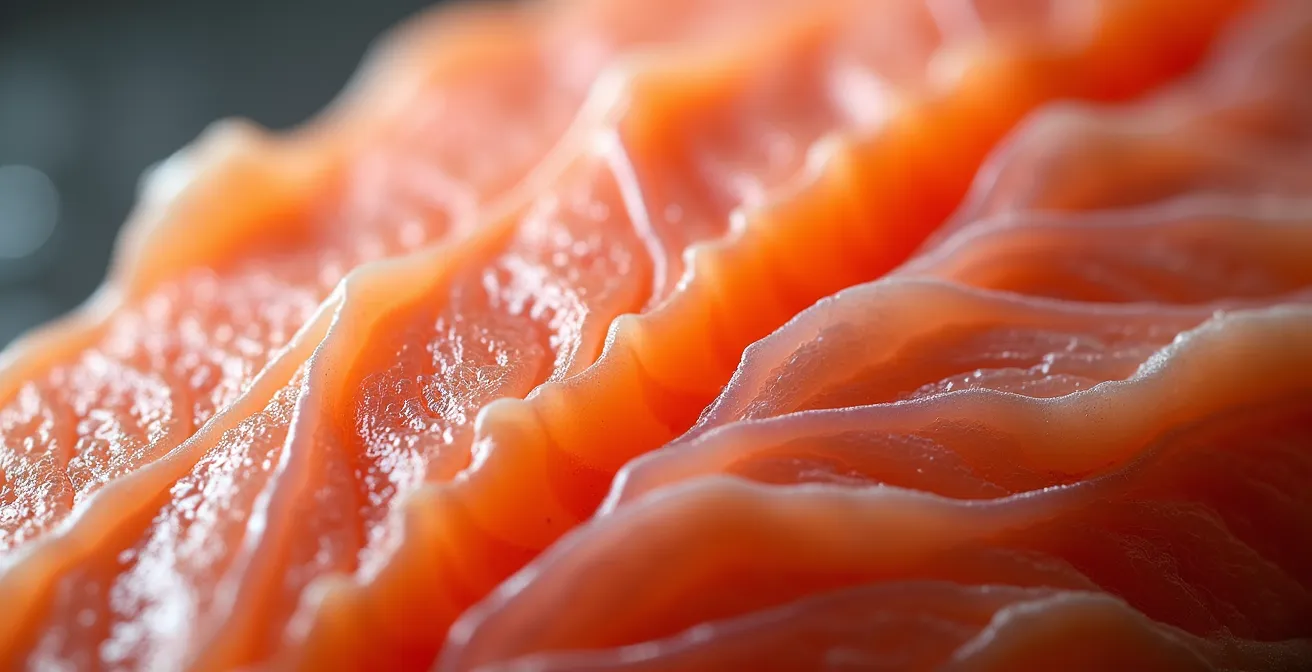
The microscopy view below shows the tense, locked muscle fibers characteristic of the rigor mortis state.
As the OMAKASE editorial team notes, this initial preparation is key to later flavor development:
Fish treated with the ikejime technique show a noticeable difference in both flavor and texture. Ikejime-processed fish develop a deeper, richer umami flavor because umami compounds naturally form after the fish dies.
– OMAKASE Editorial Team, Michelin Guide Partner Publication
Only after rigor mortis has passed—a process that can take several hours to a day, depending on the fish and how it was handled—do the fish’s own enzymes (proteases) begin to break down the muscle proteins. This process, known as proteolysis, is what tenderizes the flesh and allows the umami to develop. Serving a fish during rigor mortis means you are missing out on both optimal texture and flavor.
How Fast Do Omega-3 Fatty Acids Oxidize at Room Temperature?
While bacterial growth is a primary concern in fish aging, a second, more insidious enemy is at play, especially in fattier fish: oxidation. Fish are rich in polyunsaturated fatty acids, particularly Omega-3s. While beneficial for health, these fats are highly unstable and react readily with oxygen. At room temperature, this process is incredibly rapid. Exposure to air, light, and heat accelerates the oxidative chain reaction, breaking down the fats into aldehydes and ketones, which produce the characteristic rancid, “fishy” smell and taste. This is the flavor of decay, and it can ruin a product even if bacterial counts are low.
Dry-aging helps combat this in two ways. First, the process removes a significant amount of water from the flesh. Fresh fish contains a high percentage of moisture, which can support microbial life. By reducing this moisture, you concentrate the natural oils and proteins, intensifying the flavor and creating a less hospitable environment for bacteria. The formation of a dry, outer layer called a pellicle further protects the interior flesh from both oxygen and airborne microbes.
However, this process requires active management. The moisture drawn out of the fish can collect on the surface, creating a perfect breeding ground for bacteria and promoting lipid oxidation. This must be meticulously managed to ensure a safe and high-quality result.
Case Study: Professional Moisture Management in Dry-Aging
According to US Foods, professional chefs and operations that specialize in dry-aged fish report that active moisture management is the key to preventing oxidation. This involves regularly patting the fish’s surface dry or, in some cases, scraping away the developing pellicle if it becomes too moist or tacky. This constant vigilance is essential to prevent the fat from oxidizing and turning rancid. They note that a typical volume reduction of 20-30% is expected during the process, representing the water that has been successfully removed, thereby concentrating flavor and protecting the fish.
Controlling oxidation is just as critical as controlling bacteria. The low-temperature environment of an aging fridge slows oxidation, but proper air circulation and diligent moisture removal are the active techniques that ensure the fats remain stable, preserving the clean, rich flavor of the fish.
Key Takeaways
- Umami is a product of ATP degradation into inosinic acid, a time-limited biochemical process that peaks before declining into bitterness.
- Temperature is the single most critical control factor; a strict 1-2°C range is non-negotiable to inhibit bacterial growth while allowing enzymatic flavor development.
- Not all fish are suitable for aging: lean, white-fleshed fish excel, while high-fat, red-fleshed fish pose a significant histamine risk.
How to Appreciate Sashimi Purity Without Overusing Soy Sauce?
After days or even weeks of meticulous care—controlling temperature, managing humidity, and tracking the biochemical race—the final product is ready. To douse this perfectly aged sashimi in a pool of soy sauce is a culinary tragedy. It masks the subtle, complex flavors you have worked so hard to cultivate. The purpose of a condiment with aged fish is not to add flavor, but to complement and amplify the umami that is already present. Appreciating the purity of the fish requires a deliberate, methodical tasting protocol.
The first taste should always be of the fish completely on its own. This establishes a baseline, allowing you to assess the two primary results of your work: the final texture and the level of endogenous umami (inosinate) that has developed. Is the flavor nutty, sweet, or deeply savory? Is the texture firm, tender, or buttery? Only after this initial assessment should you introduce other elements. A tiny amount of real wasabi (not colored horseradish) can be added next to see how its sharp, aromatic heat interacts with the fish’s natural oils and flavors.
Finally, introduce the soy sauce—but with extreme restraint. Use a high-quality, sashimi-grade tamari or usukuchi (light soy sauce), which is saltier but less overpowering than koikuchi (dark soy sauce). Dip only a corner of the fish into the sauce. This is where you experience umami synergy in real-time. The glutamic acid in the soy sauce will multiply the perceived intensity of the inosinic acid in the fish, creating a flavor explosion that is far greater than the sum of its parts. This is the moment of truth, where the science of aging becomes a profound sensory experience.
To properly evaluate your work, especially when comparing different species or aging times, adopt a professional tasting sequence:
- First Taste: Sample the fish completely plain to assess the baseline umami and texture developed during aging.
- Second Taste: Add a tiny amount of real wasabi only, evaluating the interaction between the spice and the fish’s natural flavors.
- Third Taste: Lightly dip a corner of the fish in high-quality soy sauce, noting the umami amplification.
- Palate Cleanse: Use pickled ginger (gari) or a sip of clean sake to reset your palate before tasting the next variety.
Apply these scientific principles to your aging program to unlock predictable, exceptional flavor and serve your creations with absolute confidence.